Tuesday, June 20, 2006
A similar martial blog
I just added a link to another martial arts blog, Martial Views. I'd like to thank John Vesia for leaving a comment on my previous post, leading me to his site. For those of you who enjoy my writing, you'll find his a similar mix of philosophy, history and practical insight. Enjoy!


Saturday, June 10, 2006
Coining Acronyms
I like making up nicknames and acronyms for my martial art teaching. It’s a fun way to help students remember key concepts, to say nothing of my retentive skills. Here, then, are a few samples. (Feel free to add any of your own in “Comments”)
****************************************************
TAOMA – The Art Of Making Adjustments: This is my overall perspective on martial arts. Regardless of what system, style, strategy or concept to which you may subscribe, good martial artists are usually adaptive. (The corollary to that might be “predictability can get you killed.”).
I’m not the biggest, fastest, tallest, strongest or youngest. I’m a pretty average athlete with some good training. Consequently I value strategy to deal with people who are superior in those attributes. I’m not likely to overpower someone stronger or outrun someone faster; it’s a matter of finding a counter-strategy that negates such advantages, and the key to this is a mind that can adjust quickly.
Combat moves quickly, so this isn’t about deep cogitation on the issues at hand. It’s about having guiding principles to help one stay in focus. One of the core concepts in Serrada is reversal. When you encounter resistance, flow around it rather than oppose it. This is consistent with my Tai Chi training too. The mind can only do one thing at a time, a precept of “chi follows yi” (energy follows the mind), so if an opponent is strong in one direction, he must be ignoring (and therefore weaker) in another. Thus, “go where he ain’t.” That keeps you from getting stuck attempting to force an ineffective technique and forces your opponent to deal with the changes you instigate.
I particularly apply this concept when working with joint locks or pressure points. For most of us, these don’t always work reliably. For instance, pressure points are what I call “80%” techniques. They may work 80% of the time, but 10% of people you try them on might feel these and resist the pain, and 10% won’t feel or respond at all. What are the odds your neighborhood psycho or druggie will be in that 20% range? If something isn’t working, move on to something else.
SIFNIS – Somewhere In Front, Nowhere In Sight: It’s a corollary to HIPS (Hidden In Plain Sight, which is like looking for the car keys that are right out on the countertop) but a bit more focused. SIFNIS means you can be looking in the appropriate direction but you still cannot spot what you seek.
In Escrima, you may know what strike is coming, but you will generally learn more from watching the body than the stick, since the latter can move too quickly to see. We know where it is, but by the time we see it has moved, the stick already can be somewhere else. Counters are really based on educated guesses, schemas (mental constructs) that anticipate reality. The advantage is a good schema can bias the odds in your favor. The disadvantage can be a time lag in adjusting when reality differs from assumptions.
Ultimately, of course, we’d like to match perception and reality so that we flow responsively. This is the goal of Zen, to empty the mind and just be present in the moment. This is how animals seem to experience life, being fully engaged through their senses in the Now. Chinese martial arts talk of “animal flavor” as a high form of expression. Learning to embody an animal style is really a metaphor for learning to immerse oneself fully in the experience of doing, so that it become integrated with the complete expression of who you are. Sense of separation of Self from the moment disappears.
Being self-realized isn’t about emulating anything; it is about allowing one’s inner potential or Spirit to become the guiding force for one’s actions. There is a sense of joyous freedom when that takes over. People often describe the experience in wonder, as though being a spectator to their own actions, which transcend usual boundaries or self-perceived limitations.
This is also the essence of TAOMA. To make adjustments in the moment is to become free of limitation and to experience that flow of energy. The Tao is the creative source of energy, the “mother” (ma) to the world of existence and karma. In Chinese “ma” also means “horse”, and so we ride the wave of energy, feeling ourselves a part of it. In some African and Caribbean based religions, those who invoke ecstatic rapture are described as the “horse” who is mounted by Spirit. Whether one drops into unconscious trance or is elevated to heightened sense of awareness (hyperempiria), there is an opening to a greater sense of connection than our everyday egoic separation and isolation from the world around us.
****************************************************
TAOMA – The Art Of Making Adjustments: This is my overall perspective on martial arts. Regardless of what system, style, strategy or concept to which you may subscribe, good martial artists are usually adaptive. (The corollary to that might be “predictability can get you killed.”).
I’m not the biggest, fastest, tallest, strongest or youngest. I’m a pretty average athlete with some good training. Consequently I value strategy to deal with people who are superior in those attributes. I’m not likely to overpower someone stronger or outrun someone faster; it’s a matter of finding a counter-strategy that negates such advantages, and the key to this is a mind that can adjust quickly.
Combat moves quickly, so this isn’t about deep cogitation on the issues at hand. It’s about having guiding principles to help one stay in focus. One of the core concepts in Serrada is reversal. When you encounter resistance, flow around it rather than oppose it. This is consistent with my Tai Chi training too. The mind can only do one thing at a time, a precept of “chi follows yi” (energy follows the mind), so if an opponent is strong in one direction, he must be ignoring (and therefore weaker) in another. Thus, “go where he ain’t.” That keeps you from getting stuck attempting to force an ineffective technique and forces your opponent to deal with the changes you instigate.
I particularly apply this concept when working with joint locks or pressure points. For most of us, these don’t always work reliably. For instance, pressure points are what I call “80%” techniques. They may work 80% of the time, but 10% of people you try them on might feel these and resist the pain, and 10% won’t feel or respond at all. What are the odds your neighborhood psycho or druggie will be in that 20% range? If something isn’t working, move on to something else.
SIFNIS – Somewhere In Front, Nowhere In Sight: It’s a corollary to HIPS (Hidden In Plain Sight, which is like looking for the car keys that are right out on the countertop) but a bit more focused. SIFNIS means you can be looking in the appropriate direction but you still cannot spot what you seek.
In Escrima, you may know what strike is coming, but you will generally learn more from watching the body than the stick, since the latter can move too quickly to see. We know where it is, but by the time we see it has moved, the stick already can be somewhere else. Counters are really based on educated guesses, schemas (mental constructs) that anticipate reality. The advantage is a good schema can bias the odds in your favor. The disadvantage can be a time lag in adjusting when reality differs from assumptions.
Ultimately, of course, we’d like to match perception and reality so that we flow responsively. This is the goal of Zen, to empty the mind and just be present in the moment. This is how animals seem to experience life, being fully engaged through their senses in the Now. Chinese martial arts talk of “animal flavor” as a high form of expression. Learning to embody an animal style is really a metaphor for learning to immerse oneself fully in the experience of doing, so that it become integrated with the complete expression of who you are. Sense of separation of Self from the moment disappears.
Being self-realized isn’t about emulating anything; it is about allowing one’s inner potential or Spirit to become the guiding force for one’s actions. There is a sense of joyous freedom when that takes over. People often describe the experience in wonder, as though being a spectator to their own actions, which transcend usual boundaries or self-perceived limitations.
This is also the essence of TAOMA. To make adjustments in the moment is to become free of limitation and to experience that flow of energy. The Tao is the creative source of energy, the “mother” (ma) to the world of existence and karma. In Chinese “ma” also means “horse”, and so we ride the wave of energy, feeling ourselves a part of it. In some African and Caribbean based religions, those who invoke ecstatic rapture are described as the “horse” who is mounted by Spirit. Whether one drops into unconscious trance or is elevated to heightened sense of awareness (hyperempiria), there is an opening to a greater sense of connection than our everyday egoic separation and isolation from the world around us.
Tuesday, June 06, 2006
PayPal, Politics and Martial Arts
Recently PayPal decided that my products for Filipino martial arts training are illicit. Or not. Only PayPal can determine what their policy means, and they aren't explaining.
My first inkling thatPayPal had an issue with the kind of training products I've sold through my website for years came recently in an email at 1am. It kindly noted that my account was being "limited" for violation of the "accepted use policies" (AUP) regarding firearms, blades and batons.
"Limitation" is Paypal's euphemism for freezing an account. I could not conduct any transactions whatsoever, including withdrawing funds that I had allowed to accumulate there. Since my business selling sticks involves buying industrial supplies to make sticks, freezing my account in effect meant I could not pay for supplies ordered until this was resolved.
Paypal's process is simple. You are directed to a webpage that basically says you have to comply with all their policies, and there is a box to click to say you are now in compliance. There is no room to discuss or dispute their opinion. It's their way or the highway.
Since the section of their "accepted use policy" is so vague and all-encompassing, it effectively meant that everything I sell, from Escrima sticks to pocket knives and tabaks, are illicit if they say so.
In order to comply with their definitions and restrictions, I was instructed to remove all references to Paypal from my website. I then posted a notice there for customers that I was no longer able to take payments through this service.
This satisfied Paypal and they unfroze (er, "unlimited") my account, saying I was now in compliance and free to use Paypal. In other words, I could use them if I didn't use them, but if I use them, then I cannot use them. Go figure.
At that point I wrote to them, pointing out that 1) I do not, and never have, sold firearms or firearms related materials; 2) I do not, and never have, sold switchblade knives; and 3) that Escrima sticks are sold commonly on the internet including through Paypal and Ebay.
This led to an interesting correspondence. I got one email stating that "Escrima sticks are exempt" followed by several others saying I was clearly in violation of their policies, specifically: "Your website has throwing knives, batons and switchblade knives available for sale. It is against PayPal's Acceptable Use Policy to accept payments for such items via the PayPal payment platform."
Now my website clearly and explicitly says "Escrima sticks" and points out that these are for "training purposes only" in the Filipino martial arts. Nowhere on my website does it say "baton", and my sticks do not meet the specifications for police or security batons, at least according to California codes. When I wrote to point this out, I got back emails directing me, once again, to the "accepted use policy" on firearms, switchblades and batons (the AUP says vendors must meet laws "everywhere").
At this point they also began mentioning that I sell switchblades (I emphatically do not!) and throwing knives (I advertise some but have never sold any), and throwing knives are not even mentioned in their AUP! If they had an issue with any particular product listed on my site, they could have just contacted me to inform me of this. Instead it's a heavy-handed approach of economic sanctions and control.
When I pointed out that Ebay allows sale of Escrima sticks and throwing knives, the reply was that Ebay has its own rules, and (once again) I'm selling batons! I then wrote to say that whether or not Ebay has its own policy, vendors were using Paypal "buy now" buttons and other Paypal tools to sell these goods. I included links to pages showing 38 auctions for Escrima sticks and 143 auctions for throwing knives, all using Paypal. The response to that was if I had a complaint against another vendor, I should forward their website link to Paypal. In other words, they weren't going to investigate themselves, in effect making me responsible for them to enforce their own policies.
I'm not their employee, nor am I interested in doing their work for them or causing problems for other sellers. My final point to them was that their policy is completely arbitrary and discriminatory. It is also clear, from the tone of various emails received over a day or so, that I was dealing with multiple people at Paypal. However, they never identify themselves so there is no accountability or any means of following up with someone already familiar with my case or complaint, or to ask for a supervisory opinion. If you look at their website, there is no phone number to call. Paypal is as anonymous as they come.
The best part is, by defining themselves as a "transaction facilitator" they avoid banking regulations, even though they take credit cards and pay interest on balances. Somehow they have positioned themselves outside laws of fiduciary responsibility. I've heard horror stories of Paypal freezing accounts for months with no recourse; I was lucky to get my money out as quickly as I did. Do I trust them to do business at this point? No, and until they can give me assurances that I am cleared to do business, I will not use them again.
Now how much of this ties into Homeland Security, and how much is it about the stranglehold of insurance company liability policies on activities in this country? The national anthem says we are the "land of the free and home of the brave" but we are increasingly swaddled in regulations that restrict our actions "for our own good."
A recent article on Wired.com talks of the police raid and legal tribulations of a couple running a respected online chemistry supply company, one which actually has Homeland Security as a client! Common supplies that can be gleaned from other products are now forbidden under the pretext of clamping down on illegal fireworks and methamphetamine manufacturing, and the article points out how insurance and legal constraints are barring students in schools from conducting the kind of experiments that were commonplace in high schools two decades ago.
Another article in the SF Chronicle described how a high school physics teacher in Mill Valley is in trouble for a demonstration he's done, with administration approval, for the past 15 years, because it "could traumatize the children". According to the article in Wired, the U.S. has slipped in the last 30 years worldwide in number of engineering and science degrees issued from #3 to #17 currently. We're intentionally dumbing down our educational system in the name of safety and security.
Now in my opinion all this is a smokescreen. Insurance liability and security concerns are excuses. PayPal can banish a small business like mine from using their services (and I'm not alone) but the fact that they allow free access to Ebay vendors tells me that, as usual, money is the bottom line. Sellers on Ebay give a cut to the site to list there, and Paypal takes a percentage of any transaction that goes through them. In other words, it's a double-dip. It seems probable to me that this is a way to limit outside vendors like myself, driving more business through their process to maximize profit. It's the American Way.
Am I cynical? Sure. I can find a work-around by getting a credit card account, but that is much more expensive. For business on the tiny scale I operate, it's probably worth the risk, but a handicap nonetheless. In the end, I simply feel like another piece of entrepreneurial roadkill on the highway of corporate greed.
My first inkling thatPayPal had an issue with the kind of training products I've sold through my website for years came recently in an email at 1am. It kindly noted that my account was being "limited" for violation of the "accepted use policies" (AUP) regarding firearms, blades and batons.
"Limitation" is Paypal's euphemism for freezing an account. I could not conduct any transactions whatsoever, including withdrawing funds that I had allowed to accumulate there. Since my business selling sticks involves buying industrial supplies to make sticks, freezing my account in effect meant I could not pay for supplies ordered until this was resolved.
Paypal's process is simple. You are directed to a webpage that basically says you have to comply with all their policies, and there is a box to click to say you are now in compliance. There is no room to discuss or dispute their opinion. It's their way or the highway.
Since the section of their "accepted use policy" is so vague and all-encompassing, it effectively meant that everything I sell, from Escrima sticks to pocket knives and tabaks, are illicit if they say so.
In order to comply with their definitions and restrictions, I was instructed to remove all references to Paypal from my website. I then posted a notice there for customers that I was no longer able to take payments through this service.
This satisfied Paypal and they unfroze (er, "unlimited") my account, saying I was now in compliance and free to use Paypal. In other words, I could use them if I didn't use them, but if I use them, then I cannot use them. Go figure.
At that point I wrote to them, pointing out that 1) I do not, and never have, sold firearms or firearms related materials; 2) I do not, and never have, sold switchblade knives; and 3) that Escrima sticks are sold commonly on the internet including through Paypal and Ebay.
This led to an interesting correspondence. I got one email stating that "Escrima sticks are exempt" followed by several others saying I was clearly in violation of their policies, specifically: "Your website has throwing knives, batons and switchblade knives available for sale. It is against PayPal's Acceptable Use Policy to accept payments for such items via the PayPal payment platform."
Now my website clearly and explicitly says "Escrima sticks" and points out that these are for "training purposes only" in the Filipino martial arts. Nowhere on my website does it say "baton", and my sticks do not meet the specifications for police or security batons, at least according to California codes. When I wrote to point this out, I got back emails directing me, once again, to the "accepted use policy" on firearms, switchblades and batons (the AUP says vendors must meet laws "everywhere").
At this point they also began mentioning that I sell switchblades (I emphatically do not!) and throwing knives (I advertise some but have never sold any), and throwing knives are not even mentioned in their AUP! If they had an issue with any particular product listed on my site, they could have just contacted me to inform me of this. Instead it's a heavy-handed approach of economic sanctions and control.
When I pointed out that Ebay allows sale of Escrima sticks and throwing knives, the reply was that Ebay has its own rules, and (once again) I'm selling batons! I then wrote to say that whether or not Ebay has its own policy, vendors were using Paypal "buy now" buttons and other Paypal tools to sell these goods. I included links to pages showing 38 auctions for Escrima sticks and 143 auctions for throwing knives, all using Paypal. The response to that was if I had a complaint against another vendor, I should forward their website link to Paypal. In other words, they weren't going to investigate themselves, in effect making me responsible for them to enforce their own policies.
I'm not their employee, nor am I interested in doing their work for them or causing problems for other sellers. My final point to them was that their policy is completely arbitrary and discriminatory. It is also clear, from the tone of various emails received over a day or so, that I was dealing with multiple people at Paypal. However, they never identify themselves so there is no accountability or any means of following up with someone already familiar with my case or complaint, or to ask for a supervisory opinion. If you look at their website, there is no phone number to call. Paypal is as anonymous as they come.
The best part is, by defining themselves as a "transaction facilitator" they avoid banking regulations, even though they take credit cards and pay interest on balances. Somehow they have positioned themselves outside laws of fiduciary responsibility. I've heard horror stories of Paypal freezing accounts for months with no recourse; I was lucky to get my money out as quickly as I did. Do I trust them to do business at this point? No, and until they can give me assurances that I am cleared to do business, I will not use them again.
Now how much of this ties into Homeland Security, and how much is it about the stranglehold of insurance company liability policies on activities in this country? The national anthem says we are the "land of the free and home of the brave" but we are increasingly swaddled in regulations that restrict our actions "for our own good."
A recent article on Wired.com talks of the police raid and legal tribulations of a couple running a respected online chemistry supply company, one which actually has Homeland Security as a client! Common supplies that can be gleaned from other products are now forbidden under the pretext of clamping down on illegal fireworks and methamphetamine manufacturing, and the article points out how insurance and legal constraints are barring students in schools from conducting the kind of experiments that were commonplace in high schools two decades ago.
Another article in the SF Chronicle described how a high school physics teacher in Mill Valley is in trouble for a demonstration he's done, with administration approval, for the past 15 years, because it "could traumatize the children". According to the article in Wired, the U.S. has slipped in the last 30 years worldwide in number of engineering and science degrees issued from #3 to #17 currently. We're intentionally dumbing down our educational system in the name of safety and security.
Now in my opinion all this is a smokescreen. Insurance liability and security concerns are excuses. PayPal can banish a small business like mine from using their services (and I'm not alone) but the fact that they allow free access to Ebay vendors tells me that, as usual, money is the bottom line. Sellers on Ebay give a cut to the site to list there, and Paypal takes a percentage of any transaction that goes through them. In other words, it's a double-dip. It seems probable to me that this is a way to limit outside vendors like myself, driving more business through their process to maximize profit. It's the American Way.
Am I cynical? Sure. I can find a work-around by getting a credit card account, but that is much more expensive. For business on the tiny scale I operate, it's probably worth the risk, but a handicap nonetheless. In the end, I simply feel like another piece of entrepreneurial roadkill on the highway of corporate greed.
Monday, June 05, 2006
Seminar with Guro Carlito Bonjoc Jr.
Bee Safe Martial Arts Presents:
A Seminar with Guro Carlito Bonjoc Jr.
(click link for full PDF flier for this event).
Guro Carlito Bonjoc Jr. is considered by many as a leading
authority in the Filipino martial arts. With his easy to follow instruction method you will learn the advanced combative applications of Serrada Escrima.
When: July 15th 2006, from 12 p.m. to 5 p.m.
Location:
BeeSafe Martial Arts
120 Church St.
Roseville, CA 95678
(916) 628-9885 (contact Sensei Bee Landrum to register)
or email BeeSafeMA@yahoo.com
A Seminar with Guro Carlito Bonjoc Jr.
(click link for full PDF flier for this event).
Guro Carlito Bonjoc Jr. is considered by many as a leading
authority in the Filipino martial arts. With his easy to follow instruction method you will learn the advanced combative applications of Serrada Escrima.
When: July 15th 2006, from 12 p.m. to 5 p.m.
Location:
BeeSafe Martial Arts
120 Church St.
Roseville, CA 95678
(916) 628-9885 (contact Sensei Bee Landrum to register)
or email BeeSafeMA@yahoo.com
Thursday, May 25, 2006
What is Flow?
Flow is a word commonly used in FMA. There it's considered a high part of the art. Flow is also used in Tai Chi, Aikido and many other arts. Just a few questions to think about:
If flow is considered more effective in some systems than others, why?
How much of that is the mindset of each practitioner, how much the training? How are those related?
Is flow always "with" or can it be "contra"; can one flow against an opponent?
Is flow internal (intrinsic) or relational (extrinsic) or both?
Are there degrees of flowingness, or is it an absolute; you either have it or you don't?
Is flow different between soft and hard styles or is it ultimately the same experience, just different kinesthetic language?
If flow is considered more effective in some systems than others, why?
How much of that is the mindset of each practitioner, how much the training? How are those related?
Is flow always "with" or can it be "contra"; can one flow against an opponent?
Is flow internal (intrinsic) or relational (extrinsic) or both?
Are there degrees of flowingness, or is it an absolute; you either have it or you don't?
Is flow different between soft and hard styles or is it ultimately the same experience, just different kinesthetic language?
Monday, May 15, 2006
Investing in Loss
Warning: You may want galoshes for wading through this one!
I’ve slowed down on writing these past few weeks. Sometimes that comes from having too much to say rather than too little. The mind needs to slow down and process stuff.
I was dealing with the loss of my old dog. Just when I started being ok with having made the decision to put her to sleep, my favorite cat disappeared. A week later, the mystery is resolved; she’s not coming back either.
Years ago I coined a phrase, “investing in loss,” which I later found also in the writings of Stan Grof. I’ve spent a lot of time pondering its meaning, and the simplest explanation I can come up with is learning to cope with change. A Native American approaches this by saying “we are strongest when we are most vulnerable because that is when we have access to all of who we are.”
Death has a wonderful way of re-ordering priorities. Those who have been brushed by it sometimes talk about what is really important. They see things in a new way. Usually that perspective fades as we sink back into the reality of ordinary routines, but as we get older we have more opportunities to experience change in this way. That is a function of time; the longer we go, the more we see others fall away. We become conscious of our own mortality in the passage of time, recognizing how it can all be taken from us, and that one day we too will be gone.
Furthermore, time moves more quickly as we age. A year at age 10 is 1/10th our experience. At age 50 it is only 1/50th, a much smaller increment to subjectively add to our experiences. If we were to experience loss at a steady rate, still they would seem to come closer together, but as we age, so do parents, siblings, friends and pets, and so there is both a subjective and objective increase in the rate at which loss happens in our lives.
How does one “invest in loss?” Part of it is learning detachment from materialism, which includes the living as well as the inanimate. No matter how much we may have, we can always lose things that mean a lot to us, and so we have to be able to adapt to that new reality when it happens. Challenges are opportunities to grow, and so every loss is a way to assess our capacity for acceptance and self-understanding. Buddhists say, “pain is inevitable, suffering is optional.”
Learning to let go of "what is not us" helps our understanding of "what is us." Boundaries serve important functions in aiding our survival on this physical plane. Good boundaries are selectively permeable, allowing in that which is beneficial while blocking what is harmful. We also need to be able to let out what is toxic so as not to poison ourselves.
Another way is to hold closely to a memory. It is a part of who we are, and so we can embrace it in a way that expresses value to us in our lives. It can ennoble us or bring us down, depending on our capacity to process the experience.
Loss brings up emotion, “energy in motion.” Poorly channeled or suppressed, these can be dangerous forces. Viewed in a self-reflective manner, they become a conduit to realizing our deeper needs and a touchstone to find enabling resources within. Somatic psychology is based on that principle of duality, movement attracted towards or repelled away. This is simply yin and yang, direction of movement in spirit as well as in body. Awareness gives us choice, and our gift as humans is being able to distinguish and choose.
I once heard of a saying from Japan, that the ability to believe contradictory truths simultaneously is the sign of a civilized person. A simple person might only experience one overwhelming truth, such as grief. To also accept what has happened, and perhaps to even appreciate or celebrate that which was, demonstrates more sophisticated ways of modeling reality.
A certain amount of complexity can be valuable. Too much can cause schisms to our view of the world that can make it difficult to function. Still, the ability to compartmentalize experience allows us to chew on smaller chunks so that we can function on some levels while processing other stuff in the background.
Eventually we want to become reintegrated through synthesis of our experiences, what the Jungians call “individuation.” Though we retain the capacity to break experiences down into manageable bits, we have access to them as functions of who we are.
I’ve slowed down on writing these past few weeks. Sometimes that comes from having too much to say rather than too little. The mind needs to slow down and process stuff.
I was dealing with the loss of my old dog. Just when I started being ok with having made the decision to put her to sleep, my favorite cat disappeared. A week later, the mystery is resolved; she’s not coming back either.
Years ago I coined a phrase, “investing in loss,” which I later found also in the writings of Stan Grof. I’ve spent a lot of time pondering its meaning, and the simplest explanation I can come up with is learning to cope with change. A Native American approaches this by saying “we are strongest when we are most vulnerable because that is when we have access to all of who we are.”
Death has a wonderful way of re-ordering priorities. Those who have been brushed by it sometimes talk about what is really important. They see things in a new way. Usually that perspective fades as we sink back into the reality of ordinary routines, but as we get older we have more opportunities to experience change in this way. That is a function of time; the longer we go, the more we see others fall away. We become conscious of our own mortality in the passage of time, recognizing how it can all be taken from us, and that one day we too will be gone.
Furthermore, time moves more quickly as we age. A year at age 10 is 1/10th our experience. At age 50 it is only 1/50th, a much smaller increment to subjectively add to our experiences. If we were to experience loss at a steady rate, still they would seem to come closer together, but as we age, so do parents, siblings, friends and pets, and so there is both a subjective and objective increase in the rate at which loss happens in our lives.
How does one “invest in loss?” Part of it is learning detachment from materialism, which includes the living as well as the inanimate. No matter how much we may have, we can always lose things that mean a lot to us, and so we have to be able to adapt to that new reality when it happens. Challenges are opportunities to grow, and so every loss is a way to assess our capacity for acceptance and self-understanding. Buddhists say, “pain is inevitable, suffering is optional.”
Learning to let go of "what is not us" helps our understanding of "what is us." Boundaries serve important functions in aiding our survival on this physical plane. Good boundaries are selectively permeable, allowing in that which is beneficial while blocking what is harmful. We also need to be able to let out what is toxic so as not to poison ourselves.
Another way is to hold closely to a memory. It is a part of who we are, and so we can embrace it in a way that expresses value to us in our lives. It can ennoble us or bring us down, depending on our capacity to process the experience.
Loss brings up emotion, “energy in motion.” Poorly channeled or suppressed, these can be dangerous forces. Viewed in a self-reflective manner, they become a conduit to realizing our deeper needs and a touchstone to find enabling resources within. Somatic psychology is based on that principle of duality, movement attracted towards or repelled away. This is simply yin and yang, direction of movement in spirit as well as in body. Awareness gives us choice, and our gift as humans is being able to distinguish and choose.
I once heard of a saying from Japan, that the ability to believe contradictory truths simultaneously is the sign of a civilized person. A simple person might only experience one overwhelming truth, such as grief. To also accept what has happened, and perhaps to even appreciate or celebrate that which was, demonstrates more sophisticated ways of modeling reality.
A certain amount of complexity can be valuable. Too much can cause schisms to our view of the world that can make it difficult to function. Still, the ability to compartmentalize experience allows us to chew on smaller chunks so that we can function on some levels while processing other stuff in the background.
Eventually we want to become reintegrated through synthesis of our experiences, what the Jungians call “individuation.” Though we retain the capacity to break experiences down into manageable bits, we have access to them as functions of who we are.
Spring Training
Now that a long wet winter has passed, it’s nice to get outside and enjoy the warmth of the sun again. (My apologies to those up in New England these past few days!)
The indoor season was a great time to practice short sticks, knives and empty hands, but with the burst of greenery and blue skies, it definitely feels like time to get outside. That means more space to move in, and major muscle groups wanting to stretch and work out.
The two things I’ve brought out are the short staff (jo and hanbo) and the whip. I like short staves because they can be found daily as canes, walking sticks/hiking staffs, umbrellas, etc. Whips help visualizing extension of energy and focusing placement.
Staff can be practiced in smaller spaces than whips. Last week was a small class on Wednesday night, so we worked on staff indoors, then I went through the same material again on Friday outdoors. I couldn’t work whip with more than one beginner at a time in either space due to safety considerations.
Serrada movement is compact and tight. Sometimes the body wants to open and stretch. There is as much subtlety in long movement as in short. Knowing both expands your range and repertoire. Movement for health, such as in Yoga or Yang style tai chi, is usually expansive to experience and facilitate the flow of energy. Tighten it down, compact that energy, and it speeds up and becomes combative.
It’s a continuum, so there’s overlap. What’s good is to take something you know and rework it to the opposite end of its functional range, like a musician jamming on a riff seeking new variations to the theme.
The indoor season was a great time to practice short sticks, knives and empty hands, but with the burst of greenery and blue skies, it definitely feels like time to get outside. That means more space to move in, and major muscle groups wanting to stretch and work out.
The two things I’ve brought out are the short staff (jo and hanbo) and the whip. I like short staves because they can be found daily as canes, walking sticks/hiking staffs, umbrellas, etc. Whips help visualizing extension of energy and focusing placement.
Staff can be practiced in smaller spaces than whips. Last week was a small class on Wednesday night, so we worked on staff indoors, then I went through the same material again on Friday outdoors. I couldn’t work whip with more than one beginner at a time in either space due to safety considerations.
Serrada movement is compact and tight. Sometimes the body wants to open and stretch. There is as much subtlety in long movement as in short. Knowing both expands your range and repertoire. Movement for health, such as in Yoga or Yang style tai chi, is usually expansive to experience and facilitate the flow of energy. Tighten it down, compact that energy, and it speeds up and becomes combative.
It’s a continuum, so there’s overlap. What’s good is to take something you know and rework it to the opposite end of its functional range, like a musician jamming on a riff seeking new variations to the theme.
Race horses and Mutts
The San Francisco Chronicle ran an article about Navy SEAL training which described a categorization the trainers referred to as “race horses and mutts.” This is something I’m sure most teachers encounter in one way or another through the course of their profession.
Race horses are elite, those with an exceptional skill base to bring to whatever is the endeavor. In the case of the SEALS, they quietly recruit athletes at triathlons, marathons, etc, looking for those who are physically fit and mentally tough enough to endure the training.
Mutts are those people who don’t come with a high-octane pedigree. They aren’t gifted in ways that are obvious, but they can be a diamond in the rough.
Whatever category one comes from is no predictor of ultimate success. The SEAL instructors’ comments reflect my own observations, that a superior candidate won’t always have the qualities to ultimately succeed. The fact that physical gifts elevate one to the higher echelons of performance has little to do with the mental and emotional stamina to maximize that potential.
A mutt, on the other hand, has probably had to develop strong inner resources to achieve success. Lacking innate skills, this is someone who has overcome limitations throughout their life by dedication and hard work.
Look at how many legendary martial art masters started out as sickly children who were brought to training to build up their vitality. A surprising number of these guys made it to the top when stronger, more active kids dropped out. I think there is a point where they see they are moving past those to whom they once looked up, and that realization confirms a commitment to the path.
In my years I’ve seen plenty of much better athletes come and go. As the SEAL article describes, guys who've naturally excelled might quit and move on when they hit the point where natural ability no longer suffices. Someone who has struggled stubbornly early on could find their growth accelerating rather than peaking early and bogging down. No guarantees either way; all you can measure are the results.
The JKD folk talk about attributes. Size, strength and speed are physical examples, and fixed by genetics. Intelligence and toughness are harder to quantify. Just think of all the football studs who got drafted high and never made an impact in the pros, while many successful players came from behind through their focus and determination.
Clichés evolve from the wisdom of accumulated observation. Some examples are: “It’s not the size of the dog in the fight, but the size of the fight in the dog;” Kung-fu means success through effort over time;" "99% of success is showing up."
Short spurts of growth only raise the level of the dam, but it takes filling in the reservoir of experience behind it to maximize that potential. Only then can the dam be built higher, increasing the capacity for further growth.
Race horses are elite, those with an exceptional skill base to bring to whatever is the endeavor. In the case of the SEALS, they quietly recruit athletes at triathlons, marathons, etc, looking for those who are physically fit and mentally tough enough to endure the training.
Mutts are those people who don’t come with a high-octane pedigree. They aren’t gifted in ways that are obvious, but they can be a diamond in the rough.
Whatever category one comes from is no predictor of ultimate success. The SEAL instructors’ comments reflect my own observations, that a superior candidate won’t always have the qualities to ultimately succeed. The fact that physical gifts elevate one to the higher echelons of performance has little to do with the mental and emotional stamina to maximize that potential.
A mutt, on the other hand, has probably had to develop strong inner resources to achieve success. Lacking innate skills, this is someone who has overcome limitations throughout their life by dedication and hard work.
Look at how many legendary martial art masters started out as sickly children who were brought to training to build up their vitality. A surprising number of these guys made it to the top when stronger, more active kids dropped out. I think there is a point where they see they are moving past those to whom they once looked up, and that realization confirms a commitment to the path.
In my years I’ve seen plenty of much better athletes come and go. As the SEAL article describes, guys who've naturally excelled might quit and move on when they hit the point where natural ability no longer suffices. Someone who has struggled stubbornly early on could find their growth accelerating rather than peaking early and bogging down. No guarantees either way; all you can measure are the results.
The JKD folk talk about attributes. Size, strength and speed are physical examples, and fixed by genetics. Intelligence and toughness are harder to quantify. Just think of all the football studs who got drafted high and never made an impact in the pros, while many successful players came from behind through their focus and determination.
Clichés evolve from the wisdom of accumulated observation. Some examples are: “It’s not the size of the dog in the fight, but the size of the fight in the dog;” Kung-fu means success through effort over time;" "99% of success is showing up."
Short spurts of growth only raise the level of the dam, but it takes filling in the reservoir of experience behind it to maximize that potential. Only then can the dam be built higher, increasing the capacity for further growth.
Wednesday, May 03, 2006
"Old School" JKD Reunion
This is a message I'm forwarding from one of the "old guard" who was at this event.
- Jeff
***************************
An Historic Oakland "Old School" JKD Reunion and Training Seminar Held in Hayward, California, April 30, 2006
In what has to be considered one most historic gathering of Oakland Jeet Kune Do (JKD) "Old School" legends in the Bay Area in nearly forty years, the Tao of Gung-Fu Club headed by Felix Macias, Jr. and his organization, conducted a free clinic and hosted an open house to share the art with serious devotees that wish to keep the flames of knowledge that were taught by Bruce Lee and James Yimm Lee alive for future generations.
This, the first of many scheduled monthly training and discussion sessions, was hosted by Professor Joe Olivarez and Crystal Suan at their USA Karate and Boxing Gym in Hayward, California. Among many things, it was a reunion and gathering of old guard and new school Oakland Jeet Kune Do practitioners that is now being heralded as a renaissance of "old school" Jeet Kune Do that emerged from the Oakland Years (1962-1965) when Bruce Lee and James Yimm Lee
It is Sifu Felix Macias, Jr. and his close-knit cadre of devotees hopes to keep alive the training methods, techniques, philosophy and spirit of Bruce Lee and James Yimm Lee when they first began creating JKD over forty years ago. Naturally, this was a time before Bruce achieved super stardom in the martial arts action-adventure film genre and did not have time to teach as he did during that era.
Attending this open house---in some cases unexpectedly---, were Great Grandmaster Al Novak, George Tom (Oakland JKD), Felix Macias, Sr. (Oakland JKD), George Lee (Oakland JKD), Allen Joe (Oakland JKD), Greglon Yimm Lee, Jessie Glover (Seattle JKD), Doug Lee (JKD Seattle), Dr. Zee Lo (JKD Los Angeles) and a plethora of students, family, friends and fans who have kept the flame of JKD alive all of the years since Bruce and James untimely passing in 1973.
Dragon and Tiger co-authors Sid Campbell and Greglon Yimm Lee were on hand to personally inscribe their Dragon and Tiger Oakland Years books and share recollections that had been historically chronicled for twenty years and documented in their 5 volume set that are based on the creation of Jeet Kune Do when it began forming in Oakland during the mid and late 1960s.
Master Mark Gerry, President of the World Martial Arts Masters Association and Hall of Fame was on hand to lend his support and meet some of the original students that trained with both Bruce Lee and James Yimm Lee. Notably, both Bruce Lee and James Yimm Lee are in his prestigious Hall of Fame and he felt that this tribute was both an honor and privilege to attend and share in this special tribute and new birth of Oakland Jeet Kune Do.
Among the unexpected visitors at this historic kickoff monthly training was Sifu Jessie Glover. He is officially acknowledged as Bruce Lee's first student from the Seattle Years and the one that shared his expertise in Judo with the "Little Dragon".
Hanshi Sid Campbell, noted for his in depth historic research on the early creation of Jeet Kune Do in the Oakland Era, was asked to make the opening remarks and introduce the JKD "Old Guard" to the new generation of eager seminar participants that came to train and learn what the Oakland era version of Bruce Lee's art was really all about.
He took the opportunity and that time to formally introduce Bruce and Jimmie's original students Al Novak, George Lee, Allen Joe, Felix Macias, Sr. and George Tom to the anxious trainees. Campbell then formally introduced Seattle "Old Guard" Sifu Jessie Glover, as if he was a member of the Oakland Jeet Kune Do family. Sid Campbell then explained that Sifu Glover's skills and knowledge was simply another branch of Bruce Lee's martial arts tree and part of the same family genealogical wise.
Hanshi Sid Campbell emphatically expressed to the audience that all of the legends in attendance were among the original inheritors of Bruce and Jimmie's personal art and their recollections were very vivid for it being over four decades since they last trained under their mentors in those times long before Jeet Kune Do was a household word among martial arts aficionados.
After some interesting Oakland Years (1962-1965) anecdotes, accolades formal introductions of the first generation, Hanshi Campbell introduced the second-generation beginning with Sifu Felix Macias, Jr., Greglon Yimm Lee (James Yimm Lee's son) and JKD exponent and film star Dr. Zee Lo.
Sifu Felix Macias, Sr. then addressed the gathering and fondly recalled many of the memories and recollections of his early training with his teachers Bruce Lee, James Yimm Lee and Al Novak. Sifu Macias, Sr. obviously touched with emotions poignantly recounted from those early times - in an honorable and befitting tribute to these men and the impact they has had on his life during the past four decades - the caliber of talents these great men possessed. The students and spectators hung on his every word as he conveyed several accounts of where he had learned a lot about life from those early teachings. He then conveyed that he had tried to pass those on to his son Felix Macias, Jr. who he has passed on the JKD methods, techniques and philosophies that he had learned from his martial arts mentors.
After explaining just how important and vitally essential Al Novak had been to the early JKD creation in Oakland, he commenced to bestow praise on how incredibly Great Grandmaster Novak's Iron Palm and breaking techniques were during the time when everyone thought performing such feats were near impossible or quite perhaps stunt tricks to dupe the public. He added that Al Novak was the first Caucasian to be accepted into the tight clique of Chinese that studied gung-fu (kung-fu) during those early tears when the Chinese martial arts were closed to outsiders. Great Grandmaster al Novak sat nearby and quietly reflected on those times when the martial arts were barely getting a foothold in America.
Hanshi Campbell added that Al Novak was the only person that his Sifu Bruce Lee would not spar with in public, because of his enormous speed, power, barrel-like chest and rugged physique. Again, Great Grandmaster Novak sat passively but smiled knowingly that that was an era
Greglon Yimm Lee then moderated a question & answer session where each of the legendary Oakland and Seattle Jeet Kune Do pioneers fielded queries from the enthusiastic students. Sifu Jessie Glover talked about his early experiences and methods of training with Bruce Lee in the Seattle Years. He explained how he first met Bruce Lee and shared anecdotes about how he and the "Little Dragon" formed the bonds of friendship. The participants of the seminar got a chance to witness firsthand why Sifu Glover is highly sought after to teach and share the knowledge that Bruce Lee taught when he was bussing and waiting tables when he was a student at the University of Washington in Seattle.
Jessie Glover's quickness and artful control of his opponent was quite evident when volunteers stepped out on the mat and Sifu Glover demonstrated his finesse and highly times trapping and punching defense maneuvers. It was obvious to all that Glover had learned his lessons well and had not missed a beat in more than forty years of teaching and sharing what his gung fu mentor Bruce Lee had taught him back in the early '60s.
Sifu Glover also explained the situations and circumstances leading up to him traveling to San Francisco and Oakland and meeting James Yimm Lee for the first time. It was obvious it left a lasting impression on him by the way he recounted how James Yimm Lee had demonstrated some self-defense techniques on that very first introduction in the living room at Lee's home at 3039 Monticello Avenue in Oakland, California.
Then, Hanshi Sid Campbell introduced Allen Joe, of whom he remarked and remarked several times of just how close he resembled James Yimm Lee. Allen added that many, many people back in those early days thought James and he were brothers. The resemblance was uncanny and anyone knowing both James Yimm Lee and Allen Joe can see the similarities almost immediately.
Allen was James Yimm Lee's student, friend and confidant---and one most directly responsible for bringing Bruce lee and James Lee together in the first place. After taking to the floor, Allen Joe answered a lot of the questions relating to Bruce Lee's bodybuilding and training with free weights. Joe, well into his 80's and still in superb shape shared several anecdotes of how he and James were the inspiration behind Bruce wanting to do develop his physique like theirs. This would be one of Bruce Lee's trademarks when he reached the pinnacle of super stardom after the release of Enter the Dragon.
Sifu Allen Joe shared, albeit modestly and with a great deal of humbleness, how he had trained with the likes of some of the world's renowned bodybuilding champions during the 1930s and 1940"€™s. Both he and James Yimm Lee had earned reputations and held titles in bodybuilding when Asians were virtually non-existent during that era. What was impressive was that Allen Joe had been a part of the movement that brought bodybuilding into the limelight of the general public and opened the doors for Chinese to enter that sport and be respected for their discipline and training that previously had been dominated by Caucasians with seemingly larger and more robust physiques. Bruce Lee was very impressed by that and trained in the bodybuilding regiments that both Allen and James prescribed for him.
Bruce Lee spent an inordinate amount of time learning bodybuilding from both Allen and James when Bruce and Linda relocated to Oakland from Seattle during that time.
George Lee shared some of his stories about Bruce Lee, James Yimm Lee and himself that rarely get conveyed to the new JKD devotees. He, being the personal friend and confidant that built Bruce Lee's custom training equipment, the "Little Dragon" personally created and designed long after moving to Los Angeles and getting into the Green Hornet television series. Even when Bruce begun pursuing major motion picture roles George Lee continued building highly specialized pieces training equipment, punching pads and devices that he used to enhance his physique and extend the boundaries of his human potential while simultaneously taking his training to then unheard of heights.
He also had with him several copies of his book titled, Regards to a Friend that featuring 27 letters that Bruce sent to him the years when he, Linda and Brandon relocated to Los Angeles. The letters and photos contained within the book historically document Bruce Lee and George Lee's friendship and cover subjects from martial arts to philosophy to training equipment. To some there that had never met George before, this was a very special opportunity to ask questions about him and Bruce Lee's relationship and learn about what made this relationship so special. You could see it in George Lee's eyes with that spark - for a man nearing ninety years old, that the fondness for the memories that he and Bruce Lee shared were more than mere passing acquaintances. They were confidants, comrades and family when it came to sharing a love for the martial arts. And, since many had their copies of the Dragon and the Tiger, George was delighted to sign them since he was prominently featured in these works.
George Tom was then introduced and he discussed many of the training techniques and ways in which James and Bruce were simplifying their own person fighting style(s) and integrating techniques that came from different styles known to them collectively at the time. Tom further explained the importance that he thought his teachers (Sifu) Bruce and James were trying to achieve in being direct as possible when engaged in realistic combat on the street. He called for a volunteer from the audience and commenced to demonstrate some of the simplified principles that today hold a prominent place in the art of Jeet Kune Do. The attendees found the concepts to be consistent with the techniques Sifu Felix Macias, Jr. had been teaching before all of the legendary JKD pioneers arrived later that morning.
Afterward, George Tom's insightful demonstrations and recollections describing James Yimm Lee's ways of training and conditioning the hands with 2-inch diameter ball bearings in a large bucket, he relinquished the training area to Dr. Zee Lo. A second generation Jeet Kune Do practitioner and film star that has carried on Bruce Lee's traditions in both teaching and the cinematic industry.
Following, Doug Lee, one of Bruce Lee's students in Seattle that relocated to the Bay Are many years ago, shared in some of his experiences of training in the old days. He explained that the simplicity was what Bruce was always trying to achieve from experimenting around with fighting techniques. This seemed to be the theme that many of the special guests recounted from their experiences of training in "Old School" JKD.
Dr. Zee Lo then took to the mat and shared his experiences and training with his mentors who had trained directly with Bruce Lee in Los Angeles. Since he has followed in the footsteps of his Grandmaster Bruce Lee and wrote, produced and starred in of his own motion pictures, namely; Chasing the Dragon, Martial Medicine and Combat Mortal, Dr. Lo had much to share with the students in attendance at the free open house clinic and discussion workshop.
In addition to performing some very explosive and well-timed precision trapping, blocking and striking close-range fighting techniques with several volunteers from the mesmerized audience, Dr. Lo then demonstrated his version of Bruce Lee's famed 1-inch punch. To the amazement of the spectators, Zee Lo broke 2 1-inch boards with a flurry of motion and a shattering sound of wood snapping under enormous impact from a sharp single blow. This garnered resounding applause from everyone that in gym. What noticeable by many in attendance was their comments of just how much Dr. Zee Lo moved like his grandmaster Bruce Lee. His speed, timing and directness were uncanny in that regard.
After the demonstration, a Dragon and Tiger book signing was in order. Naturally co-authors Sid Campbell and Greglon Yimm Lee had their hands full signing personalized inscriptions of their first 3 volumes of "The Dragon and the Tiger" of the intended 5-volume series. Virtually everyone at the gathering secured themselves a copy of one or more of these historical biographies that chronicles the creation and development of Jeet Kune Do in Oakland. Since some of the pivotal legends that had made JKD popular back in the day were there in attendance, it was the perfect opportunity to have their books personally autographed by them as well. After all it was a historic time, a historic gathering and most certainly a historic event that will perhaps never be repeated like that again anytime soon. It was also an event that will be remembered for many years ago!
To learn more about the Oakland JKD Era visit www.OaklandJKD.com
To learn more about training in Old School Oakland JKD contact: www.Taoofgungfu.com
- Jeff
***************************
An Historic Oakland "Old School" JKD Reunion and Training Seminar Held in Hayward, California, April 30, 2006
In what has to be considered one most historic gathering of Oakland Jeet Kune Do (JKD) "Old School" legends in the Bay Area in nearly forty years, the Tao of Gung-Fu Club headed by Felix Macias, Jr. and his organization, conducted a free clinic and hosted an open house to share the art with serious devotees that wish to keep the flames of knowledge that were taught by Bruce Lee and James Yimm Lee alive for future generations.
This, the first of many scheduled monthly training and discussion sessions, was hosted by Professor Joe Olivarez and Crystal Suan at their USA Karate and Boxing Gym in Hayward, California. Among many things, it was a reunion and gathering of old guard and new school Oakland Jeet Kune Do practitioners that is now being heralded as a renaissance of "old school" Jeet Kune Do that emerged from the Oakland Years (1962-1965) when Bruce Lee and James Yimm Lee
It is Sifu Felix Macias, Jr. and his close-knit cadre of devotees hopes to keep alive the training methods, techniques, philosophy and spirit of Bruce Lee and James Yimm Lee when they first began creating JKD over forty years ago. Naturally, this was a time before Bruce achieved super stardom in the martial arts action-adventure film genre and did not have time to teach as he did during that era.
Attending this open house---in some cases unexpectedly---, were Great Grandmaster Al Novak, George Tom (Oakland JKD), Felix Macias, Sr. (Oakland JKD), George Lee (Oakland JKD), Allen Joe (Oakland JKD), Greglon Yimm Lee, Jessie Glover (Seattle JKD), Doug Lee (JKD Seattle), Dr. Zee Lo (JKD Los Angeles) and a plethora of students, family, friends and fans who have kept the flame of JKD alive all of the years since Bruce and James untimely passing in 1973.
Dragon and Tiger co-authors Sid Campbell and Greglon Yimm Lee were on hand to personally inscribe their Dragon and Tiger Oakland Years books and share recollections that had been historically chronicled for twenty years and documented in their 5 volume set that are based on the creation of Jeet Kune Do when it began forming in Oakland during the mid and late 1960s.
Master Mark Gerry, President of the World Martial Arts Masters Association and Hall of Fame was on hand to lend his support and meet some of the original students that trained with both Bruce Lee and James Yimm Lee. Notably, both Bruce Lee and James Yimm Lee are in his prestigious Hall of Fame and he felt that this tribute was both an honor and privilege to attend and share in this special tribute and new birth of Oakland Jeet Kune Do.
Among the unexpected visitors at this historic kickoff monthly training was Sifu Jessie Glover. He is officially acknowledged as Bruce Lee's first student from the Seattle Years and the one that shared his expertise in Judo with the "Little Dragon".
Hanshi Sid Campbell, noted for his in depth historic research on the early creation of Jeet Kune Do in the Oakland Era, was asked to make the opening remarks and introduce the JKD "Old Guard" to the new generation of eager seminar participants that came to train and learn what the Oakland era version of Bruce Lee's art was really all about.
He took the opportunity and that time to formally introduce Bruce and Jimmie's original students Al Novak, George Lee, Allen Joe, Felix Macias, Sr. and George Tom to the anxious trainees. Campbell then formally introduced Seattle "Old Guard" Sifu Jessie Glover, as if he was a member of the Oakland Jeet Kune Do family. Sid Campbell then explained that Sifu Glover's skills and knowledge was simply another branch of Bruce Lee's martial arts tree and part of the same family genealogical wise.
Hanshi Sid Campbell emphatically expressed to the audience that all of the legends in attendance were among the original inheritors of Bruce and Jimmie's personal art and their recollections were very vivid for it being over four decades since they last trained under their mentors in those times long before Jeet Kune Do was a household word among martial arts aficionados.
After some interesting Oakland Years (1962-1965) anecdotes, accolades formal introductions of the first generation, Hanshi Campbell introduced the second-generation beginning with Sifu Felix Macias, Jr., Greglon Yimm Lee (James Yimm Lee's son) and JKD exponent and film star Dr. Zee Lo.
Sifu Felix Macias, Sr. then addressed the gathering and fondly recalled many of the memories and recollections of his early training with his teachers Bruce Lee, James Yimm Lee and Al Novak. Sifu Macias, Sr. obviously touched with emotions poignantly recounted from those early times - in an honorable and befitting tribute to these men and the impact they has had on his life during the past four decades - the caliber of talents these great men possessed. The students and spectators hung on his every word as he conveyed several accounts of where he had learned a lot about life from those early teachings. He then conveyed that he had tried to pass those on to his son Felix Macias, Jr. who he has passed on the JKD methods, techniques and philosophies that he had learned from his martial arts mentors.
After explaining just how important and vitally essential Al Novak had been to the early JKD creation in Oakland, he commenced to bestow praise on how incredibly Great Grandmaster Novak's Iron Palm and breaking techniques were during the time when everyone thought performing such feats were near impossible or quite perhaps stunt tricks to dupe the public. He added that Al Novak was the first Caucasian to be accepted into the tight clique of Chinese that studied gung-fu (kung-fu) during those early tears when the Chinese martial arts were closed to outsiders. Great Grandmaster al Novak sat nearby and quietly reflected on those times when the martial arts were barely getting a foothold in America.
Hanshi Campbell added that Al Novak was the only person that his Sifu Bruce Lee would not spar with in public, because of his enormous speed, power, barrel-like chest and rugged physique. Again, Great Grandmaster Novak sat passively but smiled knowingly that that was an era
Greglon Yimm Lee then moderated a question & answer session where each of the legendary Oakland and Seattle Jeet Kune Do pioneers fielded queries from the enthusiastic students. Sifu Jessie Glover talked about his early experiences and methods of training with Bruce Lee in the Seattle Years. He explained how he first met Bruce Lee and shared anecdotes about how he and the "Little Dragon" formed the bonds of friendship. The participants of the seminar got a chance to witness firsthand why Sifu Glover is highly sought after to teach and share the knowledge that Bruce Lee taught when he was bussing and waiting tables when he was a student at the University of Washington in Seattle.
Jessie Glover's quickness and artful control of his opponent was quite evident when volunteers stepped out on the mat and Sifu Glover demonstrated his finesse and highly times trapping and punching defense maneuvers. It was obvious to all that Glover had learned his lessons well and had not missed a beat in more than forty years of teaching and sharing what his gung fu mentor Bruce Lee had taught him back in the early '60s.
Sifu Glover also explained the situations and circumstances leading up to him traveling to San Francisco and Oakland and meeting James Yimm Lee for the first time. It was obvious it left a lasting impression on him by the way he recounted how James Yimm Lee had demonstrated some self-defense techniques on that very first introduction in the living room at Lee's home at 3039 Monticello Avenue in Oakland, California.
Then, Hanshi Sid Campbell introduced Allen Joe, of whom he remarked and remarked several times of just how close he resembled James Yimm Lee. Allen added that many, many people back in those early days thought James and he were brothers. The resemblance was uncanny and anyone knowing both James Yimm Lee and Allen Joe can see the similarities almost immediately.
Allen was James Yimm Lee's student, friend and confidant---and one most directly responsible for bringing Bruce lee and James Lee together in the first place. After taking to the floor, Allen Joe answered a lot of the questions relating to Bruce Lee's bodybuilding and training with free weights. Joe, well into his 80's and still in superb shape shared several anecdotes of how he and James were the inspiration behind Bruce wanting to do develop his physique like theirs. This would be one of Bruce Lee's trademarks when he reached the pinnacle of super stardom after the release of Enter the Dragon.
Sifu Allen Joe shared, albeit modestly and with a great deal of humbleness, how he had trained with the likes of some of the world's renowned bodybuilding champions during the 1930s and 1940"€™s. Both he and James Yimm Lee had earned reputations and held titles in bodybuilding when Asians were virtually non-existent during that era. What was impressive was that Allen Joe had been a part of the movement that brought bodybuilding into the limelight of the general public and opened the doors for Chinese to enter that sport and be respected for their discipline and training that previously had been dominated by Caucasians with seemingly larger and more robust physiques. Bruce Lee was very impressed by that and trained in the bodybuilding regiments that both Allen and James prescribed for him.
Bruce Lee spent an inordinate amount of time learning bodybuilding from both Allen and James when Bruce and Linda relocated to Oakland from Seattle during that time.
George Lee shared some of his stories about Bruce Lee, James Yimm Lee and himself that rarely get conveyed to the new JKD devotees. He, being the personal friend and confidant that built Bruce Lee's custom training equipment, the "Little Dragon" personally created and designed long after moving to Los Angeles and getting into the Green Hornet television series. Even when Bruce begun pursuing major motion picture roles George Lee continued building highly specialized pieces training equipment, punching pads and devices that he used to enhance his physique and extend the boundaries of his human potential while simultaneously taking his training to then unheard of heights.
He also had with him several copies of his book titled, Regards to a Friend that featuring 27 letters that Bruce sent to him the years when he, Linda and Brandon relocated to Los Angeles. The letters and photos contained within the book historically document Bruce Lee and George Lee's friendship and cover subjects from martial arts to philosophy to training equipment. To some there that had never met George before, this was a very special opportunity to ask questions about him and Bruce Lee's relationship and learn about what made this relationship so special. You could see it in George Lee's eyes with that spark - for a man nearing ninety years old, that the fondness for the memories that he and Bruce Lee shared were more than mere passing acquaintances. They were confidants, comrades and family when it came to sharing a love for the martial arts. And, since many had their copies of the Dragon and the Tiger, George was delighted to sign them since he was prominently featured in these works.
George Tom was then introduced and he discussed many of the training techniques and ways in which James and Bruce were simplifying their own person fighting style(s) and integrating techniques that came from different styles known to them collectively at the time. Tom further explained the importance that he thought his teachers (Sifu) Bruce and James were trying to achieve in being direct as possible when engaged in realistic combat on the street. He called for a volunteer from the audience and commenced to demonstrate some of the simplified principles that today hold a prominent place in the art of Jeet Kune Do. The attendees found the concepts to be consistent with the techniques Sifu Felix Macias, Jr. had been teaching before all of the legendary JKD pioneers arrived later that morning.
Afterward, George Tom's insightful demonstrations and recollections describing James Yimm Lee's ways of training and conditioning the hands with 2-inch diameter ball bearings in a large bucket, he relinquished the training area to Dr. Zee Lo. A second generation Jeet Kune Do practitioner and film star that has carried on Bruce Lee's traditions in both teaching and the cinematic industry.
Following, Doug Lee, one of Bruce Lee's students in Seattle that relocated to the Bay Are many years ago, shared in some of his experiences of training in the old days. He explained that the simplicity was what Bruce was always trying to achieve from experimenting around with fighting techniques. This seemed to be the theme that many of the special guests recounted from their experiences of training in "Old School" JKD.
Dr. Zee Lo then took to the mat and shared his experiences and training with his mentors who had trained directly with Bruce Lee in Los Angeles. Since he has followed in the footsteps of his Grandmaster Bruce Lee and wrote, produced and starred in of his own motion pictures, namely; Chasing the Dragon, Martial Medicine and Combat Mortal, Dr. Lo had much to share with the students in attendance at the free open house clinic and discussion workshop.
In addition to performing some very explosive and well-timed precision trapping, blocking and striking close-range fighting techniques with several volunteers from the mesmerized audience, Dr. Lo then demonstrated his version of Bruce Lee's famed 1-inch punch. To the amazement of the spectators, Zee Lo broke 2 1-inch boards with a flurry of motion and a shattering sound of wood snapping under enormous impact from a sharp single blow. This garnered resounding applause from everyone that in gym. What noticeable by many in attendance was their comments of just how much Dr. Zee Lo moved like his grandmaster Bruce Lee. His speed, timing and directness were uncanny in that regard.
After the demonstration, a Dragon and Tiger book signing was in order. Naturally co-authors Sid Campbell and Greglon Yimm Lee had their hands full signing personalized inscriptions of their first 3 volumes of "The Dragon and the Tiger" of the intended 5-volume series. Virtually everyone at the gathering secured themselves a copy of one or more of these historical biographies that chronicles the creation and development of Jeet Kune Do in Oakland. Since some of the pivotal legends that had made JKD popular back in the day were there in attendance, it was the perfect opportunity to have their books personally autographed by them as well. After all it was a historic time, a historic gathering and most certainly a historic event that will perhaps never be repeated like that again anytime soon. It was also an event that will be remembered for many years ago!
To learn more about the Oakland JKD Era visit www.OaklandJKD.com
To learn more about training in Old School Oakland JKD contact: www.Taoofgungfu.com
Tuesday, May 02, 2006
A bit more on flamenco
It is said that modern Filipino martial arts are a blend of various influences from different cultures, including that of Spain. Much of the debate concerns itself with various Spanish schools of fencing, military history, and the effects of the Spanish occupation driving indigenous arts underground where they were sometimes disguised as dances that could be performed in the open without repercussion.
It isn’t always easy to see how historical threads interconnect. Certainly the Chinese influence in S.E. Asian martial arts is evident in styles like Kuntao or the use of certain style of weapons. Spanish influence, however, is more obscured. For one thing, Filipinos were forbidden to practice their martial arts, so it would be unlikely that the Spanish influence was learned directly. More likely the influence would be picked up by observation or through skirmishes.
Nowadays one could take fencing lessons. With some luck, you might have access to a program that included Spanish styles, and with even greater luck one that was interested more in historical combatives rather than modern sport.
One source I recommend to see Spanish fighting skills is “Sevillian Steel” by James Loriega. This is about modern styles of Spanish knife fighting. Some of the techniques in there do closely resemble those of the FMA. To what extent one culture affected the other I won’t speculate, but as has been said, many arts resemble each other, and anything too far from the norm probably got weeded out long ago because it didn’t work (leaving the experimenter dead).
Here’s another avenue to explore: flamenco dance!
Modern flamenco evolved over the past century or so from various sources in Spain. Like many traditional folk dances, the movements include movement from martial arts, particularly in footwork. Dance was one way to practice certain steps, incorporating them into other social rituals such as courtship, storytelling, etc.
Whether one looks at the courtly dances of high society or those of gypsies around a campfire, it is easy to imagine spirited young men showing their mettle and prowess to patrons, paramours and rivals.
Where I see the martial expression in flamenco dance is in the footwork and hand movement. In Serrada we have our papeet or “replacement step.” Sometimes, especially during high-speed performance of lock-and-block (numerado style attacks fed to a defender) or sumbrada style counter-for-counter sparring, there is no clear front or rear foot; instead there is side-by-side quick stepping, allowing the practitioner to quickly transition to either side. It becomes almost a machine gun staccato footwork.
Back around 1990 I was teaching at a dance studio in Albany, California. It was a great location and I had 15-20 students most classes. One night during a class a flamenco teacher and her troupe came in. She insisted we had to stop our class and leave because it was her time slot for a rehearsal (it turned out she was there on the wrong night and was trying to bully us to leave!) She instructed her guitarist to start playing; I suggested to him that he put his $2000 Ramirez away (about $5000 in today’s dollars, with inflation and appreciation of fine guitars) before someone lose a stick from a disarm which could damage such a fine instrument. This he did. The teacher, furious, walked out into the middle of a class of hard-working, sweaty students and started to dance. I went over next to her and began mimicking what she was doing. Much to my surprise, I was able to keep up with most of it!
Of course flamenco is much more intricate than that, and the versatility of its stepping can add to the repertoire of a martial artist. I believe it was Fred Astaire who said that a good dancer doesn’t restrict himself to any style, but that by learning new steps becomes more versatile. The powerful footwork of flamenco can surely find application in martial arts. Once again one can look to the confluence of dance and fighting in the gypsy arts to see this confluence.
The other aspect that seems to link with Filipino arts is the movement of the hands. Just as in various S.E. Asian arts, the movement is referred to as “flowery.” While flamenco dancers might not be familiar with the combative application of technique, I can look at their movement and see disarms and counters. Hands and feet are integrated through powerful and complex rhythms, and the art teaches a powerful projection of presence.
Passionate music, driving rhythms, hot dancers and beautiful costumes; what’s not to like? Find a class or performance in your area and drop in for a peek.
It isn’t always easy to see how historical threads interconnect. Certainly the Chinese influence in S.E. Asian martial arts is evident in styles like Kuntao or the use of certain style of weapons. Spanish influence, however, is more obscured. For one thing, Filipinos were forbidden to practice their martial arts, so it would be unlikely that the Spanish influence was learned directly. More likely the influence would be picked up by observation or through skirmishes.
Nowadays one could take fencing lessons. With some luck, you might have access to a program that included Spanish styles, and with even greater luck one that was interested more in historical combatives rather than modern sport.
One source I recommend to see Spanish fighting skills is “Sevillian Steel” by James Loriega. This is about modern styles of Spanish knife fighting. Some of the techniques in there do closely resemble those of the FMA. To what extent one culture affected the other I won’t speculate, but as has been said, many arts resemble each other, and anything too far from the norm probably got weeded out long ago because it didn’t work (leaving the experimenter dead).
Here’s another avenue to explore: flamenco dance!
Modern flamenco evolved over the past century or so from various sources in Spain. Like many traditional folk dances, the movements include movement from martial arts, particularly in footwork. Dance was one way to practice certain steps, incorporating them into other social rituals such as courtship, storytelling, etc.
Whether one looks at the courtly dances of high society or those of gypsies around a campfire, it is easy to imagine spirited young men showing their mettle and prowess to patrons, paramours and rivals.
Where I see the martial expression in flamenco dance is in the footwork and hand movement. In Serrada we have our papeet or “replacement step.” Sometimes, especially during high-speed performance of lock-and-block (numerado style attacks fed to a defender) or sumbrada style counter-for-counter sparring, there is no clear front or rear foot; instead there is side-by-side quick stepping, allowing the practitioner to quickly transition to either side. It becomes almost a machine gun staccato footwork.
Back around 1990 I was teaching at a dance studio in Albany, California. It was a great location and I had 15-20 students most classes. One night during a class a flamenco teacher and her troupe came in. She insisted we had to stop our class and leave because it was her time slot for a rehearsal (it turned out she was there on the wrong night and was trying to bully us to leave!) She instructed her guitarist to start playing; I suggested to him that he put his $2000 Ramirez away (about $5000 in today’s dollars, with inflation and appreciation of fine guitars) before someone lose a stick from a disarm which could damage such a fine instrument. This he did. The teacher, furious, walked out into the middle of a class of hard-working, sweaty students and started to dance. I went over next to her and began mimicking what she was doing. Much to my surprise, I was able to keep up with most of it!
Of course flamenco is much more intricate than that, and the versatility of its stepping can add to the repertoire of a martial artist. I believe it was Fred Astaire who said that a good dancer doesn’t restrict himself to any style, but that by learning new steps becomes more versatile. The powerful footwork of flamenco can surely find application in martial arts. Once again one can look to the confluence of dance and fighting in the gypsy arts to see this confluence.
The other aspect that seems to link with Filipino arts is the movement of the hands. Just as in various S.E. Asian arts, the movement is referred to as “flowery.” While flamenco dancers might not be familiar with the combative application of technique, I can look at their movement and see disarms and counters. Hands and feet are integrated through powerful and complex rhythms, and the art teaches a powerful projection of presence.
Passionate music, driving rhythms, hot dancers and beautiful costumes; what’s not to like? Find a class or performance in your area and drop in for a peek.
Tournament message from Master Darren Tibon
“We are building a team to compete May 20th at the San Diego Grand International Martial Arts Competition. So far Angels Disciples have joined forces with Bahalana, Stockton and Sacramento schools, Dexter Labanog, Carlito Bonjoc, the son of Gilbert Tenio and the son of Leo Giron to form a Northern Cal team."
"If you and your students are interested, training is being hosted at my academy at 4:00 p.m. every Sunday until the tournament. The first workout was today and it was excellent. I haven't seen this kind of comradery locally in the 15 years I've been teaching. It would be a pleasure to have you and your organization be included in another monumental occasion."
Your Friend,
Pangulong Guro Darren Tibon
Angels Disciples - Stockton
(209)464-3701
"If you and your students are interested, training is being hosted at my academy at 4:00 p.m. every Sunday until the tournament. The first workout was today and it was excellent. I haven't seen this kind of comradery locally in the 15 years I've been teaching. It would be a pleasure to have you and your organization be included in another monumental occasion."
Your Friend,
Pangulong Guro Darren Tibon
Angels Disciples - Stockton
(209)464-3701
Music, Martial Arts and Performance
All my life I’ve been pulled in two different directions: music and sports. The power of the pull, however, is not that they are different, but that they are so similar. Both require serious commitments of time and effort to master the physical skills.
Musicians have been described as micro-muscle athletes because they have the same kinds of stresses and demands on their body as other athletes, particularly to be able to perform at their peak.
It takes similar focus and dedication to push oneself to increasing levels of competency and then excellence. In both music and sports, it is possible to achieve Zen-like states of consciousness where everything flows from the inner self, and these transcendent moments are where one can achieve greater potential.
Goju grandmaster “Cat” Yamaguchi was known to say that he wouldn’t teach someone who didn’t like music, because martial arts is dance and without appreciation of music one has no rhythm.
Whatever conflict I had was therefore about focusing my resources. It was hard to do both equally and so there has been a pendulum between the two paths. There was a time when music was my main passion, but then the energy shifted towards martial arts. For the past 15 years or so music had been largely neglected, hardly touching my guitar, but about two years ago I came across some old acquaintances who had gotten into flamenco. Drawn by the passionate spirit of this music, I began taking lessons from master guitarist Jason McGuire.
Less than a month ago Jason asked if I was interested in playing a piece in his annual student recital, which is the opening half of one of the regular performances at San Francisco’s ODC Theater by the award-winning troupe Caminos Flamencos, directed by Jason and his wife Yaelisa, a master dancer and choreographer.
At first I freaked out and said no. I’m still very much a beginner in this art. Much like I heard about kung-fu as a kid (and kung-fu refers to skill or accomplishment in anything, not just martial arts), Jason said it takes five years to get the basics, 20 to become really good. I’m at an age that there’s a challenge simply in getting old enough to reach that milestone.
Also, for economic reasons I hadn’t scheduled a lesson since December, nearly four months, plus I'd had my hands injured saving my old dog from asphyxiation back in early February. For these reasons my practice had dropped off of late. If I ever felt incompetent to walk on stage to play music (which I hadn’t done in 25 years) as a solo performer (something I’d never done), this was it.
A day later I called back and said “Yes.”
What I realized during that interval was that I was allowing fear to hold me back. It wasn’t a lack of basic skills that was stopping me, it was confidence in myself. Once I identified that, I accepted that the universe had given me a gift, offering a challenge that could possibly change my life.
The feeling I had was not unlike how I felt when I accepted the invitation to go to the Philippines for the first WEKAF world championship tournament back in 1989. I was nervous, but that was energy that could be used positively as motivation. I also told myself that I had nothing to lose. I didn’t have a name or reputation to defend; this was just about going out and pushing myself to do something new and different, to leave my comfort zone and grow.
This gave me the confidence to put my mind to doing the best I could, and I began cramming as much practice into my schedule as my body would allow. Though I’ve had calloused fingertips for decades, they achieved a level of leathery toughness they hadn’t had since the early 1980’s. I’ve had some arthritis symptoms hindering my progress back into guitar, but playing this much pushed through until my hands felt strong again. I supplemented my practices with chi gung exercises to open and stretch the hands. I mentally rehearsed my piece in my head when I wasn’t practicing, visualizing my performance from arriving at the theater to heading backstage after I was done. I used hypnotherapy tapes to aid in this process.
Then in the middle of all this, personal tragedy struck. I had to put my old dog to sleep. Those of you who have gone through this know the trauma. A pet like that is very much a family member. Like having a child, one is responsible all the time for the care and well-being of this junior member of the household. Losing her felt devastating.
It’s probably a blessing I had something to do, to consume my evenings, demanding my focus. I poured a lot of grief into my playing, and it helped. Even so, I realized I was struggling to stay present in the moment: I burned two fingers while making sticks; I narrowly averted an accident in the kitchen; I got a knuckle popped in a class; I sprained fingers practicing guitar.
My piece had been coming together pretty well before the dog was gone. Afterwards, errors kept creeping into place where I’d never had problems before. The piece (“Gitano de Lucia” by Vicente Amigo) was challenging, but at the level at which I’ve learned it, no single part is technically too difficult. No, this was not a problem of skill, it was one of will. When errors in performance change, it is a mental thing, not physical; it’s the same in martial arts or other sports.
It was like I was working backwards; I’d fix one section, then the part preceding it would fall apart. By the day of the performance I was struggling with the opening, a part that is simple and repetitive, which also means any problem is obvious; no way to hide it because it’s all timing. During late afternoon sound check I was so nervous I fumbled that part badly, but I’d been practicing going through the piece even if I made mistakes, and so I knew that once I got to a certain point I was ok, as long as I kept my attention fully on the music and nothing else.
Finally it was time to go onstage as the first performer of the night. As I was backstage, Jason asked what I was going to think about. Suddenly thinking of Jim Kelly in “Enter the Dragon”, I joked that I was going to think about how good-looking I was. Jason laughed and said he was going to remind me to breathe, to which I replied I’d had that advice, but thinking about breathing made me forget what I was playing. Then I went on stage.
There are things for which you can prepare, and those that are new and unexpected. The “fog of war” came to mind. I knew the audience was there, and had already blocked them from my mind. It helped that the seats were in darkness and the stage well lit, and that I had to pay attention to the instrument I was playing. On the other hand, I wasn’t prepared for the lights being so bright in my eyes, creating glare off the body of the guitar.
The piece started well, but then a few measures into it my right (picking) hand stumbled and the timing started to fall apart. Oh no! This was exactly what I had feared. I could feel the audience tense up as I struggled to regain the tempo. Then I got to the next section, which had also been giving me problems, and got through it ok. At that point I relaxed with the feeling that the rest of the piece was going to be fine.
That’s where all the practice kicked in. My fingers knew what to do automatically, freeing my mind to remind me of key points at critical times. There were some small mistakes in there, but nothing noticeable to anyone not knowing what I’d actually intended. By the middle of the piece I was playing stronger and with more confidence, and by the end I was nearly as good as I could be. I was able to walk off that stage feeling ok about how I’d done. Mission accomplished; I’d gone through a barrier.
Generally what people remember are the beginning and ending of a performance, whether music, kata, whatever. First impression is important, but the ending even more so, because it is the last thing that stays with them. In that sense, my first solo performance was successful. I got some compliments, and people recognized it had been a challenging piece to play. Jason joked he could tell when I remembered I was good looking. As I said earlier, though, the real difficulty wasn’t learning the piece, it was mastering myself.
This is why I talk here about the subtle mental aspects of martial arts, because performance is clearly linked to inner belief. Confidence = Competence. Maybe not all by itself, because one does need the fundamental skills, but even an average performance done with the right attitude can be inspiring.
Towards the end of the night one of the professional guitarists was invited onstage to dance solo. He’s by no means a dancer, has no fancy moves, but he went out and did a slow flamenco pantomime and the audience went crazy with appreciation.
Flamenco has “aire,” the air or attitude one projects. Once again I was reminded that it’s not the size of the dog in the fight, but the size of the fight in the dog.
*********************************************
"Learning is taking on...mastery is letting go." -anonymous
Musicians have been described as micro-muscle athletes because they have the same kinds of stresses and demands on their body as other athletes, particularly to be able to perform at their peak.
It takes similar focus and dedication to push oneself to increasing levels of competency and then excellence. In both music and sports, it is possible to achieve Zen-like states of consciousness where everything flows from the inner self, and these transcendent moments are where one can achieve greater potential.
Goju grandmaster “Cat” Yamaguchi was known to say that he wouldn’t teach someone who didn’t like music, because martial arts is dance and without appreciation of music one has no rhythm.
Whatever conflict I had was therefore about focusing my resources. It was hard to do both equally and so there has been a pendulum between the two paths. There was a time when music was my main passion, but then the energy shifted towards martial arts. For the past 15 years or so music had been largely neglected, hardly touching my guitar, but about two years ago I came across some old acquaintances who had gotten into flamenco. Drawn by the passionate spirit of this music, I began taking lessons from master guitarist Jason McGuire.
Less than a month ago Jason asked if I was interested in playing a piece in his annual student recital, which is the opening half of one of the regular performances at San Francisco’s ODC Theater by the award-winning troupe Caminos Flamencos, directed by Jason and his wife Yaelisa, a master dancer and choreographer.
At first I freaked out and said no. I’m still very much a beginner in this art. Much like I heard about kung-fu as a kid (and kung-fu refers to skill or accomplishment in anything, not just martial arts), Jason said it takes five years to get the basics, 20 to become really good. I’m at an age that there’s a challenge simply in getting old enough to reach that milestone.
Also, for economic reasons I hadn’t scheduled a lesson since December, nearly four months, plus I'd had my hands injured saving my old dog from asphyxiation back in early February. For these reasons my practice had dropped off of late. If I ever felt incompetent to walk on stage to play music (which I hadn’t done in 25 years) as a solo performer (something I’d never done), this was it.
A day later I called back and said “Yes.”
What I realized during that interval was that I was allowing fear to hold me back. It wasn’t a lack of basic skills that was stopping me, it was confidence in myself. Once I identified that, I accepted that the universe had given me a gift, offering a challenge that could possibly change my life.
The feeling I had was not unlike how I felt when I accepted the invitation to go to the Philippines for the first WEKAF world championship tournament back in 1989. I was nervous, but that was energy that could be used positively as motivation. I also told myself that I had nothing to lose. I didn’t have a name or reputation to defend; this was just about going out and pushing myself to do something new and different, to leave my comfort zone and grow.
This gave me the confidence to put my mind to doing the best I could, and I began cramming as much practice into my schedule as my body would allow. Though I’ve had calloused fingertips for decades, they achieved a level of leathery toughness they hadn’t had since the early 1980’s. I’ve had some arthritis symptoms hindering my progress back into guitar, but playing this much pushed through until my hands felt strong again. I supplemented my practices with chi gung exercises to open and stretch the hands. I mentally rehearsed my piece in my head when I wasn’t practicing, visualizing my performance from arriving at the theater to heading backstage after I was done. I used hypnotherapy tapes to aid in this process.
Then in the middle of all this, personal tragedy struck. I had to put my old dog to sleep. Those of you who have gone through this know the trauma. A pet like that is very much a family member. Like having a child, one is responsible all the time for the care and well-being of this junior member of the household. Losing her felt devastating.
It’s probably a blessing I had something to do, to consume my evenings, demanding my focus. I poured a lot of grief into my playing, and it helped. Even so, I realized I was struggling to stay present in the moment: I burned two fingers while making sticks; I narrowly averted an accident in the kitchen; I got a knuckle popped in a class; I sprained fingers practicing guitar.
My piece had been coming together pretty well before the dog was gone. Afterwards, errors kept creeping into place where I’d never had problems before. The piece (“Gitano de Lucia” by Vicente Amigo) was challenging, but at the level at which I’ve learned it, no single part is technically too difficult. No, this was not a problem of skill, it was one of will. When errors in performance change, it is a mental thing, not physical; it’s the same in martial arts or other sports.
It was like I was working backwards; I’d fix one section, then the part preceding it would fall apart. By the day of the performance I was struggling with the opening, a part that is simple and repetitive, which also means any problem is obvious; no way to hide it because it’s all timing. During late afternoon sound check I was so nervous I fumbled that part badly, but I’d been practicing going through the piece even if I made mistakes, and so I knew that once I got to a certain point I was ok, as long as I kept my attention fully on the music and nothing else.
Finally it was time to go onstage as the first performer of the night. As I was backstage, Jason asked what I was going to think about. Suddenly thinking of Jim Kelly in “Enter the Dragon”, I joked that I was going to think about how good-looking I was. Jason laughed and said he was going to remind me to breathe, to which I replied I’d had that advice, but thinking about breathing made me forget what I was playing. Then I went on stage.
There are things for which you can prepare, and those that are new and unexpected. The “fog of war” came to mind. I knew the audience was there, and had already blocked them from my mind. It helped that the seats were in darkness and the stage well lit, and that I had to pay attention to the instrument I was playing. On the other hand, I wasn’t prepared for the lights being so bright in my eyes, creating glare off the body of the guitar.
The piece started well, but then a few measures into it my right (picking) hand stumbled and the timing started to fall apart. Oh no! This was exactly what I had feared. I could feel the audience tense up as I struggled to regain the tempo. Then I got to the next section, which had also been giving me problems, and got through it ok. At that point I relaxed with the feeling that the rest of the piece was going to be fine.
That’s where all the practice kicked in. My fingers knew what to do automatically, freeing my mind to remind me of key points at critical times. There were some small mistakes in there, but nothing noticeable to anyone not knowing what I’d actually intended. By the middle of the piece I was playing stronger and with more confidence, and by the end I was nearly as good as I could be. I was able to walk off that stage feeling ok about how I’d done. Mission accomplished; I’d gone through a barrier.
Generally what people remember are the beginning and ending of a performance, whether music, kata, whatever. First impression is important, but the ending even more so, because it is the last thing that stays with them. In that sense, my first solo performance was successful. I got some compliments, and people recognized it had been a challenging piece to play. Jason joked he could tell when I remembered I was good looking. As I said earlier, though, the real difficulty wasn’t learning the piece, it was mastering myself.
This is why I talk here about the subtle mental aspects of martial arts, because performance is clearly linked to inner belief. Confidence = Competence. Maybe not all by itself, because one does need the fundamental skills, but even an average performance done with the right attitude can be inspiring.
Towards the end of the night one of the professional guitarists was invited onstage to dance solo. He’s by no means a dancer, has no fancy moves, but he went out and did a slow flamenco pantomime and the audience went crazy with appreciation.
Flamenco has “aire,” the air or attitude one projects. Once again I was reminded that it’s not the size of the dog in the fight, but the size of the fight in the dog.
*********************************************
"Learning is taking on...mastery is letting go." -anonymous
Thursday, April 20, 2006
Elevens (just the number, not the angle)
About a year ago I started noticing the number eleven. This was around the time my brother announced he had cancer. The first time or two the number came up in consciousness I just marked it as coincidence; random association.
When it kept happening, though, elevens became synchronistic, seemingly unrelated events that are somehow connected. I began to make note of each occurrence, and just by the act of so doing they became more significant.
Whether or not this means anything to the universe, it takes on meaning through the subjective value we associate with it. This is the nature of symbols, which have to be interpreted according to our individual awareness. If we ignore things, there are no messages. What messages exist, well up from within our own unconscious mind. Just that fact alone creates context, allowing us to gain deeper insight into our nature and our circumstances.
Most of the elevens I saw were on clocks. It always seemed to be eleven minutes after the hour. That, to me, was more portentous than if I were merely seeing the number fixed somewhere. This was my internal clock driving me to look at the time eleven minutes after each hour, and too consistently to be mere coincidence. So what did it mean to me?
Well, eleven is right before twelve, which is the end of each hour. The “Atomic Watch” by concerned scientists often shows the time as five minutes (or less) before midnight, and so pointing towards the “11”.
In terms of minutes, it’s an odd marker. Ten minutes is a common theme but eleven doesn’t fit. It’s the number after, and so for me it came to represent the meaning that “it’s later than you think.”
Eleven is a double digit, which is a doubled digit: 11. It is like two individuals standing together; relationship.
Eleven also has a space between the digits, so the number actually consists of three elements; triad of mind, body and spirit. The spirit is largely invisible to us. Our nature as humans is also that we can make choices, and so we stand in the middle between the yin and yang of that nature.
When I think on the nature of this, it makes me realize the preciousness of time. What have I done that I wanted to do? What is still left to do? Too many people say “someday” and that day never comes.
I thought elevens would fade away after my brother died, but they kept coming up. Today I called my kid and left a message; the time of the call was 1:11. I then walked into another room and checked the time; 4:11. I guess I keep reminding myself to live each moment in this way, and so recently I accepted a new challenge.
Two years ago I started learning flamenco guitar. It’s about as huge a challenge on that instrument as there is, and I’m not very good at it yet. Anyway, my teacher contacted me two weeks ago and asked if I wanted to do a piece in a recital. At first I said no (very firmly). I hadn’t gone to a lesson since December and I’d had my hands injured in February, so I hadn’t played in nearly two months. It’s been 25 years since I was on stage, and that was with a punk-funk band.
Then I thought about it. How many chances to do I get to step out of my comfort zone in a meaningful way? To go sit onstage alone is a test of inner resources.
My hands were stiff when I started practicing. That passed, but now my fingers are swollen and sore, limiting how much more I can work. I know the piece, but I can use more practice than the pain will allow. Technical errors creep in, but the reason they do is mental inconsistency, not playing the whole piece with full attention to the music section by section, second by second. I know the piece at my simple level of performance, but maintaining conscious focus on each note is the tricky part. When my mind lingers anywhere, the next bit loses coherence. It’s all about the music and staying in the flow; I don’t have the luxury to think of anything else.
This is exactly the kind of thing I talk about in martial arts. It is that Zen awareness in the moment, the ability to focus intently without wavering. Playing music solo is very revealing; there is no place to hide, and whatever happens is all your doing, and so I practice, I run through the music in my head, and I visualize the entire experience from walking on stage until I leave, hearing it run as perfectly as possible. This is a use of self-programming or self-hypnosis. I’m also using some performance-enhancing tapes to help prepare myself.
In a way this is scarier than when I prepared to go to the Philippines to fight in ’89 because it seemed easier not to have expectations in that bigger event. In another way, however, this is very similar. I’m not testing myself because I know I can do this. Quite the opposite, I’m doing it because I don’t know the outcome. That is the nature of a test; one is questioned and whatever happens, good or bad, is the answer. In that regard it helps to look at this not as a destination but just a point in time. Whether I ever perform like this again or not, this is nothing more than a sign, a place along the road to help refine goals.
When it kept happening, though, elevens became synchronistic, seemingly unrelated events that are somehow connected. I began to make note of each occurrence, and just by the act of so doing they became more significant.
Whether or not this means anything to the universe, it takes on meaning through the subjective value we associate with it. This is the nature of symbols, which have to be interpreted according to our individual awareness. If we ignore things, there are no messages. What messages exist, well up from within our own unconscious mind. Just that fact alone creates context, allowing us to gain deeper insight into our nature and our circumstances.
Most of the elevens I saw were on clocks. It always seemed to be eleven minutes after the hour. That, to me, was more portentous than if I were merely seeing the number fixed somewhere. This was my internal clock driving me to look at the time eleven minutes after each hour, and too consistently to be mere coincidence. So what did it mean to me?
Well, eleven is right before twelve, which is the end of each hour. The “Atomic Watch” by concerned scientists often shows the time as five minutes (or less) before midnight, and so pointing towards the “11”.
In terms of minutes, it’s an odd marker. Ten minutes is a common theme but eleven doesn’t fit. It’s the number after, and so for me it came to represent the meaning that “it’s later than you think.”
Eleven is a double digit, which is a doubled digit: 11. It is like two individuals standing together; relationship.
Eleven also has a space between the digits, so the number actually consists of three elements; triad of mind, body and spirit. The spirit is largely invisible to us. Our nature as humans is also that we can make choices, and so we stand in the middle between the yin and yang of that nature.
When I think on the nature of this, it makes me realize the preciousness of time. What have I done that I wanted to do? What is still left to do? Too many people say “someday” and that day never comes.
I thought elevens would fade away after my brother died, but they kept coming up. Today I called my kid and left a message; the time of the call was 1:11. I then walked into another room and checked the time; 4:11. I guess I keep reminding myself to live each moment in this way, and so recently I accepted a new challenge.
Two years ago I started learning flamenco guitar. It’s about as huge a challenge on that instrument as there is, and I’m not very good at it yet. Anyway, my teacher contacted me two weeks ago and asked if I wanted to do a piece in a recital. At first I said no (very firmly). I hadn’t gone to a lesson since December and I’d had my hands injured in February, so I hadn’t played in nearly two months. It’s been 25 years since I was on stage, and that was with a punk-funk band.
Then I thought about it. How many chances to do I get to step out of my comfort zone in a meaningful way? To go sit onstage alone is a test of inner resources.
My hands were stiff when I started practicing. That passed, but now my fingers are swollen and sore, limiting how much more I can work. I know the piece, but I can use more practice than the pain will allow. Technical errors creep in, but the reason they do is mental inconsistency, not playing the whole piece with full attention to the music section by section, second by second. I know the piece at my simple level of performance, but maintaining conscious focus on each note is the tricky part. When my mind lingers anywhere, the next bit loses coherence. It’s all about the music and staying in the flow; I don’t have the luxury to think of anything else.
This is exactly the kind of thing I talk about in martial arts. It is that Zen awareness in the moment, the ability to focus intently without wavering. Playing music solo is very revealing; there is no place to hide, and whatever happens is all your doing, and so I practice, I run through the music in my head, and I visualize the entire experience from walking on stage until I leave, hearing it run as perfectly as possible. This is a use of self-programming or self-hypnosis. I’m also using some performance-enhancing tapes to help prepare myself.
In a way this is scarier than when I prepared to go to the Philippines to fight in ’89 because it seemed easier not to have expectations in that bigger event. In another way, however, this is very similar. I’m not testing myself because I know I can do this. Quite the opposite, I’m doing it because I don’t know the outcome. That is the nature of a test; one is questioned and whatever happens, good or bad, is the answer. In that regard it helps to look at this not as a destination but just a point in time. Whether I ever perform like this again or not, this is nothing more than a sign, a place along the road to help refine goals.
Thursday, April 13, 2006
Tempus Rerum Imperator
“Time commands all things.” And so it is that a few hours ago I had to say a final farewell to one of the best companions I’ve ever known.
Pepper was my old Labrador, and the dog whose life I saved just over 2 months ago when she was choking. We cheated the grim reaper a couple of times, she and I, but I’d known for some time that this day was coming.
She was full of life and love right to the end. Our last 24 hours together were as good as could be, a beautiful farewell, but her belly, increasingly distended from disease, was clearly causing her pain. At 15, I couldn’t see putting her through the kind of intrusive medical interventions that, in the end, would probably have done little to prolong her life. At some point quality of life is more important than merely marking time, and she deserved to go peacefully and with dignity.
This was one of the hardest decisions I’ve had to make. Sometimes the right thing just feels like crap, but we all knew it was time. She told me in many ways over the past several weeks that she was ready to let go, and all of us close to her were in agreement.
In the end, a prick of the needle, and in seconds she was gone ….
Pepper was my old Labrador, and the dog whose life I saved just over 2 months ago when she was choking. We cheated the grim reaper a couple of times, she and I, but I’d known for some time that this day was coming.
She was full of life and love right to the end. Our last 24 hours together were as good as could be, a beautiful farewell, but her belly, increasingly distended from disease, was clearly causing her pain. At 15, I couldn’t see putting her through the kind of intrusive medical interventions that, in the end, would probably have done little to prolong her life. At some point quality of life is more important than merely marking time, and she deserved to go peacefully and with dignity.
This was one of the hardest decisions I’ve had to make. Sometimes the right thing just feels like crap, but we all knew it was time. She told me in many ways over the past several weeks that she was ready to let go, and all of us close to her were in agreement.
In the end, a prick of the needle, and in seconds she was gone ….
Monday, April 10, 2006
#1 – The Mother of All Angles
One of the things that attracted me to Escrima is the use of angles as a template for grouping attacks and various defenses against them. To me this seemed more scientific than randomly grouping techniques according to subjective criteria such as testing material for belt promotions.
There are many schemes for numbering these angles, but almost all weapon-based FMA systems share a similar #1 angle, the high right forehand. It is the most primal strike for most humans, utilizing lots of big muscles and gravity. The Dog Brothers refer to it as "the Caveman". By prioritizing it as the threat most likely to be encountered, a substantial proportion of one’s self-defense capabilities are instilled very quickly.
I think a lot of students overlook the value of that first angle. To many, it seems as though it is just a first baby step towards the real goal of learning higher, more “advanced” angles. In reality those are less common, and perhaps the sign of a more sophisticated attack. Duels between equals is rare; self-defense tends towards more basic and uneven scenarios.
I've seen students who excel at later angles because their skill was better when they got there, yet the basic angles that laid the foundation have not been polished to at least an equivalent level. In fact, one should excel at the basics because they have been practiced the longest and most often, a part of every session. One needs to be mindful not to look past these as merely warm-ups for the "good stuff". That is a waste of valuable learning opportunity. "A rising tide lifts all boats," and so skill should be applicable across the board.
Study pictures of riots whenever they are in the news, and what one sees is the same thing repeatedly - the #1 strike - whether by trained personnel or civilians. These are from today's news.
AP photo, 4/10/2006 - A policeman using a #1 strike on a protestor in Nepal.
Even as early as the second angle, systems diverge in priority. For many it is a high right backhand strike, forming the other half of a downward figure-8 with the first strike. Others might emphasize a low horizontal forehand strike. The choice of weapon might dictate which is preferred. A horizontal forehand might be more natural with a long swinging weapon like a baseball bat or the rattan staffs of these Nepalese police, than using a high backhand as with a shorter club.
Another AP photo in the news today. Interesting shin guards.
Another reason the horizontal forehand (#3 in Serrada) might be common in police tactics is if a shield is used. Depending on equipment, that might tactically limit or even interfere somewhat with cross-body backhand strikes. Also, this group is so close together, only vertical strikes can be used without hitting their own people.
Know how to defend a few angles well and you are covered for most contingencies. As Angel Cabales used to say, the advanced angles are more for recognizing an unusual attack and using what you already know. The basic skill set will still be effective if you've learned it well. The training for those angles refines those skills, more than being anything completely new and different.
There are many schemes for numbering these angles, but almost all weapon-based FMA systems share a similar #1 angle, the high right forehand. It is the most primal strike for most humans, utilizing lots of big muscles and gravity. The Dog Brothers refer to it as "the Caveman". By prioritizing it as the threat most likely to be encountered, a substantial proportion of one’s self-defense capabilities are instilled very quickly.
I think a lot of students overlook the value of that first angle. To many, it seems as though it is just a first baby step towards the real goal of learning higher, more “advanced” angles. In reality those are less common, and perhaps the sign of a more sophisticated attack. Duels between equals is rare; self-defense tends towards more basic and uneven scenarios.
I've seen students who excel at later angles because their skill was better when they got there, yet the basic angles that laid the foundation have not been polished to at least an equivalent level. In fact, one should excel at the basics because they have been practiced the longest and most often, a part of every session. One needs to be mindful not to look past these as merely warm-ups for the "good stuff". That is a waste of valuable learning opportunity. "A rising tide lifts all boats," and so skill should be applicable across the board.
Study pictures of riots whenever they are in the news, and what one sees is the same thing repeatedly - the #1 strike - whether by trained personnel or civilians. These are from today's news.
AP photo, 4/10/2006 - A policeman using a #1 strike on a protestor in Nepal.
Even as early as the second angle, systems diverge in priority. For many it is a high right backhand strike, forming the other half of a downward figure-8 with the first strike. Others might emphasize a low horizontal forehand strike. The choice of weapon might dictate which is preferred. A horizontal forehand might be more natural with a long swinging weapon like a baseball bat or the rattan staffs of these Nepalese police, than using a high backhand as with a shorter club.
Another AP photo in the news today. Interesting shin guards.
Another reason the horizontal forehand (#3 in Serrada) might be common in police tactics is if a shield is used. Depending on equipment, that might tactically limit or even interfere somewhat with cross-body backhand strikes. Also, this group is so close together, only vertical strikes can be used without hitting their own people.
Know how to defend a few angles well and you are covered for most contingencies. As Angel Cabales used to say, the advanced angles are more for recognizing an unusual attack and using what you already know. The basic skill set will still be effective if you've learned it well. The training for those angles refines those skills, more than being anything completely new and different.
Wednesday, April 05, 2006
Higher Awareness
Higher consciousness isn’t just an abstract theory, it’s a part of us, something that we experience from time to time as a little voice of wisdom. Usually it is hidden below our threshold of awareness. Those that are more attuned to it are sometimes labeled either mystics or madmen, though the distinction may say as much about the person making it as the one being judged.
The concept of levels of the mind is nothing new. It exists in most cultures, from ancient times right up into our present one. Whether we give obeisance in a house of worship or through pursuit of the grail of holistic health, the trinity of mind, body and spirit is such an embedded paradigm because it reflects the range of human experience.
Most of us only experience it directly at times of peak experience, which is part of the allure for climbing mountains or running marathons. It is more than endorphins, though that is certainly a manifestation at the physical level. We have bodies, we have minds. What affects one, affects the other. Books have been written about the rhythmic effects of running creating trance-like states similar to shamanic drumming, chanting or meditation.
Most people think of themselves just as their identity, but that is something we create as a way of adapting to experience, and many of those processes are operating on far too subtle levels for our minds to grasp. Freud popularized the notion of the unconscious mind, but perhaps his real innovation was the idea of defense mechanisms, which are often vital coping strategies rather than the pathologies most people imagine them to be. Defenses, however, are not the mind. They are merely edifices erected by the mind as a way of protecting the deeper self.
There’s a lot I could say about the subconscious, especially from a perspective of training the body through programming the mind. I come at it from a more spiritual angle rather than the psychological, but that will be for another blog. I’m diverging from my original intent, which was to tell a story that embodies a higher consciousness experience for me. I’m sure many of you will recognize this for yourselves.
The story itself would be unremarkable except for this element. It happened about twenty years ago, in the bar area of a friend’s restaurant in Berkeley which had some of the best Mexican food in the Bay Area. It was the first place I ever had nachos; this past Christmas as a favor my friend made me some, and I almost weep because his are so good … but again I digress … I met my friend through two different connections. A lot of rock ‘n rollers I knew frequented the restaurant, then later I discovered he had been the California junior grand champion in Kajukenbo as well as a trained gymnast. Eventually we trained at the same Kenpo school, where he was one of the top fighters, second only to the head instructor.
So all this leads me to that day when I went there for a beer and nachos, and my buddy was at the bar with his two brothers and a waitress from a place next door, who used to come by to flirt with him. I remember she was a skinny young gal from Hong Kong who had a brash attitude. For some reason that day she started play fighting with me, which I thought was cool. We were just throwing light finger taps when suddenly for no reason (and I can hear Freud laughing) she dropped low and punched me in the groin as hard as she could.
I remember that I grabbed her and spun her around, pulling her into a bear hug to restrain her, and probably to help hold me up at that moment. I shouted at my friend “What the (expletive deleted) is wrong with her?” She then grabbed my arm and bit it! I pushed her away; she took a step and turned towards me, cocking her hand back in a fist to punch me, and that is when the magic happened.
As soon as I saw her right fist coming forward, my left hand began moving on its own with a jab towards her face. Everything was in slow motion, almost deliberate. Halfway through the punch I was startled when a voice whispered in my left ear: “Don’t hit the glasses!” My hand did a spontaneous loop up and over them, smacking her in the forehead. She staggered back and her friends caught her. That’s when time shifted back to a more normal perspective.
Now I certainly do not advocate hitting women. I dislike violence, and I don’t like the look of fear in someone’s eyes because I’m too empathetic and I feel it too. Nevertheless, there are circumstances where morality dictates action. I’ve hit women three other times. Two times I’ve stopped large women from assaulting a smaller one, and as a ten-year-old kid I was attacked by an adult. All four incidents ended with a single determined action to stop the violence.
Anyway, after this incident I was upset and left. I went back a couple of days later to apologize to everyone and see how she was doing. Apparently she had a headache for three days, and the upshot was we never spoke again. My friend, however, was excited to see me. How, he asked, did I throw that punch?
Now here was a guy who pretty much created his own style of monkey kung fu. He could nail you with a flying kick, roll on landing, then come up into a leap off the wall that would launch him horizontally across the room to punch you on the other side of your head while you were still figuring out where that first kick came from. He was a magician, and he’d been to enough Chinatown cinemas to have seen the best moves of the genre, yet he was asking me, a relative novice, how I’d done something of which I was barely aware.
“What do you mean?” I asked in innocence. According to his observation, the punch flicked out lightning-quick, yet somehow completely changed direction in mid-air. He was amazed anything moving so quick could do that. To me the punch had felt slow, as though time was standing still, and I felt as though I had been more a witness than a participant. I was also quite surprised to hear the effect it had, since it felt no harder than a skin-deep tap. Even the witnesses said it looked like a light pop.
What changed, though, was a complete shift of consciousness. While the play leading up to this had been in a daily mode of awareness, the escalation to violence shifted that paradigm. Training ingrains the subconscious mind with patterns of behavior, but it was a higher level of the psyche that was able to change the flow of time and interject the command to do less harm.
I’ve had this kind of time distortion a few other times, such as during a motorcycle accident where I somehow guided myself to a flat landing rather than into a wall that would have crushed me. I’ve heard that inner voice a few other times too, such as a warning not to buy a particular truck, and I’ve learned that ignoring the advice usually comes at a cost. My old Tai Chi teacher came from a Kahuna family, and he talked a lot about paying attention to these kinds of things. That inner guidance is always there; it is up to us to learn how to hear it.
The concept of levels of the mind is nothing new. It exists in most cultures, from ancient times right up into our present one. Whether we give obeisance in a house of worship or through pursuit of the grail of holistic health, the trinity of mind, body and spirit is such an embedded paradigm because it reflects the range of human experience.
Most of us only experience it directly at times of peak experience, which is part of the allure for climbing mountains or running marathons. It is more than endorphins, though that is certainly a manifestation at the physical level. We have bodies, we have minds. What affects one, affects the other. Books have been written about the rhythmic effects of running creating trance-like states similar to shamanic drumming, chanting or meditation.
Most people think of themselves just as their identity, but that is something we create as a way of adapting to experience, and many of those processes are operating on far too subtle levels for our minds to grasp. Freud popularized the notion of the unconscious mind, but perhaps his real innovation was the idea of defense mechanisms, which are often vital coping strategies rather than the pathologies most people imagine them to be. Defenses, however, are not the mind. They are merely edifices erected by the mind as a way of protecting the deeper self.
There’s a lot I could say about the subconscious, especially from a perspective of training the body through programming the mind. I come at it from a more spiritual angle rather than the psychological, but that will be for another blog. I’m diverging from my original intent, which was to tell a story that embodies a higher consciousness experience for me. I’m sure many of you will recognize this for yourselves.
The story itself would be unremarkable except for this element. It happened about twenty years ago, in the bar area of a friend’s restaurant in Berkeley which had some of the best Mexican food in the Bay Area. It was the first place I ever had nachos; this past Christmas as a favor my friend made me some, and I almost weep because his are so good … but again I digress … I met my friend through two different connections. A lot of rock ‘n rollers I knew frequented the restaurant, then later I discovered he had been the California junior grand champion in Kajukenbo as well as a trained gymnast. Eventually we trained at the same Kenpo school, where he was one of the top fighters, second only to the head instructor.
So all this leads me to that day when I went there for a beer and nachos, and my buddy was at the bar with his two brothers and a waitress from a place next door, who used to come by to flirt with him. I remember she was a skinny young gal from Hong Kong who had a brash attitude. For some reason that day she started play fighting with me, which I thought was cool. We were just throwing light finger taps when suddenly for no reason (and I can hear Freud laughing) she dropped low and punched me in the groin as hard as she could.
I remember that I grabbed her and spun her around, pulling her into a bear hug to restrain her, and probably to help hold me up at that moment. I shouted at my friend “What the (expletive deleted) is wrong with her?” She then grabbed my arm and bit it! I pushed her away; she took a step and turned towards me, cocking her hand back in a fist to punch me, and that is when the magic happened.
As soon as I saw her right fist coming forward, my left hand began moving on its own with a jab towards her face. Everything was in slow motion, almost deliberate. Halfway through the punch I was startled when a voice whispered in my left ear: “Don’t hit the glasses!” My hand did a spontaneous loop up and over them, smacking her in the forehead. She staggered back and her friends caught her. That’s when time shifted back to a more normal perspective.
Now I certainly do not advocate hitting women. I dislike violence, and I don’t like the look of fear in someone’s eyes because I’m too empathetic and I feel it too. Nevertheless, there are circumstances where morality dictates action. I’ve hit women three other times. Two times I’ve stopped large women from assaulting a smaller one, and as a ten-year-old kid I was attacked by an adult. All four incidents ended with a single determined action to stop the violence.
Anyway, after this incident I was upset and left. I went back a couple of days later to apologize to everyone and see how she was doing. Apparently she had a headache for three days, and the upshot was we never spoke again. My friend, however, was excited to see me. How, he asked, did I throw that punch?
Now here was a guy who pretty much created his own style of monkey kung fu. He could nail you with a flying kick, roll on landing, then come up into a leap off the wall that would launch him horizontally across the room to punch you on the other side of your head while you were still figuring out where that first kick came from. He was a magician, and he’d been to enough Chinatown cinemas to have seen the best moves of the genre, yet he was asking me, a relative novice, how I’d done something of which I was barely aware.
“What do you mean?” I asked in innocence. According to his observation, the punch flicked out lightning-quick, yet somehow completely changed direction in mid-air. He was amazed anything moving so quick could do that. To me the punch had felt slow, as though time was standing still, and I felt as though I had been more a witness than a participant. I was also quite surprised to hear the effect it had, since it felt no harder than a skin-deep tap. Even the witnesses said it looked like a light pop.
What changed, though, was a complete shift of consciousness. While the play leading up to this had been in a daily mode of awareness, the escalation to violence shifted that paradigm. Training ingrains the subconscious mind with patterns of behavior, but it was a higher level of the psyche that was able to change the flow of time and interject the command to do less harm.
I’ve had this kind of time distortion a few other times, such as during a motorcycle accident where I somehow guided myself to a flat landing rather than into a wall that would have crushed me. I’ve heard that inner voice a few other times too, such as a warning not to buy a particular truck, and I’ve learned that ignoring the advice usually comes at a cost. My old Tai Chi teacher came from a Kahuna family, and he talked a lot about paying attention to these kinds of things. That inner guidance is always there; it is up to us to learn how to hear it.
Sunday, March 26, 2006
Guro George Brewster, R.I.P.
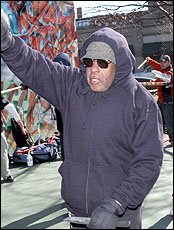
The FMA community is fairly small. Those of us who participate actively hear about or come in contact with each other from time to time, though it’s hard to keep up with the growth of the art and all the new people who are coming up. The elders in the art, however, are a dwindling group, just as steadily leaving us to make way for the new.
The first thing I learned this morning was of the passing of Guro George Brewster back in Boston, Massachusetts. I never met Mr. Brewster, but about 15 years ago or so we corresponded and talked on the phone a few times. One of my goal in doing Stickman Escrima Products was to create a matrix that would put me in touch with other people doing FMA (this was before the internet was the staple it is today) and Mr. Brewster was the kind of person I was most pleased to get to know, a real gentleman and a pioneer in teaching this art here in the U.S.A.
There were one or two transactions where he bought some sticks from me, but mostly I remember our conversations. I asked a few questions, mostly listened. Guro Brewster taught Lanada Arnis, originally starting in the ‘70’s under Amante Marinas Sr. and then continuing as Grandmaster Lanada’s representative in New England after Marinas formed his own association. Mr. Brewster also knew something of Serrada through both GM Angel Cabales and Master JC Cabiero.
There was an article in the Boston Herald just a month ago, showing him leading a class outdoors in the cold at age 81. He was a tough old guy, a veteran of the Battle of the Bulge, who would carry a shovel on the bus (along with his training gear) to clear a space in the snow to train in the park with his students.
George passed away quietly in his sleep after a typical day of training hard with his students. It’s good to see he was active so long, sharing what he loved to the end. It’s unfortunate that, like so many instructors, he only had a few dedicated students, and then towards the end there was a sudden upsurge of interest.
It’s funny how some people make a strong impression in just a few moments. I’m sorry I never got to meet him in person, but he is someone I never forgot about over the years. Those who knew and trained with him have lost not just a mentor but also a friend. Train strong and keep his legacy alive. I’m sure that would make him proud.
Update: I just had a long conversation with sensei/guro Peter Freedman, who is the designated successor as head of the Boston Arnis Club. He can be reached through his website for the Ketsugo Jujutsu schools and George Brewster's Arnis in Boston and Weare, New Hampshire.
Saturday, March 25, 2006
Footwork angles
Something I’ve been pondering these past few days after viewing fights on the Dog Brothers clips is directness, and in particular how it relates to the male and female triangles. On one level these symbols are a map of efficient movement, though on a practical level they are perhaps better as metaphors for moving to an optimal position, wherever that may be.
For anyone here who is not clear on what these represent, the male triangle has a point in front, on the centerline in the direction one is facing. The female triangle has the triangle pointing towards the rear, so forward movement is angled off the centerline.
Conversely, in retreating the forward triangle moves offline, the female triangle moves in towards the center.
Both directions (forward and backward) are worth considering.
Most FMA schools emphasize the female triangle, yet the prototypical FMA symbol is represented by a male triangle inside a circle. Why this paradox, and what might it meaning?
For anyone here who is not clear on what these represent, the male triangle has a point in front, on the centerline in the direction one is facing. The female triangle has the triangle pointing towards the rear, so forward movement is angled off the centerline.
Conversely, in retreating the forward triangle moves offline, the female triangle moves in towards the center.
Both directions (forward and backward) are worth considering.
Most FMA schools emphasize the female triangle, yet the prototypical FMA symbol is represented by a male triangle inside a circle. Why this paradox, and what might it meaning?

Watching the Dog Brothers clips, what I noticed was how fights arrive at point of directness. Fighters may circle, looking to time an entry or snipe a peripheral shot on the fly, but at some point the aggressor takes control and goes after his opponent. Subtlety of angle is out; finishing is about taking it right at the other guy. Maybe my perception is skewed, but that’s how it generally appears to me. So how and why do different triangles theories work?
In talking about entries, it’s about setting up the position from where to attack. We can come straight in by defeating defenses or go around them to a less defended point. Theory often stresses the latter, but experience seems to favor the former.
I’ll start with the female triangle, as training it is more familiar to most people. It is useful in several ways. One can evade a direct attack while countering forward; it zones away from the opposite hand (unless one stays inside between the hands and simply opens up the stance, not my favorite concept) and it allows one to get to the opponent’s backside.
The male triangle has a different set of attributes. It can cut the opponent’s balance and energy by bisecting his baseline. Being direct gets point-to-point faster than longer circling, plus it more readily attacks vital targets on the centerline rather than the periphery. Taking the center redirects the opponent’s energy towards the outside of the circle while staying compact, like the hub of the wheel.
This is only for the forward direction of these triangles. Moving away from an opponent the qualities are reversed. The yin triangle pulls in towards the center, the male triangle steps outwards. People typically backpedal in a straight line when charged, as can be seen frequently in the Dog Brothers clips. It takes a bit more awareness to move offline effectively, a task made more difficult because a forward fast moving attacker may overwhelm one’s response, or be able to adapt so quickly as to re-align on his target.
This is a point frequently made by Marc “Animal” MacYoung in his seminars, where he demonstrates a realistic street attack as opposed to the kind of squared-off dueling practiced in many martial art schools. In the face of something that intense, shifting off the line of attack can be critical, and not everybody can do it well.
Is there a difference in a self-defense situation compared to a ring fight, even one as open as the Dog Brothers? Perhaps. In self-defense one may have an element of surprise on the part of either party. An attack could be a surprise, or perhaps the counter catches the attacker unawares. It is less likely that both parties are equally primed to fight or armed with similar weaponry. Thus there can be variable mismatches to overcome.
Ultimately the value of any footwork is positioning. Whether the goal is to get to an opponent’s weak spot or prevent him from finding yours, one has to have an awareness of these as prerequisite to any plan or strategy. The purpose of tactics is simply a means to an end, and as such it is limiting to think only of them in terms of a single triangle. I think it better to see them as a continuum within larger forms.
Consider that the angles of a triangle must add up to 180º. Many people step at a 45º angle on the female triangle, which works for largo counters at longer distance (mostly towards the limbs) but may veer too wide for deeper strikes or grapples. Entering from greater distance decreases deflective angle and vice versa. The tighter 60º angles of the FMA logo might be a more accurate roadmap for many applications. At closer range, one may need more angle of deflection, but then the counter angle back towards the center is a sharper turn.
A common training aid is to cross two lines in an “x”, creating both male and female triangles. Along with the lines, however, one can step to the quadrants thus formed, and those steps are like a “+”. This creates the “eight directions” which is a popular strategy of direction in Japanese and Korean martial arts, among others. Draw lines connecting the tips of the “x” and “+” shapes to form a square and diamond, and overlaid together these form an 8-pointed star, a common motif in Moslem art.
If you look at the inside lines, triangles are but half squares or rectangles. In this shape each triangle is a 90º angle and two 45º angles. Compare it to the 60º angles of the FMA logo above. That triangle, overlaid in male/female duality, creates a six pointed star, which creates a different pattern of movement. You can lay tape on the ground to practice stepping; each has it’s own logic and lessons to teach. Don’t you wish geometry had been this interesting in high school?
Monday, March 20, 2006
My shortest blog
Something I read today that resonated; simple and elegant:
Learning is taking on...mastery is letting go.
- Anon.
Learning is taking on...mastery is letting go.
- Anon.
Low Strikes
This weekend I browsed the excellent Dog Brothers website to view their video clips. I get asked questions about things people see on there from time to time, so I thought I should refresh my memory and see what is new. For anyone who is not familiar with the Dog Brothers, they promote a highly realistic version full-contact stick fighting, the closest thing to street reality that can be practiced. Under the direction of Marc Denny, they have developed a very comprehensive format of training that incorporates elements from many martial arts, ranging from FMA to Silat, Muay Thai/Krabi Krabong and Brazilian Jujitsu.
The initial reason I was viewing clips was to look at knee shots. My first FMA training was back around 1978, from a guy named Bob Flores who grew up with Leo Gaje on Negros, Philippines. He taught me a Pekiti Tirsia drill that included a knee strike. When I first got to Stockton in 1985, I showed this to a couple of advanced students who scoffed at the attack, even though we have our low angles (#9 and #11) in Serrada. Their reasoning was that they would take the hit to the knee in exchange for delivering one to the head; better to crawl away from your downed opponent than vice versa.
I’ve since encountered that response many times, and while it has the ring of truism, I’ve always felt it a bit glib. It depreciates the value of timing and deception. Any technique can succeed if done right, or fail if done inappropriately. It also looks past the value of a strike – any strike - to be effective.
It is not uncommon in martial arts, and I include boxing, to see a seemingly innocuous blow end a fight, while powerfully delivered shots are absorbed with little effect. A blow can be delivered with full intent and strength but be off by a tiny margin in target, timing or angle, while I’ve heard Cacoy Canete talk of incidental taps in training that caused injuries. These bring to mind Yoda’s saying to young Luke Skywalker: “No try; DO!” Hard shots often are too contrived whereas something thrown naturally and un-self-consciously might engage one’s innate resources more fully.
Whatever the case, though, a good shot is a good shot, and anything that can hurt enough is a respectable target. A strategy I learned from Samoan fighters is to strike to the feet. This may not be a fight-stopper by itself, but it is useful for slowing down big, fast, powerful guys and expands the field of target opportunity by making them defend more space, akin to throwing a long pass in football to stretch the field underneath. Sonny Umpad is another source who’s taught me about this strategy.
Limb destruction is a cornerstone of FMA, and the armbar is a staple in every martial art not playing by restricted rules. The knee might not be as common a target for hand/weapon oriented arts, but conversely it is more vulnerable by element of surprise, and perhaps not as well defended by one not well versed in low strikes or street kicking arts.
There are a couple of good examples of effective knee shots on the Dog Brothers clips. In “Dogzilla’s First Day” he takes a nerve strike from Marc Denny to the back of the leg. The effect is instantaneous. On the “Dog Brothers Promo Clip” a guy gets his kneecap split; fight over. In neither case did the person delivering the strike take a significant hit back. Both got in cleanly, and getting out was simplified by the fact that the person hit was reacting to a new reality.
I’ve experienced firsthand the numbing effect of a hit to the nerves in the back of the knee, and in the course of life I’ve had a couple of painful bruises to the kneecap. While the degree to which individuals react to pain may vary, one cannot dismiss something just because you think it will not work on you, a dangerous illusion in which to indulge. Often our blind spots work two ways; what we can’t do, we think can’t be done. If you don’t think it can work, you won’t learn how, reinforcing the belief it isn’t useful.
Interestingly, it seems to work well to hit someone with what he uses against you. Our choice of targeting is a window to what we believe to be effective. If we think it will work on someone else, that is an internalized belief. On some level we respect that target because we wouldn’t want to be hit there ourselves.
Examples of psychological reversal happen in all sports. In the recent NCAA basketball postseason, Cal hit a big shot but North Carolina nailed their own similar 3 pointer 12 seconds later. Both sides described this as the turning point in the game. Cal thought it had momentum but was deflated immediately, shifting the flow of energy to the other team.
In the movie “Game of Death,” the opening of the fight between Bruce Lee and Dan Inosanto provides a classic of this strategy. Dan hits Bruce with a surprise shot, and while he’s boasting, Bruce smacks him back with the same thing, silencing him with not just the action but also the attitude behind it.
It’s surprising to me how many of the younger generation of martial artists have never taken the time to watch Bruce Lee’s films. I think this is a shame because he was such a dynamic presence and a phenomenal martial artist. Even if his film work was exaggerated for the camera, they are teaching vehicles for the arts, demonstrating values on a multitude of levels.
Some of this lack of awareness of Bruce’s work is perhaps due to the passage of time; these are older films and the hype is gone. There are other issues at work as well, so for those of you who have not seen Bruce Lee movies, hie thee to whatever video emporium still carries them and watch while you still can. They ain’t classics for nuthin’.
The initial reason I was viewing clips was to look at knee shots. My first FMA training was back around 1978, from a guy named Bob Flores who grew up with Leo Gaje on Negros, Philippines. He taught me a Pekiti Tirsia drill that included a knee strike. When I first got to Stockton in 1985, I showed this to a couple of advanced students who scoffed at the attack, even though we have our low angles (#9 and #11) in Serrada. Their reasoning was that they would take the hit to the knee in exchange for delivering one to the head; better to crawl away from your downed opponent than vice versa.
I’ve since encountered that response many times, and while it has the ring of truism, I’ve always felt it a bit glib. It depreciates the value of timing and deception. Any technique can succeed if done right, or fail if done inappropriately. It also looks past the value of a strike – any strike - to be effective.
It is not uncommon in martial arts, and I include boxing, to see a seemingly innocuous blow end a fight, while powerfully delivered shots are absorbed with little effect. A blow can be delivered with full intent and strength but be off by a tiny margin in target, timing or angle, while I’ve heard Cacoy Canete talk of incidental taps in training that caused injuries. These bring to mind Yoda’s saying to young Luke Skywalker: “No try; DO!” Hard shots often are too contrived whereas something thrown naturally and un-self-consciously might engage one’s innate resources more fully.
Whatever the case, though, a good shot is a good shot, and anything that can hurt enough is a respectable target. A strategy I learned from Samoan fighters is to strike to the feet. This may not be a fight-stopper by itself, but it is useful for slowing down big, fast, powerful guys and expands the field of target opportunity by making them defend more space, akin to throwing a long pass in football to stretch the field underneath. Sonny Umpad is another source who’s taught me about this strategy.
Limb destruction is a cornerstone of FMA, and the armbar is a staple in every martial art not playing by restricted rules. The knee might not be as common a target for hand/weapon oriented arts, but conversely it is more vulnerable by element of surprise, and perhaps not as well defended by one not well versed in low strikes or street kicking arts.
There are a couple of good examples of effective knee shots on the Dog Brothers clips. In “Dogzilla’s First Day” he takes a nerve strike from Marc Denny to the back of the leg. The effect is instantaneous. On the “Dog Brothers Promo Clip” a guy gets his kneecap split; fight over. In neither case did the person delivering the strike take a significant hit back. Both got in cleanly, and getting out was simplified by the fact that the person hit was reacting to a new reality.
I’ve experienced firsthand the numbing effect of a hit to the nerves in the back of the knee, and in the course of life I’ve had a couple of painful bruises to the kneecap. While the degree to which individuals react to pain may vary, one cannot dismiss something just because you think it will not work on you, a dangerous illusion in which to indulge. Often our blind spots work two ways; what we can’t do, we think can’t be done. If you don’t think it can work, you won’t learn how, reinforcing the belief it isn’t useful.
Interestingly, it seems to work well to hit someone with what he uses against you. Our choice of targeting is a window to what we believe to be effective. If we think it will work on someone else, that is an internalized belief. On some level we respect that target because we wouldn’t want to be hit there ourselves.
Examples of psychological reversal happen in all sports. In the recent NCAA basketball postseason, Cal hit a big shot but North Carolina nailed their own similar 3 pointer 12 seconds later. Both sides described this as the turning point in the game. Cal thought it had momentum but was deflated immediately, shifting the flow of energy to the other team.
In the movie “Game of Death,” the opening of the fight between Bruce Lee and Dan Inosanto provides a classic of this strategy. Dan hits Bruce with a surprise shot, and while he’s boasting, Bruce smacks him back with the same thing, silencing him with not just the action but also the attitude behind it.
It’s surprising to me how many of the younger generation of martial artists have never taken the time to watch Bruce Lee’s films. I think this is a shame because he was such a dynamic presence and a phenomenal martial artist. Even if his film work was exaggerated for the camera, they are teaching vehicles for the arts, demonstrating values on a multitude of levels.
Some of this lack of awareness of Bruce’s work is perhaps due to the passage of time; these are older films and the hype is gone. There are other issues at work as well, so for those of you who have not seen Bruce Lee movies, hie thee to whatever video emporium still carries them and watch while you still can. They ain’t classics for nuthin’.
Thursday, March 16, 2006
Some thoughts on unity
Since the gathering in Sacramento two weeks ago, there’s been a lot of positive chatter about both the event and the possibility of some sort of unification within Serrada. While it’s certainly premature to make any forecasts, the buzz alone is noteworthy, if for no other reason than to bring this topic up once again on the radar screens of those involved in this art.
I suspect those in leadership positions are monitoring the pulse of things. In politics this would be called taking a poll. While there is no electorate to satisfy here, the big guys have their own desires and agendas, and many have an appreciation of both the advantages of working in unity and the downside that the schism within the Serrada family has had in terms of general public view of this art. While controversy might be music to the sales departments of magazines, in the boots-on-the-ground world of teaching martial arts, it probably turns away more students than are attracted by it.
Like anything in the world of politics, a lot happens behind the scenes to set the stage for the main actors to appear. Whether or not the various heads of organizations are talking to each other privately or not, those of us on second and third level tiers are kicking around ideas, and it sounds like a lot of similar views are coming up. Hopefully this kind of thing filters up to loftier elevations, or perhaps like the Hundredth Monkey theorem, if enough people begin to believe a change will happen, eventually it will become part of the consciousness of the group through morphic resonance.
The following is essentially a repost of a response I made on a Serrada newsletter. All this may come to naught, but for what it’s worth, here’s one possible way to go about things. This is essentially the same advice I (and others) have been giving (usually unsolicited) for the past 15 years.
**********************************
I don't necessarily envision a Serrada unification as a single entity, but rather an association of related organizations. A model for this might be Kajukenbo, which despite differences retains an umbrella identity. Within Kajukenbo are several formally recognized and distinct styles that have evolved, and within each of them are member organizations consisting of businesses started and run by entrepreneurial teachers, each with their own following of students.
If Serrada were to try to organize into a larger body, I certainly don't see the present organizations dissolving themselves. The model I'd envision would base itself on a board of directors consisting of heads of various member bodies and perhaps others elected at large according to a charter. This isn't unlike corporations whose boards are populated by representatives of other businesses that hold large blocks of voting shares.
Under such an arrangement, Vincent could operate like the president or chairman of the board. The CEO does all the real work of running the business, so someone who is motivated to be involved in that capacity could help move things forward. In fact, many countries run like this too, with a President at the head for ceremonial purposes and a Prime Minister to carry out policies and to maintain coalitions of political parties.
What benefits might come from such an arrangement?
First and foremost is the question of qualifications for ranking both instructors and students. An association can set standards by which members of different participating organizations would be recognized. This alone would alleviate a sticking point within the art. Testing could take place within schools for student ranks, much like is done now on whatever basis the head instructor chooses, but if a formal structure is used, teachers from other schools could be invited to sit as witnesses on promotion boards.
A larger organization can draw on the energy of membership to host a variety of events through the course of the year. For instance, there could be a commemorative tournament on Angel’s birthday and an awards banquet on the anniversary of his passing. Testing boards could convene periodically for those seeking teaching rank, in conjunction with seminars for the benefit of all instructors.
There are other possibilities that could eventually come up as part of the growth of an art, such as reworking a ranking system. For instance, the 12 angles in Serrada are each promotions within the art, but these are akin to kyu ranks in karate. Any diligent student can learn the angles. What takes place beyond that, though? Not all who graduate will teach. Some great fighters are temperamentally not qualified to teach or simply have no interest, and not all great teachers are the best fighters. Nevertheless, our society is a meritocracy where people expect to be rewarded for time and effort. There could be separate recognition for both teaching and non-teaching members, rewarding skill and dedication for those who are committed to the art. Few who train will become masters, but there should be a way to acknowledge the difference between a teenager who has just graduated from the 12 angles and a teacher who has decades of experience.
Right now such a proposal sounds controversial, especially since there is no precedent within Serrada for these things, and nobody would recognize such innovations outside the school that did this. Nevertheless, if there were an organizational body, changes such as these could help expand the art. What works well for a small academy might not be the right model for creating a network of schools across the country or the globe. Many small businesses in all fields have learned that it takes different skills to operate on a larger scale.
Perhaps this isn’t the right direction for Serrada. Maybe this is an art that will stay close to home, or spread underground organically, beneath the radar of public awareness. There are those who think it should stay this way, held secretively in private. There are other possibilities, however. This is a beautiful and exciting art with the potential to move out in the world. Angel didn’t promote guros and masters just to have Serrada go back into hiding; he was proud of his art and his students and encouraged those of us with the desire to continue to propagate it. How we do so is up to us, whether each by our own designs or by working together towards larger goals.
**********************************
A quick aside to those who might think I’m yearning for the good old days yet to come. I am not a fan of big schools, organizations, or even big parties. I’ve done the bulk of my training in martial arts in small schools, often one-to-one with the instructor. I generally teach small classes, much the way I learned. Escrima is an art that is generally taught in a highly intensive manner like this, using direct transmission of experience from teacher to student. As much as I enjoy this, however, I realize that it takes a lot of students to develop one expert. Many teachers only find one or two willing and able to achieve true success. Angel was lucky. He had the reputation to attract many who were already successful in martial arts. For those of us still in mid-career, it’s a numbers game to find those student gems. Remember the old daffy-nition of overnight success: twenty years of hard work!
OK, I promise I’m working on a blog about the art itself. Too much politics is bad for the digestion anyway. Ask any politician who’s been on the “rubber chicken” banquet circuit!
I suspect those in leadership positions are monitoring the pulse of things. In politics this would be called taking a poll. While there is no electorate to satisfy here, the big guys have their own desires and agendas, and many have an appreciation of both the advantages of working in unity and the downside that the schism within the Serrada family has had in terms of general public view of this art. While controversy might be music to the sales departments of magazines, in the boots-on-the-ground world of teaching martial arts, it probably turns away more students than are attracted by it.
Like anything in the world of politics, a lot happens behind the scenes to set the stage for the main actors to appear. Whether or not the various heads of organizations are talking to each other privately or not, those of us on second and third level tiers are kicking around ideas, and it sounds like a lot of similar views are coming up. Hopefully this kind of thing filters up to loftier elevations, or perhaps like the Hundredth Monkey theorem, if enough people begin to believe a change will happen, eventually it will become part of the consciousness of the group through morphic resonance.
The following is essentially a repost of a response I made on a Serrada newsletter. All this may come to naught, but for what it’s worth, here’s one possible way to go about things. This is essentially the same advice I (and others) have been giving (usually unsolicited) for the past 15 years.
**********************************
I don't necessarily envision a Serrada unification as a single entity, but rather an association of related organizations. A model for this might be Kajukenbo, which despite differences retains an umbrella identity. Within Kajukenbo are several formally recognized and distinct styles that have evolved, and within each of them are member organizations consisting of businesses started and run by entrepreneurial teachers, each with their own following of students.
If Serrada were to try to organize into a larger body, I certainly don't see the present organizations dissolving themselves. The model I'd envision would base itself on a board of directors consisting of heads of various member bodies and perhaps others elected at large according to a charter. This isn't unlike corporations whose boards are populated by representatives of other businesses that hold large blocks of voting shares.
Under such an arrangement, Vincent could operate like the president or chairman of the board. The CEO does all the real work of running the business, so someone who is motivated to be involved in that capacity could help move things forward. In fact, many countries run like this too, with a President at the head for ceremonial purposes and a Prime Minister to carry out policies and to maintain coalitions of political parties.
What benefits might come from such an arrangement?
First and foremost is the question of qualifications for ranking both instructors and students. An association can set standards by which members of different participating organizations would be recognized. This alone would alleviate a sticking point within the art. Testing could take place within schools for student ranks, much like is done now on whatever basis the head instructor chooses, but if a formal structure is used, teachers from other schools could be invited to sit as witnesses on promotion boards.
A larger organization can draw on the energy of membership to host a variety of events through the course of the year. For instance, there could be a commemorative tournament on Angel’s birthday and an awards banquet on the anniversary of his passing. Testing boards could convene periodically for those seeking teaching rank, in conjunction with seminars for the benefit of all instructors.
There are other possibilities that could eventually come up as part of the growth of an art, such as reworking a ranking system. For instance, the 12 angles in Serrada are each promotions within the art, but these are akin to kyu ranks in karate. Any diligent student can learn the angles. What takes place beyond that, though? Not all who graduate will teach. Some great fighters are temperamentally not qualified to teach or simply have no interest, and not all great teachers are the best fighters. Nevertheless, our society is a meritocracy where people expect to be rewarded for time and effort. There could be separate recognition for both teaching and non-teaching members, rewarding skill and dedication for those who are committed to the art. Few who train will become masters, but there should be a way to acknowledge the difference between a teenager who has just graduated from the 12 angles and a teacher who has decades of experience.
Right now such a proposal sounds controversial, especially since there is no precedent within Serrada for these things, and nobody would recognize such innovations outside the school that did this. Nevertheless, if there were an organizational body, changes such as these could help expand the art. What works well for a small academy might not be the right model for creating a network of schools across the country or the globe. Many small businesses in all fields have learned that it takes different skills to operate on a larger scale.
Perhaps this isn’t the right direction for Serrada. Maybe this is an art that will stay close to home, or spread underground organically, beneath the radar of public awareness. There are those who think it should stay this way, held secretively in private. There are other possibilities, however. This is a beautiful and exciting art with the potential to move out in the world. Angel didn’t promote guros and masters just to have Serrada go back into hiding; he was proud of his art and his students and encouraged those of us with the desire to continue to propagate it. How we do so is up to us, whether each by our own designs or by working together towards larger goals.
**********************************
A quick aside to those who might think I’m yearning for the good old days yet to come. I am not a fan of big schools, organizations, or even big parties. I’ve done the bulk of my training in martial arts in small schools, often one-to-one with the instructor. I generally teach small classes, much the way I learned. Escrima is an art that is generally taught in a highly intensive manner like this, using direct transmission of experience from teacher to student. As much as I enjoy this, however, I realize that it takes a lot of students to develop one expert. Many teachers only find one or two willing and able to achieve true success. Angel was lucky. He had the reputation to attract many who were already successful in martial arts. For those of us still in mid-career, it’s a numbers game to find those student gems. Remember the old daffy-nition of overnight success: twenty years of hard work!
OK, I promise I’m working on a blog about the art itself. Too much politics is bad for the digestion anyway. Ask any politician who’s been on the “rubber chicken” banquet circuit!
Sunday, March 05, 2006
Images from Sacramento Gathering
The pictures speak for themselves ....

Group Photo (partial)
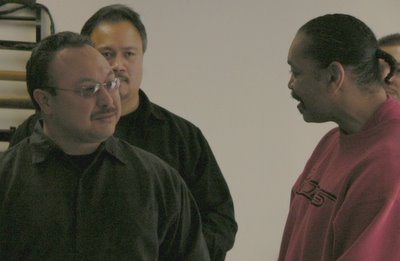
Vincent Cabales, Darren Tibon and Anthony Davis
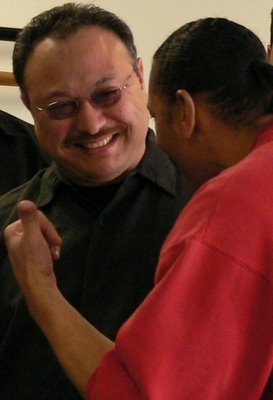
Vincent and Anthony
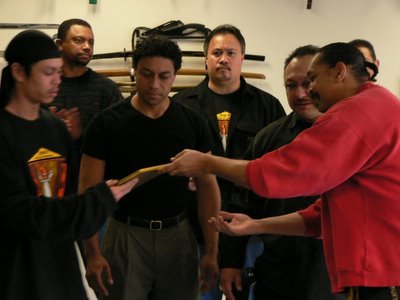
Gelmar, Jerry Preciado, Vincent Jr., Darren, Vincent, Anthony
Gelmar Cabales and Vincent Cabales Jr.
Ronnie Saturno and Jojo Soribel

Carlito Bonjoc, Wade Williams, Jeff Finder
Elrik Jundis and crew
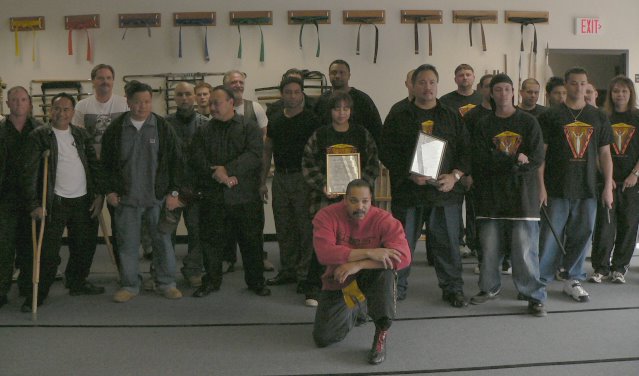
Group Photo (partial)
Vincent Cabales, Darren Tibon and Anthony Davis
Vincent and Anthony
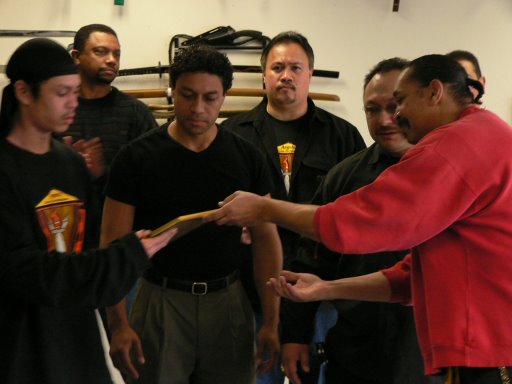
Gelmar, Jerry Preciado, Vincent Jr., Darren, Vincent, Anthony
Gelmar Cabales and Vincent Cabales Jr.
Ronnie Saturno and Jojo Soribel
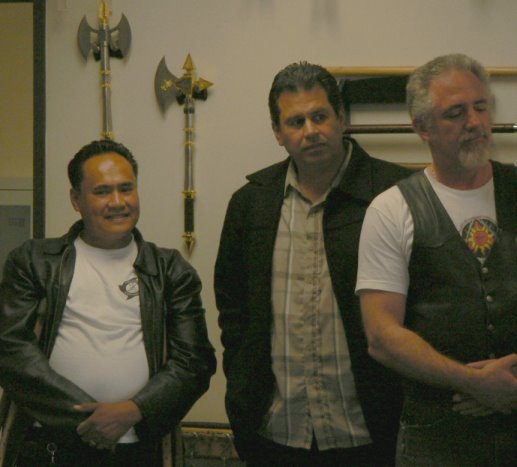
Carlito Bonjoc, Wade Williams, Jeff Finder
Elrik Jundis and crew
Subscribe to:
Posts (Atom)