Here are some thoughts about Sonny now, while they’re still fresh, kind of like a signpost to mark where we are at his passing. In ten years, I hope we can look back and see how his influence has spread in the FMA community.
Yesterday I called Sonny a giant, though few actually met him. He was a very private man, and for years rarely took his art outside of his home, preferring to let those whom he trusted come to him. Thus his legacy will someday be better known through those who propagate his teachings rather than directly by his hand.
Some of those are folks who trained with Bruce and James Yimm Lee, such as Jesse Glover in Seattle and Gary Cagaanan in Oakland. Others are younger notables in the martial arts such as Kelly Worden in Tacoma and Alfred Plath in Germany. Most, however, are a new generation of martial artists just coming of age now, entering their prime years blessed with the deep knowledge of a master teacher.
Sonny was a bridge across generations in the arts. Growing up in the Philippines, he experienced first-hand the art in its native setting. He was a witness to history, crossing paths with some of the greats most of us only know from reading about them, but perhaps the greatest aspect of his legacy was his knowledge gained from the streets. Sonny knew more about what he called “the dark side” of the arts than just about anyone I’ve known, but to his credit he lived a life in the light, focusing on laughter and the beauty in the art. Before he emerged in the martial community, he was, like Bruce Lee, a champion cha-cha dancer, and he brought those skills into the Corto Cadena style he created.
Sonny’s genius was that he took disparate elements of the Filipino arts and re-integrated them into a comprehensive whole. More than just that, however, he synthesized those elements to create something uniquely his. His earliest influences seemed to be Balintawok, which was prominent where he grew up in Cebu. Some of his early formal training was with Cacoy Canete and later with Raymond Tobosa in Hawaii (as I recall). In California he rubbed shoulders with legends like Angel Cabales. He took something from each but wasn’t limited to merely imitating. He examined each element of his art critically, ensuring it had value towards his goal.
When I first met him back in 1986, through a seminar at Joe Olivarez’ U.S. Karate in Hayward, Sonny was unveiling perhaps the first of his unique innovations, the centerline roll for double sticks, based on Wing Chun’s circular punching. Unlike most double stick, which is taught by learning numerous patterns and pairing them up, this was genius in its simplicity. By merely mastering this single technique, one could match up against any strike using either hand in a continuous barrage. Still, as easy as it looks and sounds, few could do it with the speed and precision Sonny applied to his art, and his understanding of leverage generated power that belied his slight physique.
I spent perhaps the most time with Sonny in the early 1990’s, after Angel Cabales passed away. He and Angel met only infrequently but had a warm relationship, sharing roots in the same locales and slipping back into the old dialects of their youths. As the younger man, Sonny affectionately called Angel “Doh,” uncle. Angel used to say many people stole his ideas, though many wouldn’t acknowledge it. Sonny was upfront, giving me his famous line that “if you’re going to steal, do it from the best.” His affinity for Angel’s material is not surprising, given the Cebuano roots of both their arts.
Around this time Sonny was working on his sikaran, the low kicking art developed to work in conjunction with weapons, as opposed to the high flashy kicks common to many popular modern arts. Sonny would test his ideas out on me and I’d share my variations on these themes from my years in Kenpo. Even then, however, it was apparent that Sonny was working from a very different source, drawing inspiration for his low body movement and turned-out stepping from Moro-Moro sayaw. With great natural flexibility and dancer's fluidity, Sonny had an ability to come from unusual angles. It was in the sikaran that I began to see the functionality of his pendulum movement, which allowed him to strike while seemingly out of range.
It was this confluence of the Moro and Cebuano arts that marked the emergence of the next phase of Sonny’s body of work, and that was his knowledge of the blade. As with all other aspects of his work, this was something nurtured from careful analysis. The blade is enmeshed with Filipino culture, and so having been raised there, Sonny had insights that lent themselves to appreciation of edged weapons without the romanticism with which less experienced folk often hold them.
Sonny’s creative genius went beyond just movement, extending also to the artifacts he created in conjunction with his art. Anyone who ever visited him had to be impressed by the array of weaponry adorning the walls of his home, all crafted by his hand. From elaborately carved rattan sticks to beautifully designed traditional weapons in wood and metal, Sonny was a master artisan. He was also prolific, and eventually every bit of his home was filled with his work, making it a veritable museum of Filipino martial culture. In every corner one could find unusual devices, like his impenetrable armor vest for “breaking in” students on the knife, the racks of fiberglass training fencing foils, or his swinging pendulum and various sparring targets.
This was a man who lived life fully. I’ve always had a hard time imagining how he fit so much into the moments of each day. I marvel at how it seemed that every visit to his home revealed a new facet of his personality, such as his passion for playing and writing music on the keyboard and recording it on his four-track. I was amazed by his rebuilt acoustic guitar with the tuning head moved into the body, which I’d never seen in 35 years as a player.
It is my everlasting regret that I didn’t spend more time with Sonny. Part of it was reluctance to take advantage of his generosity. There wasn’t a time I visited that he didn’t want to show me what he was working on. I realized that he shared much more with me than I could offer back, but when I suggested I start taking lessons as his student, he smiled and said we were contemporaries. In that he was overly generous, and in my embarassment I stopped coming by so often. Still, I found other ways to try to repay him, such as helping market his innovative padded training sticks or helping hook up prospective students.
Some of those are my seniors in Serrada, such as masters Wade Williams and Carlito Bonjoc, and many others are faces and names I am only now starting to put together. It is through the imprint of Sonny’s movement and knowledge that I see his art living on, and hopefully through them I will finally take the time for more of those lessons I missed along the way. I’m sure I’m not alone in this, for there were so many facets and phases along the arc of Sonny’s career that many of us only got what was currently his passion, and so it is important that we share.
Those who came later were fortunate to reap the benefit of all that had gone on before. Sonny wasn’t merely a caretaker but a builder, and those who absorbed even a part of his spirit have come away with something uniquely different. His is not a cookie cutter style of stick fighting, but something that transformed people to the core of their being, and just as Sonny was a generous soul, so I see this shining from the faces of those who were attracted to him.
We are fortunate that Sonny left such a huge legacy in the form of his recordings. There was always videotape rolling, whether recording students’ lessons or playing them back on the tv. Sonny was someone with great affinity for modern technology and he used it more than anyone else I know. Perhaps someday some of his vast library of recordings can be made available for study. It is an invaluable resource, and one that should be both preserved and shared for posterity.
In the meantime, the art is a living thing, passed from hand to hand, and so it is up to this next generation to move forward in their own personal development and as teachers. What I see in them is kindred to Sonny, a humbleness of spirit combined with skill, intelligence and determination.
I recall the words of Gilbert Tenio following the funeral for his old contemporary Angel Cabales, that the art was not meant to compete with each other, but to ensure mutual survival. It is a bond of brotherhood, and the words of this manong were meant to guide us to appreciate what we share in common. The love we have for our teachers, and above that our passion for what we do, is something greater than differences of opinion or ego. This is something Sonny understood, and he always saw the best in people. As long as this principle is at the forefront, the art will flourish and be strong, keeping the chain alive.
Friday, August 25, 2006


B.gif)
Thursday, August 24, 2006
Sonny Umpad Gone
It is with heavy heart that I'm announcing the passing of master Sonny Umpad this morning. He was a giant in our community and he will be greatly missed.
Sonny at his 58th birthday with family and friends

Doing what he loved, moving with a stick
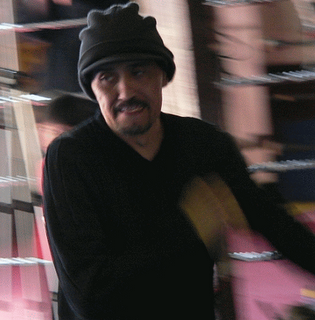
Sonny at his 58th birthday with family and friends
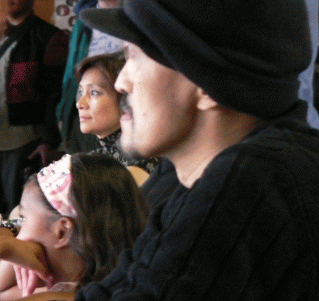
Doing what he loved, moving with a stick

Wednesday, August 23, 2006
Old School FMA Video
Here's some very authentic old-school style demo footage. They train hard in the Philippines! I don't know who this is; at the end it says "agent Christopher Lo" and that's who posted it on Grouper. If anyone knows, I'll update this post.
Tip on saving posts
If you read a post you'd like to find easily later, you can bookmark the specific archived copy without having to search my whole blog.
At the bottom of each blog entry it says "Posted by Stickman" and then the time, which is hyperlinked. That will take you directly to that blog, and you can then bookmark the entry by itself.
Click comments if you have feedback on the post. That makes this a two-way medium!
At the bottom of each blog entry it says "Posted by Stickman" and then the time, which is hyperlinked. That will take you directly to that blog, and you can then bookmark the entry by itself.
Click comments if you have feedback on the post. That makes this a two-way medium!
Three New West Coast Seminars
On September 2, Master Roger Agbulos will be doing a Lameco seminar in Vancouver, Canada. Roger is a first generation student of the last grandmaster Edgar Sulite, as well as Bakbakan Kali Ilustrisimo grandmasters Rey Galang and Christopher Ricketts.
Then on September 16 he will be co-hosting the Tipunan Sa Los Angeles (Gathering in Los Angeles)along with Jay de Leon and guest master instructors Christopher and Bruce Ricketts, Ramon Rubia, and Willie Laureano & Victor Gendrano.
Finally, Master Agbulos will be doing a Lameco seminar at Alex France's school in Pleasanton, California on October 7.
These all look like great events. I hope folks take advantage of the opportunities!
Then on September 16 he will be co-hosting the Tipunan Sa Los Angeles (Gathering in Los Angeles)along with Jay de Leon and guest master instructors Christopher and Bruce Ricketts, Ramon Rubia, and Willie Laureano & Victor Gendrano.
Finally, Master Agbulos will be doing a Lameco seminar at Alex France's school in Pleasanton, California on October 7.
These all look like great events. I hope folks take advantage of the opportunities!
Monday, August 21, 2006
Photos from Carlito's Seminar
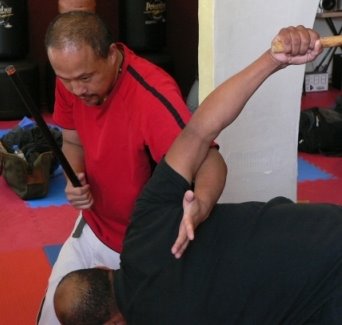
Carlito Bonjoc in action with a bolo. Photos can't show the power in his technique, but everyone there could hear it!
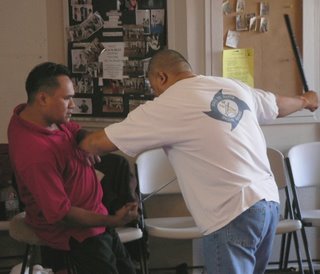
Jojo Soriben, another old protegé of grandmaster Angel Cabales, showing classic Serrada technique
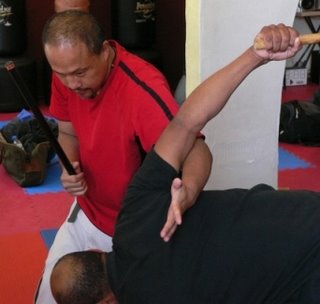
Group Photo. Guro Bob Manalo and some IESA members dropped by earlier to pay respects, and Master Wade Williams was also there part of the afternoon.
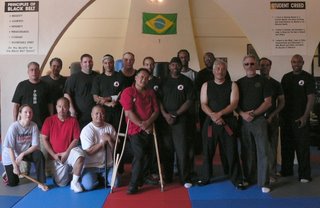
Instructors: Jojo Soriben on the far left, Serrada Master Ron Saturno on the far right; sponsor Professor James Hundon standing to the right of Carlito. Two of Carlito's talented students, standing behind him and on his right side next to Jojo.

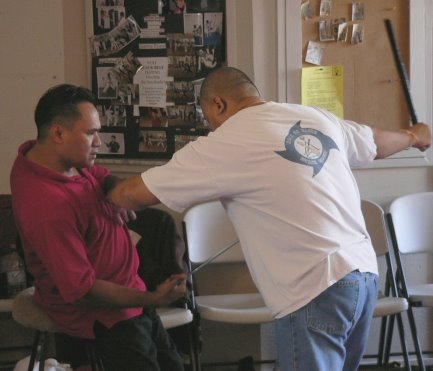
Jojo Soriben, another old protegé of grandmaster Angel Cabales, showing classic Serrada technique
Group Photo. Guro Bob Manalo and some IESA members dropped by earlier to pay respects, and Master Wade Williams was also there part of the afternoon.
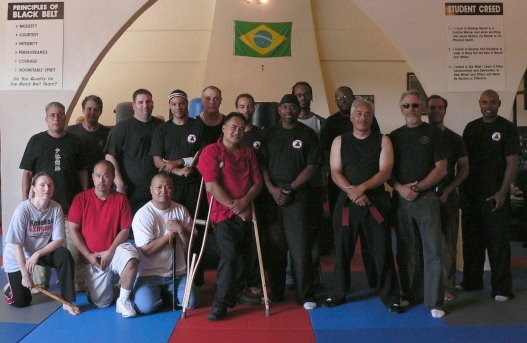
Instructors: Jojo Soriben on the far left, Serrada Master Ron Saturno on the far right; sponsor Professor James Hundon standing to the right of Carlito. Two of Carlito's talented students, standing behind him and on his right side next to Jojo.

Drumming and Martial Arts
Sound has always been held sacred. The bible says that in the beginning was the word, the eminance of creation. The Hindus believe “OM” to be that primal sound of the universe. Starting in the late 1950’s, Dr. Hans Jenny conducted a series of experiments that became the science of cymatics. Using an oscillator, resonator plate and materials such as sand or metal filings, he demonstrated how various frequencies would vibrate the materials into semblances of organic forms, sometimes even creating pulsating three-dimensional figures.
The implication is that life follows vibrational patterns of resonance, and is responsive to the sound waves of the environment. We know that music can affect the emotions, from elevating the spirit to creating sadness. Exposure to loud or chaotic sound can weaken the body and lower resistance of the immune system. Amplified music is used to break prisoners’ wills, and by the military to psychologically assault fortified positions. New experiments are being done with focused sound waves as weapons, much as the laser uses focused, amplified light.
Shamanic traditions from around the world have used drumming to alter states of consciousness, drawing inspiration from natural sources such as thunder, water or wind. The feeling of a rhythmic beat can affect our physiology from trance-like states to exhilleration and action. Studies on the effects of drumming and changing have led to what are now known as binary beats. This refers to a subtle vibration between two frequencies that are close together, usually about 10hz. apart. These align the left and right hemispheres of the brain to duplicate meditative states at different levels of consciousness, ranging from alpha brain waves down to theta.
Martial arts and sound have an association that go back to earliest times. From the war cry to drumming, sound has been a way to focus energy of the mind and body as one. Drumming has a particular resonance that carries across distance and vibrates the body, with the unique ability to connect many as one. The source of the sound can be secondary, such as the cadence of feet marching in unison, or as portentious as the thunder of galloping hoofbeats. More deliberately, drums have been used to unify the will and fortify the courage of one’s own troops while intimidating the enemy with implied power.
On a specific level, drumming is about timing and focus, which should be of interest to martial artists. Because it involves striking, it has implications that go beyond that of any other instrument except the breath. I learned long ago not to slap box with conga players, whose hands are trained to strike endlessly with focus and power.
A friend related a story to me many years ago about something he witnessed at a classical Indian music concert. The legendary tabla master Allarakha Khan was annoyed by a microphone stand too close to his drums. Without missing a beat he tapped it back, but the focus of the hit was so precise that the metal stand snapped in half rather than pushing away. This is a feat that any iron palm master would do well to replicate.
The great Japanese swordsman Musashi was also a renowned painter. He claimed the sword gave his brush a bold stroke, while the brush gave him control to the tip of his weapon. For those of us who train with weapons, learning to play a drum kit would be a similar logical extension of our martial art. One learns to hit endlessly with relaxed power, and controlling the small tip of a drumstick can only enhance accuracy with larger weaponry.
Furthermore, it is aerobic exercise. Drumming involves the whole body, training hands and feet to move in precise relationship, and like martial arts, basic stepping with the feet supports hands that move quickly in multiple directions to accurately strike targets for specific intended effects.
Like martial arts, the essence of drumming is flow. At first there is a learning curve as one discovers the many simple details that must be mastered. Once the unconscious mind overcomes inhibitions and can handle those functions autonomically, then one can begin to think creatively, using those skills as tools for self-expression. Once again, a punch becomes just a punch.
I believe it was Goju master Cat Yamaguchi who said he wouldn’t teach a student who couldn’t dance, because the inner sense of rhythm is so important. Some martial arts practice to drumming or other instruments. In Capoeira, for instance, the music determines the rhythm of the fight, and the Capoerista learns to sit behind the drum as well as dance in front of it.
Of course one needn’t invest in a drum set to begin drumming. Tables, chairs, even one’s own body can provide resonance and resistance, all one really needs. Ordinary objects have been used as instruments around the world, from the clapping and table drumming of flamenco to spoons and washboards of early American music.
Meanwhile, listen to the sounds of the world around you, the source of much musical inspiration from tribal whistles to modern jazz. Hear the rhythms in martial arts, from breathing to footsteps, blocks and strikes, even the rustling of clothes and the sounds of spectators or other players. As martial artists we develop sensitivity to our environment through sensory perception. We learn to see and to feel, but how many of us learn to listen? Drumming can be a doorway to that world.
The implication is that life follows vibrational patterns of resonance, and is responsive to the sound waves of the environment. We know that music can affect the emotions, from elevating the spirit to creating sadness. Exposure to loud or chaotic sound can weaken the body and lower resistance of the immune system. Amplified music is used to break prisoners’ wills, and by the military to psychologically assault fortified positions. New experiments are being done with focused sound waves as weapons, much as the laser uses focused, amplified light.
Shamanic traditions from around the world have used drumming to alter states of consciousness, drawing inspiration from natural sources such as thunder, water or wind. The feeling of a rhythmic beat can affect our physiology from trance-like states to exhilleration and action. Studies on the effects of drumming and changing have led to what are now known as binary beats. This refers to a subtle vibration between two frequencies that are close together, usually about 10hz. apart. These align the left and right hemispheres of the brain to duplicate meditative states at different levels of consciousness, ranging from alpha brain waves down to theta.
Martial arts and sound have an association that go back to earliest times. From the war cry to drumming, sound has been a way to focus energy of the mind and body as one. Drumming has a particular resonance that carries across distance and vibrates the body, with the unique ability to connect many as one. The source of the sound can be secondary, such as the cadence of feet marching in unison, or as portentious as the thunder of galloping hoofbeats. More deliberately, drums have been used to unify the will and fortify the courage of one’s own troops while intimidating the enemy with implied power.
On a specific level, drumming is about timing and focus, which should be of interest to martial artists. Because it involves striking, it has implications that go beyond that of any other instrument except the breath. I learned long ago not to slap box with conga players, whose hands are trained to strike endlessly with focus and power.
A friend related a story to me many years ago about something he witnessed at a classical Indian music concert. The legendary tabla master Allarakha Khan was annoyed by a microphone stand too close to his drums. Without missing a beat he tapped it back, but the focus of the hit was so precise that the metal stand snapped in half rather than pushing away. This is a feat that any iron palm master would do well to replicate.
The great Japanese swordsman Musashi was also a renowned painter. He claimed the sword gave his brush a bold stroke, while the brush gave him control to the tip of his weapon. For those of us who train with weapons, learning to play a drum kit would be a similar logical extension of our martial art. One learns to hit endlessly with relaxed power, and controlling the small tip of a drumstick can only enhance accuracy with larger weaponry.
Furthermore, it is aerobic exercise. Drumming involves the whole body, training hands and feet to move in precise relationship, and like martial arts, basic stepping with the feet supports hands that move quickly in multiple directions to accurately strike targets for specific intended effects.
Like martial arts, the essence of drumming is flow. At first there is a learning curve as one discovers the many simple details that must be mastered. Once the unconscious mind overcomes inhibitions and can handle those functions autonomically, then one can begin to think creatively, using those skills as tools for self-expression. Once again, a punch becomes just a punch.
I believe it was Goju master Cat Yamaguchi who said he wouldn’t teach a student who couldn’t dance, because the inner sense of rhythm is so important. Some martial arts practice to drumming or other instruments. In Capoeira, for instance, the music determines the rhythm of the fight, and the Capoerista learns to sit behind the drum as well as dance in front of it.
Of course one needn’t invest in a drum set to begin drumming. Tables, chairs, even one’s own body can provide resonance and resistance, all one really needs. Ordinary objects have been used as instruments around the world, from the clapping and table drumming of flamenco to spoons and washboards of early American music.
Meanwhile, listen to the sounds of the world around you, the source of much musical inspiration from tribal whistles to modern jazz. Hear the rhythms in martial arts, from breathing to footsteps, blocks and strikes, even the rustling of clothes and the sounds of spectators or other players. As martial artists we develop sensitivity to our environment through sensory perception. We learn to see and to feel, but how many of us learn to listen? Drumming can be a doorway to that world.
Saturday, August 19, 2006
Sword Dances of India
I just saw this sword dance from India on Mushtaq Ali's blog. You might find it interesting, as is the rest of his blog, The Traceless Warrior (the link is on the column to the right).
I'd also suggest going to YouTube and doing search on gatka, a Sikh art from northern India. There's some good stuff there, like this tribute to Ustaad Bhai Charnjeet Singh.
I'd also suggest going to YouTube and doing search on gatka, a Sikh art from northern India. There's some good stuff there, like this tribute to Ustaad Bhai Charnjeet Singh.
Thursday, August 17, 2006
Modern Arnis Seminar in Burbank 9/17
Toma's Modern Arnis © presents a seminar with 8TH Dan Professor Danny Anderson, senior master instructor and founder, MA-80 System Of Modern Arnis, on Sunday September 17, 2006. Professor Anderson is also the author of a number of books and videos on Modern Arnis and Karate.
Wednesday, August 16, 2006
Upcoming Seminars
Master Wade Williams and Guro Carlito Bonjoc Jr. are two of the top proponents of Serrada Escrima, demonstrating and teaching this art at the highest levels. They will be presenting a two-day seminar in Antioch on September 23rd and 24th from noon-5pm.
Here's a reminder that Carlito will be doing a seminar in Oakland this coming Saturday, August 19th.
If you are interested in this compact, explosive art, I highly suggest you make it to these workshops!
************************************
Also this Saturday, from 9am to about noon, the U.S. Filipino Martial Arts Federation will be conducting a free seminar for tournament judges and referees at 4460 Hacienda Drive in Pleasanton, Ca.
(Map here)
(Directions here)
Those certified will be eligible to officiate in local and regional qualifying tournaments leading up to the national championships at the huge Disney World Martial Arts Festival The following links includes FMA contact info and the schedule for their Anaheim event Feb. 3&4, 2007.
This is open to all FMA styles.
Here's a reminder that Carlito will be doing a seminar in Oakland this coming Saturday, August 19th.
If you are interested in this compact, explosive art, I highly suggest you make it to these workshops!
************************************
Also this Saturday, from 9am to about noon, the U.S. Filipino Martial Arts Federation will be conducting a free seminar for tournament judges and referees at 4460 Hacienda Drive in Pleasanton, Ca.
(Map here)
(Directions here)
Those certified will be eligible to officiate in local and regional qualifying tournaments leading up to the national championships at the huge Disney World Martial Arts Festival The following links includes FMA contact info and the schedule for their Anaheim event Feb. 3&4, 2007.
This is open to all FMA styles.
Tuesday, August 15, 2006
The Benefit For Sonny
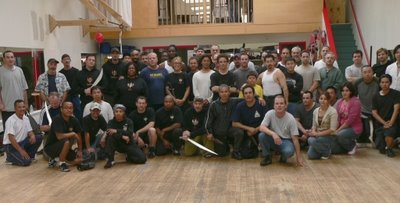
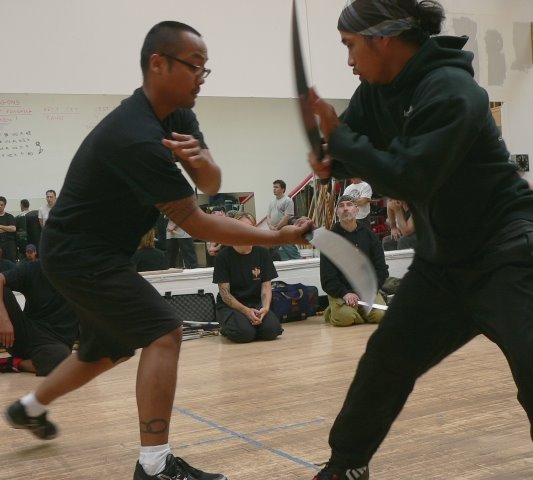
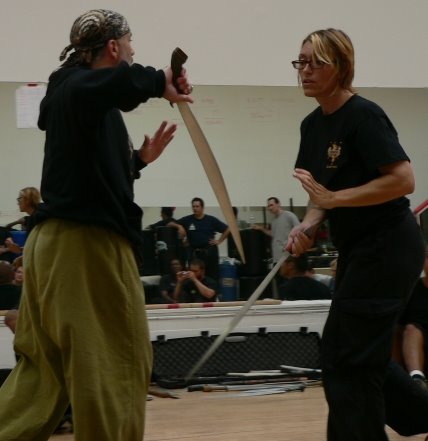
2006 has been a year of historic proportions for gatherings of the clans here in Northern California. This weekend marked another milestone as students and friends of ailing escrima master Sonny Umpad came together for the first time in a group for a benefit seminar on his behalf.
There were over 70 participants filling Nash’s Northern Tiger Kempo in San Francisco, a tribute to the esteem in which Sonny is held within the martial arts community. People came from all corners of the Bay Area and from a wide range of different arts (FMA, Wing Chun, Kempo, Hwarang-do) in order to show their support for one of the most innovative martial art teachers of our generation.
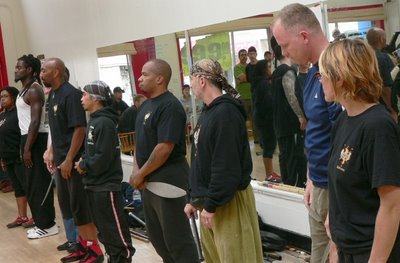
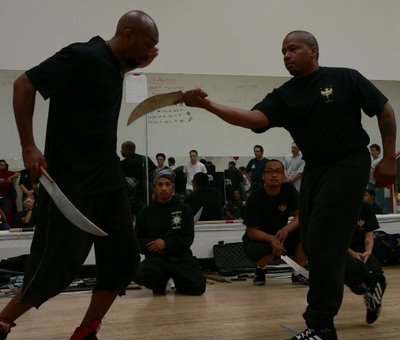
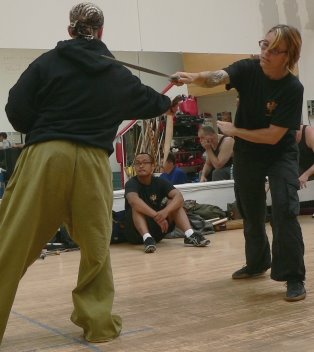
Attendees were rewarded with a strong showing by more than half a dozen of Sonny’s senior instructors. Their demonstrations of his Visayan Corto Cadena system covered a range from empty hands to sikaran (kicking), sticks, knives, bolos and swords. It was as thorough an exposition of Filipino martial arts as one might ever see, reflecting Sonny’s versatility in integrating so many facets within FMA.
Detailed attention was paid to Sonny’s “pendulum,” which uses dynamic Moro-based footwork to counter and evade. This is the basis for the sophisticated movement required for close quarter combat with the blade, representing a very high level of understanding timing and range.
Participants got a taste of some of these concepts in their workouts, and there were plenty of Sonny’s senior and advanced students to assist those who were more novice.
This was a warm and friendly crowd, all there to show support. Egos were checked at the door. I was particularly impressed with how the instructors got along, working together as a team and supporting each other. This too is a reflection of their maestro, for Sonny is a genuine and humble man who shares great talent freely with those around him.
If there was an off-note to the day, it was that Sonny himself was not feeling well enough to attend, spending the day at home with family and old friends, and his absence was the elephant in the room. In truth, this has been one of the hardest blogs for me to write. Most of the people there know and love Sonny, and all our prayers go towards his health.
Here are some of Sonny’s students who were there, listed simply by alphabetical order, not by seniority. My apologies to any whom I might have missed:
Chris Suboreau, Cisco Spano, Craig Merchant, Eric Momburg, George Yore, Gregory Manalo, Jason Santucci, Jay Pugao, Ken Ingram, Kevin and Felicia Baptiste, Maija Soderholm, Manny Piojo, Mike Braten, Phillip (Professor Pitt) Colas, Renato Alphonso, Steve Seto, Steve Van Manen.
Group photo at the end of the day
Instructors
One of the devastating low kicking techniques of Sikaran

Passing the low slash of a knife (the basic counter for angle #4 in Serrada)

Targeting the knee with a low counter off an outside parry

Fast work - getting in close with the long blades ...


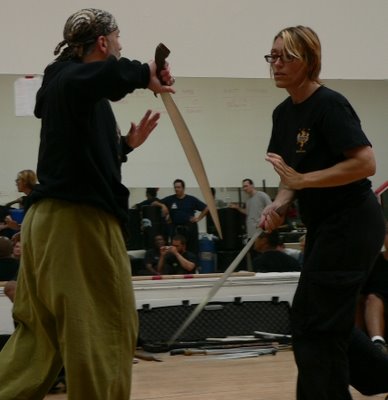
There were over 70 participants filling Nash’s Northern Tiger Kempo in San Francisco, a tribute to the esteem in which Sonny is held within the martial arts community. People came from all corners of the Bay Area and from a wide range of different arts (FMA, Wing Chun, Kempo, Hwarang-do) in order to show their support for one of the most innovative martial art teachers of our generation.
Attendees were rewarded with a strong showing by more than half a dozen of Sonny’s senior instructors. Their demonstrations of his Visayan Corto Cadena system covered a range from empty hands to sikaran (kicking), sticks, knives, bolos and swords. It was as thorough an exposition of Filipino martial arts as one might ever see, reflecting Sonny’s versatility in integrating so many facets within FMA.
Detailed attention was paid to Sonny’s “pendulum,” which uses dynamic Moro-based footwork to counter and evade. This is the basis for the sophisticated movement required for close quarter combat with the blade, representing a very high level of understanding timing and range.
Participants got a taste of some of these concepts in their workouts, and there were plenty of Sonny’s senior and advanced students to assist those who were more novice.
This was a warm and friendly crowd, all there to show support. Egos were checked at the door. I was particularly impressed with how the instructors got along, working together as a team and supporting each other. This too is a reflection of their maestro, for Sonny is a genuine and humble man who shares great talent freely with those around him.
If there was an off-note to the day, it was that Sonny himself was not feeling well enough to attend, spending the day at home with family and old friends, and his absence was the elephant in the room. In truth, this has been one of the hardest blogs for me to write. Most of the people there know and love Sonny, and all our prayers go towards his health.
Here are some of Sonny’s students who were there, listed simply by alphabetical order, not by seniority. My apologies to any whom I might have missed:
Chris Suboreau, Cisco Spano, Craig Merchant, Eric Momburg, George Yore, Gregory Manalo, Jason Santucci, Jay Pugao, Ken Ingram, Kevin and Felicia Baptiste, Maija Soderholm, Manny Piojo, Mike Braten, Phillip (Professor Pitt) Colas, Renato Alphonso, Steve Seto, Steve Van Manen.
Group photo at the end of the day
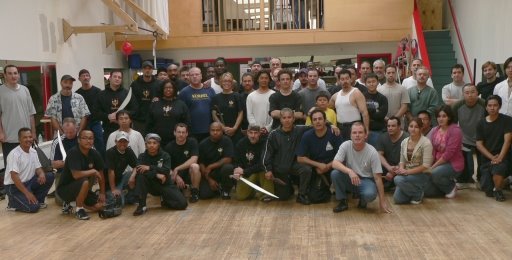
Instructors
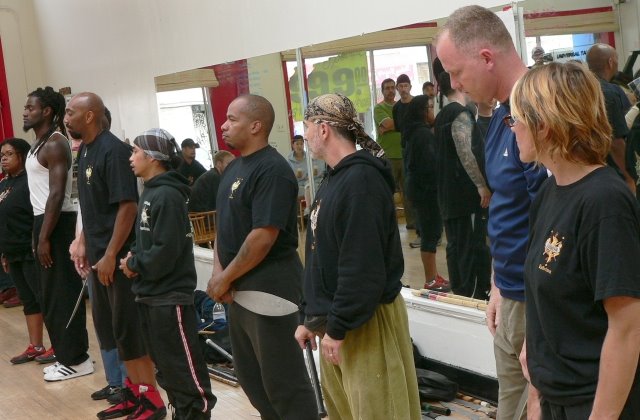
One of the devastating low kicking techniques of Sikaran

Passing the low slash of a knife (the basic counter for angle #4 in Serrada)

Targeting the knee with a low counter off an outside parry
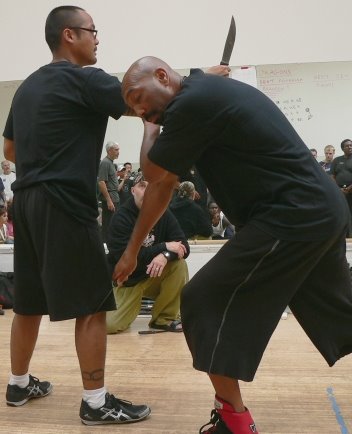
Fast work - getting in close with the long blades ...



Sunday, August 13, 2006
Spirituality in FMA
Someone posted the following quote on a martial art digest. Below is my response:
“People confuse filipino fighting arts with chinese and japanese arts. we are not founded by priests. we do not try to "make students better character", or "good people", that is what churches and mosques are for. FMA has one goal, to make good and effective fighters, to hurt people. you cannot do this in your mind or even at the drawing board. FMA has too many people with too many theories, not enough hands on.”
Yes and no. I certainly don't dispute the pragmatic goal of strong fighting skills as the raison d'etre for FMA training. As Master Han says in "Return of the Dragon", who knows how many treasures have been lost to the world because of the lack of the will to defend them. That statement, however, defines fighting skill as an outer level, whose purpose is as a shield to protect the inner. However, inner and outer are not separate but rather are part of each other by definition. A person empowered by their thoughts and beliefs will be stronger than one who is unsure or conflicted.
The power of the spirit was certainly known to Filipinos, the basis for practices like oracion and anting-anting. Before angles were known by numbers, they were taught by name association. Angle #1 was often called San Miguel because Saint Michael is depicted with an upraised sword of truth and justice, depicting that strike. Similarly, the Moros were feared not just for their fighting techniques, because Cebuanos and others proved equal in battle, but because it was the strength of their convictions that made them such formidable adversaries.
We may not think of murder and mayhem as spiritual, but even societies engaged in such practices have empowering belief systems. Viking beserkers were a terror across Europe, but they believed in Valhalla and an afterlife, which helped them conquer their fear of death.
It is said that one man's terrorist is another's freedom fighter. Is taking up arms spiritual? Depends which side of that equation you are on. Does it make you a better person? Anything that engages us completely is a transformative experience, which is why the samurai took so readily to Zen, understanding the power of having "one mind." Most modern FMA is taught in a niche of "practicality" but anyone who undertakes a process of change experiences it inwardly as well. The old manongs would sometimes hold their hand over the head of a prospective student to see if they were too "hot-headed" to be trusted with deadly knowledge. They were concerned with the character of their students just as many of us are today.
Esoteric knowledge of the inner self has always been secretive, not just as a way to control power but because the masses were not deemed awakened enough to understand. It takes time to develop someone to a level of understanding, and the repression of Filipino culture under the Spanish diminished this part as well. Martial arts typically in times of war are less concerned with niceties of personal development, and so the FMA became noted for straightforward practicality. Now we live in an era in which knowledge is much more open through literacy and mass communication.
I see no reason not to include deeper awareness through self-examination as part of a curriculum. It may not suit every student, and it isn't the first thing taught, but in my experience such self-understanding enables people to progress further than if they are dependent on others to give them knowledge. Mind-body integration happens regardless of intentionality, but awareness is more powerful than ignorance. The discipline to train the body comes from the mind, and this process develops the spirit and will to succeed. These are not separate things.
Now not every instructor will delve into this. Many may not have the ability to communicate what they themselves feel internally, and so it is only through the training that they lead others towards mastery. Make no mistake, though. Mastery is not just of the techniques, but of the self; polish the spirit and the results will be evident.
This connection is more prominent in many styles of Silat than FMA these days, but the similarity of the arts and cultural connections are a clue such awareness can be found in both. In the end, spirituality is the essence of each of us, not just something to be controlled by religious organizations. When we dedicate ourselves through effort, we elevate ourselves regardless of what it is we choose to do.
“People confuse filipino fighting arts with chinese and japanese arts. we are not founded by priests. we do not try to "make students better character", or "good people", that is what churches and mosques are for. FMA has one goal, to make good and effective fighters, to hurt people. you cannot do this in your mind or even at the drawing board. FMA has too many people with too many theories, not enough hands on.”
Yes and no. I certainly don't dispute the pragmatic goal of strong fighting skills as the raison d'etre for FMA training. As Master Han says in "Return of the Dragon", who knows how many treasures have been lost to the world because of the lack of the will to defend them. That statement, however, defines fighting skill as an outer level, whose purpose is as a shield to protect the inner. However, inner and outer are not separate but rather are part of each other by definition. A person empowered by their thoughts and beliefs will be stronger than one who is unsure or conflicted.
The power of the spirit was certainly known to Filipinos, the basis for practices like oracion and anting-anting. Before angles were known by numbers, they were taught by name association. Angle #1 was often called San Miguel because Saint Michael is depicted with an upraised sword of truth and justice, depicting that strike. Similarly, the Moros were feared not just for their fighting techniques, because Cebuanos and others proved equal in battle, but because it was the strength of their convictions that made them such formidable adversaries.
We may not think of murder and mayhem as spiritual, but even societies engaged in such practices have empowering belief systems. Viking beserkers were a terror across Europe, but they believed in Valhalla and an afterlife, which helped them conquer their fear of death.
It is said that one man's terrorist is another's freedom fighter. Is taking up arms spiritual? Depends which side of that equation you are on. Does it make you a better person? Anything that engages us completely is a transformative experience, which is why the samurai took so readily to Zen, understanding the power of having "one mind." Most modern FMA is taught in a niche of "practicality" but anyone who undertakes a process of change experiences it inwardly as well. The old manongs would sometimes hold their hand over the head of a prospective student to see if they were too "hot-headed" to be trusted with deadly knowledge. They were concerned with the character of their students just as many of us are today.
Esoteric knowledge of the inner self has always been secretive, not just as a way to control power but because the masses were not deemed awakened enough to understand. It takes time to develop someone to a level of understanding, and the repression of Filipino culture under the Spanish diminished this part as well. Martial arts typically in times of war are less concerned with niceties of personal development, and so the FMA became noted for straightforward practicality. Now we live in an era in which knowledge is much more open through literacy and mass communication.
I see no reason not to include deeper awareness through self-examination as part of a curriculum. It may not suit every student, and it isn't the first thing taught, but in my experience such self-understanding enables people to progress further than if they are dependent on others to give them knowledge. Mind-body integration happens regardless of intentionality, but awareness is more powerful than ignorance. The discipline to train the body comes from the mind, and this process develops the spirit and will to succeed. These are not separate things.
Now not every instructor will delve into this. Many may not have the ability to communicate what they themselves feel internally, and so it is only through the training that they lead others towards mastery. Make no mistake, though. Mastery is not just of the techniques, but of the self; polish the spirit and the results will be evident.
This connection is more prominent in many styles of Silat than FMA these days, but the similarity of the arts and cultural connections are a clue such awareness can be found in both. In the end, spirituality is the essence of each of us, not just something to be controlled by religious organizations. When we dedicate ourselves through effort, we elevate ourselves regardless of what it is we choose to do.
Wednesday, August 09, 2006
Kajukenbo Ohana Seminar this Saturday!
Prof. Greg Lagera (Kajukenbo 8th Dan) is having an all-day seminar (which includes lunch) from 9-6 on Saturday in Newark, in the East Bay between Hayward and San Jose. This 8-Hour workout will include Kajukenbo Self-Defense, Filipino Martial Arts, Jeet Kune Do, Kickboxing, Submission Grappling, and Live Sparring.
(Open to all ages and skill levels.)
Some of the best martial arts instructors anywhere will be attending, such as grandmasters Al Novak, Ted Sotelo, Emil Bautista and more. I've known Greg Lagera since he and my Kenpo teacher were top competitors at tournaments in the 1980's. Cost is $45 at the door, but for an event of this caliber (and lunch) it's a steal!
For those who are not familiar with Kajukenbo, it is a highly effective street-fighting system incorporating a number of different root systems, including escrima, so you might find it an effective transition from weapons to empty hands.
Take 880 and exit at Thorton Ave. going west (towards the Bay, away from the hills). Turn right on Mayhews Landing (about 1/2 mile; 2 lights), which will curve left, and then right on Cherry. The event is in the park at Cherry and Montcalm.
(Open to all ages and skill levels.)
Some of the best martial arts instructors anywhere will be attending, such as grandmasters Al Novak, Ted Sotelo, Emil Bautista and more. I've known Greg Lagera since he and my Kenpo teacher were top competitors at tournaments in the 1980's. Cost is $45 at the door, but for an event of this caliber (and lunch) it's a steal!
For those who are not familiar with Kajukenbo, it is a highly effective street-fighting system incorporating a number of different root systems, including escrima, so you might find it an effective transition from weapons to empty hands.
Take 880 and exit at Thorton Ave. going west (towards the Bay, away from the hills). Turn right on Mayhews Landing (about 1/2 mile; 2 lights), which will curve left, and then right on Cherry. The event is in the park at Cherry and Montcalm.
Tuesday, August 08, 2006
Tales from Hurricane Katrina
My first college roommate lived in Bay St. Louis, a paradise that was ground zero for Hurricane Katrina. He just sent me a link to these gripping tales, written by a town survivor, detailing the horrors of the hurricane and its aftermath there and in New Orleans. Absolutely riveting ... and a cautionary tale for anyone expecting help to arrive. As one policeman told a woman there, she "might be standing on American soil, but it wasn’t America any more."
Here's a blog about battling insurers and bureaucrats to rebuild. As the author writes, ten months after the hurricane "some relief workers who had been working on the December 2004 Asian Tsunami relief effort toured New Orleans and were shocked that so little had been done. They concluded that in Third World countries such as Indonesia, the people weren't hindered by government agencies and the insurance industry." It's sad how things are run here nowadays. And scary.
Here's a blog about battling insurers and bureaucrats to rebuild. As the author writes, ten months after the hurricane "some relief workers who had been working on the December 2004 Asian Tsunami relief effort toured New Orleans and were shocked that so little had been done. They concluded that in Third World countries such as Indonesia, the people weren't hindered by government agencies and the insurance industry." It's sad how things are run here nowadays. And scary.
Monday, August 07, 2006
Sonny Umpad Benefit Seminar This Sunday!
On the thirteenth of this month, students of Master Sonny Umpad
will be holding a seminar/ benefit on his behalf.
Senior students from every generation will be represented, teaching
the unique aspects of Visayan Eskrima. There will be many teachers
on hand to help further your understanding of this art.
This is truly a once in a lifetime opportunity as the students of
Master Umpad , come together to share his style of eskrima.
Where:
John Nash, Northern Tiger Kempo
1319, 20th ave (at Irving)
SF, CA 94122 When:
August, 13 2006 from noon to four $50 dollars at the door (cash only)
You must supply your own training weapons.
will be holding a seminar/ benefit on his behalf.
Senior students from every generation will be represented, teaching
the unique aspects of Visayan Eskrima. There will be many teachers
on hand to help further your understanding of this art.
This is truly a once in a lifetime opportunity as the students of
Master Umpad , come together to share his style of eskrima.
Where:
John Nash, Northern Tiger Kempo
1319, 20th ave (at Irving)
SF, CA 94122 When:
August, 13 2006 from noon to four $50 dollars at the door (cash only)
You must supply your own training weapons.
Wedges
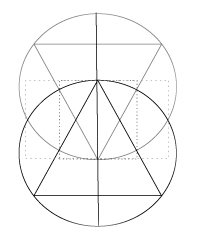
Everyone here is probably familiar with triangle stepping and angles. I constantly remind students that the FMA logo (triangle in circle) is not just symbolic, but also a more literal roadmap.
This is always shown with the "male triangle" which points up or forward. Forward usually means towards the opponent's centerline, but it can also mean facing the strongest point of his attack. Situations vary. Rotated, of course, into the female position, the points demonstrate angles of evasion.

Points are strong, being reinforced. Lines are strong in direction of movement from point to point. They are vulnerable, however, across their width. Think of a pencil; strong one way, weak the other.
Inside the triangle's lines lies our safe zone. Outside the triangle increases exposure. An example is doing a cross-block (a downward pointing defense on our check-hand side) but leaving our rear elbow or shoulder exposed wide, outside the angle of protection afforded by the defense.
The closer we get to the point, the tighter the lines and smaller the area we have to move to stay within them, yet the angles themselves are the same degrees of arc at any range.
This is a key essence of Serrada. We want to find the smallest, tightest range at which we can function. It represents our last line of defense, what is closest to us.
Functionality is, of course, the key. Too much compression could be immobilizing or collapse. Some might think it lacks power because there is less room to accelerate. Understanding fulcrums and balance, however, gives us full measure. In every technique I seek to apply GM Ed Parker's three maxims for power: linear, rotational, gravity.
Al Thomas, my original Kenpo teacher, used to remind us of the magnifying effect of adrenaline. His point was if we train like a golf ball, we'll fight like a baseball; train like a baseball, fight like a basketball; train like a basketball, we'll fight like a beachball. In other words, we open ourselves up under stress. By training more tightly, that habit tends to remain more effective when it's most needed.
A basketball isn't a bad area of protection for the body, but a beachball is excessive movement. It it too much volume of space to protect and takes too long to finish a movement. Even largo mano (long range) techniques tend to hit pretty directly to the target. No matter what style you do, nothing matters until "point of impact" (POI) anyway, and so we want to maximize our effectiveness there, whether we hit and run or jam and control.
Range is a basic tactical choice, but efficiency is even more fundamental. It allows us more time to observe our opponent and to engage less telegraphically.
Like a sine wave, greater ranges involve more momentum whereas closer ranges increase frequency though the energy can remain a constant (how a whip accelerates and cracks, for instance). Top speed is traded for speed of reversal, and to a certain extent power might be traded for accuracy (though expert proponents can demonstrate otherwise).
Closer ranges have different risks. There are fewer weapons to monitor at longer ranges. As one moves in, the opposing hand can strike, then grab, then envelop or encircle. One needs to be as aware of one's own vulnerable targets as is attention to the opponent.
Once again we have our "threat triangle" to monitor, and this has been a reminder to keep everything protected within it, both front and rear sides of your body. Pay attention, as you move your guard towards or or away from your opponent, how it will open and close different areas relative to your opponent's weapon and centerline.
In this diagram we stand in the center of our circle/triangle, which is the point to which our opponent reaches. The back half is our largo range where we move our vital targets out of reach.

This might be redundant to many, and others may not want to dig through the archives anyway. Regardless, it's always good practice to review fundamental concepts, refreshing the touchstone from which we measure our understanding and progress.
This is always shown with the "male triangle" which points up or forward. Forward usually means towards the opponent's centerline, but it can also mean facing the strongest point of his attack. Situations vary. Rotated, of course, into the female position, the points demonstrate angles of evasion.

Points are strong, being reinforced. Lines are strong in direction of movement from point to point. They are vulnerable, however, across their width. Think of a pencil; strong one way, weak the other.
Inside the triangle's lines lies our safe zone. Outside the triangle increases exposure. An example is doing a cross-block (a downward pointing defense on our check-hand side) but leaving our rear elbow or shoulder exposed wide, outside the angle of protection afforded by the defense.
The closer we get to the point, the tighter the lines and smaller the area we have to move to stay within them, yet the angles themselves are the same degrees of arc at any range.
This is a key essence of Serrada. We want to find the smallest, tightest range at which we can function. It represents our last line of defense, what is closest to us.
Functionality is, of course, the key. Too much compression could be immobilizing or collapse. Some might think it lacks power because there is less room to accelerate. Understanding fulcrums and balance, however, gives us full measure. In every technique I seek to apply GM Ed Parker's three maxims for power: linear, rotational, gravity.
Al Thomas, my original Kenpo teacher, used to remind us of the magnifying effect of adrenaline. His point was if we train like a golf ball, we'll fight like a baseball; train like a baseball, fight like a basketball; train like a basketball, we'll fight like a beachball. In other words, we open ourselves up under stress. By training more tightly, that habit tends to remain more effective when it's most needed.
A basketball isn't a bad area of protection for the body, but a beachball is excessive movement. It it too much volume of space to protect and takes too long to finish a movement. Even largo mano (long range) techniques tend to hit pretty directly to the target. No matter what style you do, nothing matters until "point of impact" (POI) anyway, and so we want to maximize our effectiveness there, whether we hit and run or jam and control.
Range is a basic tactical choice, but efficiency is even more fundamental. It allows us more time to observe our opponent and to engage less telegraphically.
Like a sine wave, greater ranges involve more momentum whereas closer ranges increase frequency though the energy can remain a constant (how a whip accelerates and cracks, for instance). Top speed is traded for speed of reversal, and to a certain extent power might be traded for accuracy (though expert proponents can demonstrate otherwise).
Closer ranges have different risks. There are fewer weapons to monitor at longer ranges. As one moves in, the opposing hand can strike, then grab, then envelop or encircle. One needs to be as aware of one's own vulnerable targets as is attention to the opponent.
Once again we have our "threat triangle" to monitor, and this has been a reminder to keep everything protected within it, both front and rear sides of your body. Pay attention, as you move your guard towards or or away from your opponent, how it will open and close different areas relative to your opponent's weapon and centerline.
In this diagram we stand in the center of our circle/triangle, which is the point to which our opponent reaches. The back half is our largo range where we move our vital targets out of reach.
This might be redundant to many, and others may not want to dig through the archives anyway. Regardless, it's always good practice to review fundamental concepts, refreshing the touchstone from which we measure our understanding and progress.
Monday, July 31, 2006
Edge Weapons workshop in New Hampshire
Date: 8/13/06 (Sunday)
Location: Freedman's Ketsugo Bu-Jutsu Kai, Weare NH.
Time: 12:00 / 2:00PM
Cost: $40.00 (Cash Only) no checks
Contact info: Weare NH. Dojo (603)529-3564
Email: peterfreedman@hotmail.com
Web Sight: www.jujutsu.org
Instructor: Peter Freedman Sensei / Guro
--------------------------------------------------------------------------------
Please bring:
Sneakers
Loosely fitting cloths
Rubber training knife (we have some here for sale $10.00)
Eye protection
Lightly padded gloves
Water & Snack
Note Book
A friend to pair off with
Dues $40.00 cash
Questions - as many as possible
--------------------------------------------------------------------------------
No experience required, we will teach you from the beginning & up.
People who already have skill, we will build upon your skill level.
Workshop details:
type of knives used for (self protection) folders - verses fixed blade
grips (holding skills - hand switching skills etc.)
foot work & body angles (attack & evasion skills)
angles of cutting & thrusting (nine basic angles)
hand evasion skills & techniques (offense & defense)
eye exercises (distance control)
breathing technique (fear control / heart beat)
basic first aid (for cuts or wounds)
And much more !
We hope you can come & attend this workshop with a friend to pair off with.
This workshop is open to Men & woman.
No Children, please.
Teenagers 15/16 & up ok, as long as accompanied by a parent.
Law enforcement / Military welcomed - (no discounts at this time)
No group discounts at this time.
Respectfully yours
Freedman Sensei / Guro
Location: Freedman's Ketsugo Bu-Jutsu Kai, Weare NH.
Time: 12:00 / 2:00PM
Cost: $40.00 (Cash Only) no checks
Contact info: Weare NH. Dojo (603)529-3564
Email: peterfreedman@hotmail.com
Web Sight: www.jujutsu.org
Instructor: Peter Freedman Sensei / Guro
--------------------------------------------------------------------------------
Please bring:
Sneakers
Loosely fitting cloths
Rubber training knife (we have some here for sale $10.00)
Eye protection
Lightly padded gloves
Water & Snack
Note Book
A friend to pair off with
Dues $40.00 cash
Questions - as many as possible
--------------------------------------------------------------------------------
No experience required, we will teach you from the beginning & up.
People who already have skill, we will build upon your skill level.
Workshop details:
type of knives used for (self protection) folders - verses fixed blade
grips (holding skills - hand switching skills etc.)
foot work & body angles (attack & evasion skills)
angles of cutting & thrusting (nine basic angles)
hand evasion skills & techniques (offense & defense)
eye exercises (distance control)
breathing technique (fear control / heart beat)
basic first aid (for cuts or wounds)
And much more !
We hope you can come & attend this workshop with a friend to pair off with.
This workshop is open to Men & woman.
No Children, please.
Teenagers 15/16 & up ok, as long as accompanied by a parent.
Law enforcement / Military welcomed - (no discounts at this time)
No group discounts at this time.
Respectfully yours
Freedman Sensei / Guro
Sunday, July 30, 2006
Carlito Bonjoc's Oakland Seminar - August 19th
Carlito Bonjoc will be doing a seminar in Oakland on Saturday, August 19, from noon till 5pm. Carlito is one of the outstanding proponents of Serrada as well as inheritor of his family's system of escrima. I encourage anyone who can make it to attend, as he always shares a wealth of information. I learn a lot from Carlito, and I'm sure you will too!
Lock Position #2 - The Threat Triangle
The “Threat Triangle” is a term I’ve coined to describe the tactical use of the lock position. Again, it is not a static position but an active and responsive tracking method. We want our “guns” facing the main threat, and there are nuances to this orientation as we move relative to an opponent.
The most fundamental is footwork, using the male triangle to face the opponent’s centerline. We lead with either foot, using papeet (replacement step) to orient towards either the left or right sides. If we control the center of the encounter, there are advantages of leverage and shorter lines of movement with the shorter stick.
Our basic consideration is the centerline, which is the most inside line. Our footwork and weapon should maintain directness.
There is also an outside line, which is the widest angle from which we need to guard against the most likely threat presented at that moment.
If we just lock facing forward and the tip of our opponent’s weapon can thrust around our guard, we are vulnerable; think of a rapier or dagger.
Too many people just finish a technique, give a cursory lock, and they’re done, or they just step straight up the center as though that threat had been neutralized. The purpose of the lock is to defend against the next attack. Why assume it will not be with the same weapon, from its previous position? Angel Cabales was a master of the quick thrust, and the lock has to be able to intercept that. For this, angle is critical.
If our opponent is beyond contact distance, the angle between his centerline and outside line is very slight. As we approach, that angle gets wider, and the longer the weapon, the deeper he can reach around us. Visualize his attack as anywhere on an arc, with you in the center of the circle.
At a longer distance, or closer but all weapons forward, our lock can be straight in front. If my opponent’s weapon is off towards my right, that is the side I most likely need to defend, and if he moves the other way, I should be shadowing that direction.
The idea is simple. If I am already in a position that cuts off a surprise attack simply, without resorting to a long or complicated maneuver, my defense will be quicker and more likely to succeed. I don’t want to have to think about a sudden threat when it’s time to react, so if I’m already pre-positioned to intercept that move, I get better use of trained subconscious reflexes.
I can’t always just rotate my body or move my weapon over to cover an angle because I might expose another, more vital one. If the threat you track is a fake, you may have played into your opponent’s strategy.
A good way to solve this is to angle my weapon, using the male triangle principle. For instance, if I am in a right lead, my opponent might be showing a low thrust to my left abdomen. If my weapon is just forward, I’ve left him that gap. If I angle the tip of my weapon back toward the left, my right hand covers the centerline. Both inside and outside angles have proximate coverage.
If my opponent sweeps his weapon to the other side, I would papeet into a left lead. Now the tip of my weapon covers the centerline while my right weapon hand is tracking the opposing weapon. At all times some part of my weapon accounts for every angle his weapon’s got.
In this diagram, the attacker is in red, the defender is black. The light dotted lines represent movement; the heavier black dotted lines represent the position of Black's stick (and his hand) as he thrusts inward from an outside position.
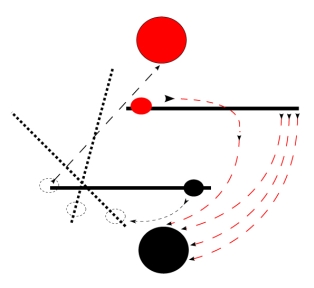
Notice the entry path available from the end of Red's stick using an arcing strike. There is also a line showing how moving Red's hand over across the body allows even deeper access toward the front of our body. This is particularly important against witiks (snapping blows), especially if sharpened by reverse tapping our own arm to accelerate the effect.
The defender also has a similar angle to counter-attack in this diagram. Black shows a thrust on a direct line from the tip as his hand moves over to compensate. The Threat Triangle is thus the separation by degree of incoming angles we have to monitor, from the weapon hand to the the end of that weapon, as these lines converge on target. In other words, an attack can come from either end of the weapon! We can see this triangle clearly in Black's diagram, using the lines of sight and thrust.
My old Kenpo teacher used to have us imagine having an eye on the toe of our foot. We'd actually place our head on the ground to see what openings that our foot could "see." I do the same thing with my stick, because what is apparent from the tip is different from what I see where my head is located.
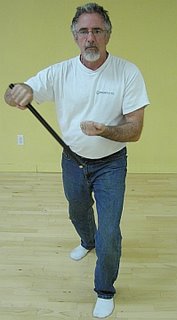
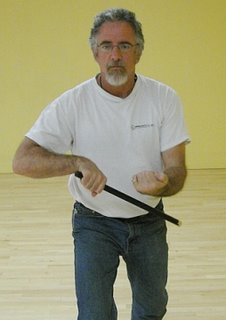
Here I'm facing forward once again, but I'm guarding against an attack from my right, closing off the low line off attack from the tip of an opponent's weapon. Compare the stick position to that in the picture on the previous post. There my opponent's weapon is directly in front and so my angle is more direct.
The most fundamental is footwork, using the male triangle to face the opponent’s centerline. We lead with either foot, using papeet (replacement step) to orient towards either the left or right sides. If we control the center of the encounter, there are advantages of leverage and shorter lines of movement with the shorter stick.
Our basic consideration is the centerline, which is the most inside line. Our footwork and weapon should maintain directness.
There is also an outside line, which is the widest angle from which we need to guard against the most likely threat presented at that moment.
If we just lock facing forward and the tip of our opponent’s weapon can thrust around our guard, we are vulnerable; think of a rapier or dagger.
Too many people just finish a technique, give a cursory lock, and they’re done, or they just step straight up the center as though that threat had been neutralized. The purpose of the lock is to defend against the next attack. Why assume it will not be with the same weapon, from its previous position? Angel Cabales was a master of the quick thrust, and the lock has to be able to intercept that. For this, angle is critical.
If our opponent is beyond contact distance, the angle between his centerline and outside line is very slight. As we approach, that angle gets wider, and the longer the weapon, the deeper he can reach around us. Visualize his attack as anywhere on an arc, with you in the center of the circle.
At a longer distance, or closer but all weapons forward, our lock can be straight in front. If my opponent’s weapon is off towards my right, that is the side I most likely need to defend, and if he moves the other way, I should be shadowing that direction.
The idea is simple. If I am already in a position that cuts off a surprise attack simply, without resorting to a long or complicated maneuver, my defense will be quicker and more likely to succeed. I don’t want to have to think about a sudden threat when it’s time to react, so if I’m already pre-positioned to intercept that move, I get better use of trained subconscious reflexes.
I can’t always just rotate my body or move my weapon over to cover an angle because I might expose another, more vital one. If the threat you track is a fake, you may have played into your opponent’s strategy.
A good way to solve this is to angle my weapon, using the male triangle principle. For instance, if I am in a right lead, my opponent might be showing a low thrust to my left abdomen. If my weapon is just forward, I’ve left him that gap. If I angle the tip of my weapon back toward the left, my right hand covers the centerline. Both inside and outside angles have proximate coverage.
If my opponent sweeps his weapon to the other side, I would papeet into a left lead. Now the tip of my weapon covers the centerline while my right weapon hand is tracking the opposing weapon. At all times some part of my weapon accounts for every angle his weapon’s got.
In this diagram, the attacker is in red, the defender is black. The light dotted lines represent movement; the heavier black dotted lines represent the position of Black's stick (and his hand) as he thrusts inward from an outside position.

Notice the entry path available from the end of Red's stick using an arcing strike. There is also a line showing how moving Red's hand over across the body allows even deeper access toward the front of our body. This is particularly important against witiks (snapping blows), especially if sharpened by reverse tapping our own arm to accelerate the effect.
The defender also has a similar angle to counter-attack in this diagram. Black shows a thrust on a direct line from the tip as his hand moves over to compensate. The Threat Triangle is thus the separation by degree of incoming angles we have to monitor, from the weapon hand to the the end of that weapon, as these lines converge on target. In other words, an attack can come from either end of the weapon! We can see this triangle clearly in Black's diagram, using the lines of sight and thrust.
My old Kenpo teacher used to have us imagine having an eye on the toe of our foot. We'd actually place our head on the ground to see what openings that our foot could "see." I do the same thing with my stick, because what is apparent from the tip is different from what I see where my head is located.

Here I'm facing forward once again, but I'm guarding against an attack from my right, closing off the low line off attack from the tip of an opponent's weapon. Compare the stick position to that in the picture on the previous post. There my opponent's weapon is directly in front and so my angle is more direct.
Saturday, July 29, 2006
Lock Position #1
For those unfamiliar with Serrada, the “lock position” is a signature of the system, an on-guard where our weapon is held in a neutral position more or less horizontally in front of our bodies. It isn’t exclusive to Serrada; grandmaster Navales from Panay teaches it in his system too. However, it is uncommon to most FMA styles and is often misunderstood even by Serrada students.
Here’s how I teach the basic mechanics: I have my students hold their stick out in front around solar plexus level, using both hands pronate (palms downward) to grasp the ends. Simply open the left hand and let that end drop. With a moderate grip, the left end will fall to maybe a 30º angle so the stick is at a diagonal. The left hand stays level with the right hand.
Defenses are typically diagonal - think of kick blocks in empty-hand arts – since low attacks are often horizontal. A vertical triangle like this covers more of your body. The lock position also keeps the weapon in front of you, central to any direction very quickly. If you carry the weapon too vertical, for instance, you have little power to go further in that direction and a longer way down to protect low lines.
Relax your wrist, elbow and shoulder, without going limp. This lets your upper arm cover the ribs better, and you’ll be faster using whipping energy than muscles alone. This lock position might not feel natural at first, but it will. Don’t just push a strike; the strengths of a stick are extension and leverage, which create speed and power. Eventually we want our whole body integrated in each motion, taking advantage of mechanical torque and gravity as power multipliers.
Also consider how much you reach with your hands. A common mistake is to extend outward too far. Remember that your hand is a target, and the farther it reaches, the longer it takes to retrieve. Since the stick is faster than the hand, you’re more likely to get hit if caught reaching. As a general rule I teach our on-guard is from the elbow out. In other words, unless otherwise required, I let my upper arms drop to cover my ribs. I may hold them slightly towards the front of my body rather than more fully relaxed.
Now that we have a basic angle, height and reach, we need movement. The lock position is not static. It’s relational, a way to track and intercept incoming attacks. As Angel taught it, one hand is always moving towards the opponent while the other returns. To get the feel of this, jog in place while holding the stick in the right hand across your body. Notice how the hands naturally fall into a back-and-forth rhythm. This is similar to what you want. However, the movement is not exactly symmetrical, because the weapon should always protect the empty hand and so stays towards the front.
A common error is to reach more with the left hand than with the weapon. This exposes the hand unnecessarily and can possibly interfere with your own weapon being deployed. Keep that left hand behind your primary weapon unless it is being used tactically. After all, our bodies feel pain, our sticks do not, and it’s easier to replace the latter than fix a broken bone. Think of your stick as also being a shield, or perhaps as the bumper on your car, there to take impacts before you do.
I finally got blogger to upload a picture of the lock position facing forward
Here’s how I teach the basic mechanics: I have my students hold their stick out in front around solar plexus level, using both hands pronate (palms downward) to grasp the ends. Simply open the left hand and let that end drop. With a moderate grip, the left end will fall to maybe a 30º angle so the stick is at a diagonal. The left hand stays level with the right hand.
Defenses are typically diagonal - think of kick blocks in empty-hand arts – since low attacks are often horizontal. A vertical triangle like this covers more of your body. The lock position also keeps the weapon in front of you, central to any direction very quickly. If you carry the weapon too vertical, for instance, you have little power to go further in that direction and a longer way down to protect low lines.
Relax your wrist, elbow and shoulder, without going limp. This lets your upper arm cover the ribs better, and you’ll be faster using whipping energy than muscles alone. This lock position might not feel natural at first, but it will. Don’t just push a strike; the strengths of a stick are extension and leverage, which create speed and power. Eventually we want our whole body integrated in each motion, taking advantage of mechanical torque and gravity as power multipliers.
Also consider how much you reach with your hands. A common mistake is to extend outward too far. Remember that your hand is a target, and the farther it reaches, the longer it takes to retrieve. Since the stick is faster than the hand, you’re more likely to get hit if caught reaching. As a general rule I teach our on-guard is from the elbow out. In other words, unless otherwise required, I let my upper arms drop to cover my ribs. I may hold them slightly towards the front of my body rather than more fully relaxed.
Now that we have a basic angle, height and reach, we need movement. The lock position is not static. It’s relational, a way to track and intercept incoming attacks. As Angel taught it, one hand is always moving towards the opponent while the other returns. To get the feel of this, jog in place while holding the stick in the right hand across your body. Notice how the hands naturally fall into a back-and-forth rhythm. This is similar to what you want. However, the movement is not exactly symmetrical, because the weapon should always protect the empty hand and so stays towards the front.
A common error is to reach more with the left hand than with the weapon. This exposes the hand unnecessarily and can possibly interfere with your own weapon being deployed. Keep that left hand behind your primary weapon unless it is being used tactically. After all, our bodies feel pain, our sticks do not, and it’s easier to replace the latter than fix a broken bone. Think of your stick as also being a shield, or perhaps as the bumper on your car, there to take impacts before you do.

I finally got blogger to upload a picture of the lock position facing forward
Saturday, July 15, 2006
Insight Delight
It’s a surprise when something one has done for years suddenly flashes fresh insight. The experience can be both pleasant and disconcerting, the former for obvious reasons of discovery, the latter more a sense of “what took so long?” followed by “What else am I missing here?”
Some things need to percolate and evolve, often waiting for that moment the right question is asked, the key that unlocks the door. We have an “Aha!” moment, but it’s really been there awhile for us to see. It isn’t called “insight” for nothing!
This is also a benefit of teaching, since one is always going over basic information, the raw material feeding our creative unconscious mind. It’s been said (and I’m repeating myself) that UC Berkeley has so many Nobel winners because tenured professors are forced to endure giving those horrid undergraduate courses. This allegedly keeps them grounded in the fundamentals of their disciplines. Same thing here.
So yesterday I had an unexpected insight on “the pass” for angle #3, also known as “the two-step”. Serrada’s angle #3 is thrown as right-handed horizontal forehand slash across the mid-section; the defender sees it coming in left to right. This does what the name implies; it passes the attack through to the other side. In essence, it is an outside parry for a low attack on the left, analogous to the outside block on angle #1. “Inside” refers to being between an attacker’s hands (in front) vs. “outside” which is to the outside of one arm or the other, angled away from the opposite arm.
There has been some controversy within the Serrada community about how this technique is properly done. The majority of people I know do it the way I learned it, which is how Angel Cabales taught the move throughout the 1980’s. The move begins by cocking the left hand and foot, then doing a papeet (replacement step or quick step) with the right leg back. Vincent teaches this as a papeet with the left leg back.
This isn’t insignificant, because it changes the balance, angles and range of the counter-strikes all the way through to the end. Furthermore, there are things in the later version that appear inconsistent with basic Serrada theories, like always facing the attack. Vincent’s method is clearer on that regard. He told me that his way is authentic, and that his father changed the move while training Jimmy Tacosa because Jimmy did it that way.
This never made sense to me, because Angel didn’t do things arbitrarily like that. In fact, I often heard him reply to questions about why certain students would do things differently, by saying “He wants to do it that way and doesn’t listen, so I let him.” In other words, the student might change things, but Angel didn’t follow their lead.
There was a mystery here, a deeper truth to uncover. I’ve always felt I had a piece of this puzzle, because Angel also showed me – once - the footwork pattern Vincent uses, only Angel referred to this as Serrada’s version of a largo mano technique (largo mano is the range where your head is out of your opponent’s reach but his attacking hand is within your reach). Like Vincent, Angel moved back slightly on the first move, then surged in on the counterstrike. (It’s a bit like Sonny Umpad’s “pendulum” this way.)
Since I had seen both versions from Angel, I didn’t think of them as incompatible but rather as complementary. The way I was taught kept things a hair closer, relying more on the check hand to suppress the incoming attack, thereby altering its range. By keeping these as separate and discrete, I didn’t get confused. I spent some time trying Vincent’s version as the “only” way, but it just messed my timing up with either pattern. Once I realized it matched Angel’s “largo” I could keep it safely categorized as an alternative move.
This, however, was an old perspective from 15 years ago. I still had not fully deciphered the reason Angel allegedly changed the footwork so radically. In particular his later method seemed to leave the last strike off-balance and at an awkward angle. This strike is a right downward chop with the right leg forward. While our basic #1 strike steps in like this, here we are stepping back with the left leg, so we do not get the benefit of dropping our weight forward fully into the strike. This actually tends to pull energy away from the blow, which seems odd. I often tried to explain discrepancies as the move setting up for the reverse backhand strike (angle #4) to follow, but that also presented some technical inconsistencies which then had to be explained away.
Then last night as I was teaching this technique to someone new, I heard myself say something I’d never heard or thought before. This was regarding that finishing strike. I’d been thinking for some time that the power comes from torquing the upper body counterclockwise, which was somehow at odds with a vertical right forehand finishing blow. What I heard myself say was “you can chop diagonally to your opponent’s inside, towards the centerline, to take the upper arm.”
This tied together several other pieces of information. I’ve often told the story, related to me by a Modern Arnis teacher who had worked as a doctor in the Philippines, that after knife or sword fights, corpses frequently had cuts to the upper sword arm, but survivors almost never had such a wound. The implication was clear that such a cut incapacitated the loser’s ability to further defend, a good example of “killing the fang.”
What triggered this association was recognizing that if an attacker throws a powerful #3 strike and misses, it will likely carry his arm all the way across his body, removing the forearm as a target, at least until he comes back with the reverse #4 strike. With the forearm out of range, the logical target changes, and the closest and most effective is the upper arm.
This is consistent with defender’s direction of power in that hard torso twist to the left. Using a short chop, followed by a quick abanico to the “lock” position (weapon held across the body in an on-guard position) put one’s focus right on the opponent’s centerline. Previously I’d been targeting back to the forearm, which meant either striking towards my own outside line off the hip (as opposed to keeping power in towards my own center, which is more fundamental to our theories) or stepping wider across my opponent to orient power but exposing my low line to greater extent.
I’m sure others have had this insight too, but I’ve never heard it. There has always been vagueness as to why this technique looked different from so many others. By analyzing the power structure and alignment of both attacker and defender, an odd technique suddenly feels technically sound.
Some things need to percolate and evolve, often waiting for that moment the right question is asked, the key that unlocks the door. We have an “Aha!” moment, but it’s really been there awhile for us to see. It isn’t called “insight” for nothing!
This is also a benefit of teaching, since one is always going over basic information, the raw material feeding our creative unconscious mind. It’s been said (and I’m repeating myself) that UC Berkeley has so many Nobel winners because tenured professors are forced to endure giving those horrid undergraduate courses. This allegedly keeps them grounded in the fundamentals of their disciplines. Same thing here.
So yesterday I had an unexpected insight on “the pass” for angle #3, also known as “the two-step”. Serrada’s angle #3 is thrown as right-handed horizontal forehand slash across the mid-section; the defender sees it coming in left to right. This does what the name implies; it passes the attack through to the other side. In essence, it is an outside parry for a low attack on the left, analogous to the outside block on angle #1. “Inside” refers to being between an attacker’s hands (in front) vs. “outside” which is to the outside of one arm or the other, angled away from the opposite arm.
There has been some controversy within the Serrada community about how this technique is properly done. The majority of people I know do it the way I learned it, which is how Angel Cabales taught the move throughout the 1980’s. The move begins by cocking the left hand and foot, then doing a papeet (replacement step or quick step) with the right leg back. Vincent teaches this as a papeet with the left leg back.
This isn’t insignificant, because it changes the balance, angles and range of the counter-strikes all the way through to the end. Furthermore, there are things in the later version that appear inconsistent with basic Serrada theories, like always facing the attack. Vincent’s method is clearer on that regard. He told me that his way is authentic, and that his father changed the move while training Jimmy Tacosa because Jimmy did it that way.
This never made sense to me, because Angel didn’t do things arbitrarily like that. In fact, I often heard him reply to questions about why certain students would do things differently, by saying “He wants to do it that way and doesn’t listen, so I let him.” In other words, the student might change things, but Angel didn’t follow their lead.
There was a mystery here, a deeper truth to uncover. I’ve always felt I had a piece of this puzzle, because Angel also showed me – once - the footwork pattern Vincent uses, only Angel referred to this as Serrada’s version of a largo mano technique (largo mano is the range where your head is out of your opponent’s reach but his attacking hand is within your reach). Like Vincent, Angel moved back slightly on the first move, then surged in on the counterstrike. (It’s a bit like Sonny Umpad’s “pendulum” this way.)
Since I had seen both versions from Angel, I didn’t think of them as incompatible but rather as complementary. The way I was taught kept things a hair closer, relying more on the check hand to suppress the incoming attack, thereby altering its range. By keeping these as separate and discrete, I didn’t get confused. I spent some time trying Vincent’s version as the “only” way, but it just messed my timing up with either pattern. Once I realized it matched Angel’s “largo” I could keep it safely categorized as an alternative move.
This, however, was an old perspective from 15 years ago. I still had not fully deciphered the reason Angel allegedly changed the footwork so radically. In particular his later method seemed to leave the last strike off-balance and at an awkward angle. This strike is a right downward chop with the right leg forward. While our basic #1 strike steps in like this, here we are stepping back with the left leg, so we do not get the benefit of dropping our weight forward fully into the strike. This actually tends to pull energy away from the blow, which seems odd. I often tried to explain discrepancies as the move setting up for the reverse backhand strike (angle #4) to follow, but that also presented some technical inconsistencies which then had to be explained away.
Then last night as I was teaching this technique to someone new, I heard myself say something I’d never heard or thought before. This was regarding that finishing strike. I’d been thinking for some time that the power comes from torquing the upper body counterclockwise, which was somehow at odds with a vertical right forehand finishing blow. What I heard myself say was “you can chop diagonally to your opponent’s inside, towards the centerline, to take the upper arm.”
This tied together several other pieces of information. I’ve often told the story, related to me by a Modern Arnis teacher who had worked as a doctor in the Philippines, that after knife or sword fights, corpses frequently had cuts to the upper sword arm, but survivors almost never had such a wound. The implication was clear that such a cut incapacitated the loser’s ability to further defend, a good example of “killing the fang.”
What triggered this association was recognizing that if an attacker throws a powerful #3 strike and misses, it will likely carry his arm all the way across his body, removing the forearm as a target, at least until he comes back with the reverse #4 strike. With the forearm out of range, the logical target changes, and the closest and most effective is the upper arm.
This is consistent with defender’s direction of power in that hard torso twist to the left. Using a short chop, followed by a quick abanico to the “lock” position (weapon held across the body in an on-guard position) put one’s focus right on the opponent’s centerline. Previously I’d been targeting back to the forearm, which meant either striking towards my own outside line off the hip (as opposed to keeping power in towards my own center, which is more fundamental to our theories) or stepping wider across my opponent to orient power but exposing my low line to greater extent.
I’m sure others have had this insight too, but I’ve never heard it. There has always been vagueness as to why this technique looked different from so many others. By analyzing the power structure and alignment of both attacker and defender, an odd technique suddenly feels technically sound.
Friday, July 07, 2006
Kelly Worden's Blog
I'd like to welcome Kelly Worden to the world of blogging. His first piece is an article he wrote about growing up in his hometown. Kelly brings a critical honesty to martial arts writing that is both refreshing and bold. You can use this link to get there, or the one I've posted permanently on my sidebar. Congratulations, Kelly!
Sunday, July 02, 2006
FMA's Ship Finally Pulling In?!!
I’ve been actively involved in Filipino martial arts now for over 25 years, and for much of that time I’ve heard that it is about to become “the next big thing” in martial arts.
Judo, Karate, Taekwondo, Kung-Fu, Kenpo, Ninjutsu, JKD, Aikido, Brazilian Jujitsu; the list seems endless for all the arts that have had their moment in the media’s spotlight as the featured flavor. For the most part, the FMA have remained the worst kept secret in martial arts, an insider’s connection that was often hidden in plain view by those who incorporated elements of the training into other styles.
Since the late 1980’s there has been significant growth within the FMA community as there have been more teachers to bring the art forward, promoting various legacies in their own right. Tournaments have evolved to provide opportunities for newcomers to test their courage and skills and to promote visibility to the general public. There have been various full-contact and point rules for both live and padded sticks. Some tournaments have been all-FMA, others have been divisions within other martial art tournaments, but few if any have had access to mass exposure through public media.
THAT IS ABOUT TO CHANGE!
For the past half-dozen years Disney World has promoted the Disney Martial Arts Festival, a monumental event that has grown to include over 1000 athletes in 16 different disciplines ranging from traditional to modern expressions of punching, kicking and grappling arts from around the world. What have been conspicuously absent until now are the Filipino martial arts.
Every competition within the Festival is affiliated with a national organization that creates the formats and rules for their particular art, and which bring competitors together for this event. Disney becomes the sponsor, providing everything necessary to run the tournament, from mats, tables and chairs all the way to medals.
But wait! There’s more! (as they say on infomercials).
DISNEY'S TOURNAMENTS ARE CARRIED ON ESPN2!
That’s right folks. We’re talking martial arts with major corporate sponsorship and national television exposure! This is a world-class event, as close to “Wide World of Sports” or the Olympics as most martial arts will ever get. (Then again, some participating organizations are IOC affiliates …)
Anyway, here is your chance to shine and let your friends and family see you on TV, and for those who are ambitious, you could even try combining different competitions, such as FMA and BJJ, Kajukenbo, TKD, Karate or even Tai Chi or Savate!
Oh, and if you thought one tournament was good, there are two! Disney holds events on each coast; there will be an FMA demonstration at the one this fall in Orlando, then competition will commence in Anaheim in February.
To meet Disney’s protocols and promote FMA participation, a group has been created, the “U.S. Filipino Martial Arts Federation” (USFMAF), whose role is to promote a high quality FMA tournament at this and other sanctioned events.
Over the past couple of weeks a group of volunteers from across the country have met via meetings and conference calls, forming a board of governors that has selected an executive board to take on responsibility for making this tournament a success.
Members of the executive board are:
Elrick Jundis, Executive Director; FMA teacher, promoter and organizer, a strong consensus builder;
Darren Tibon, President; a highly motivated and effective teacher, tournament coach and organizer;
Alex France, Vice President; Secretary General of Ernesto Presas’ IPMAF, FMA teacher, another strong consensus builder;
Darlene Tibon, Secretary General; a key member of Darren’s organization;
Anthony Wade, Treasurer.
I’ve known most of these people for years; they are hard-working, with a love and dedication to the art that is second to none. While this group is all from northern California, that was decided by consensus on a national conference call to facilitate launching an organization on a tight deadline. Moreover, this is a group with depth of experience in promoting tournaments, seminars and other public events. I have no qualms about the quality of this board; it is a first-rate list, and one I am sure will make this event an outstanding showcase competition for Filipino martial arts.
In addition there is one other special mention. Eugene Tibon is Technical Advisor to the USFMAF, and really its godfather. Gene has a list of credentials that would take all day to type, but to be brief, he is our contact to Disney, someone with the credentials to present a new federation to their board of directors and a guide through the ins-and-outs of joining forces with an organization of this magnitude.
More in depth, besides running one of the more successful martial arts chain of schools I know, also Gene holds positions as: President, USANKF of Northern California, Inc.; Regional Sports Organization for Karate; Executive Vice President, USA National Karate-do Federation; Member of the USA Olympic Committee; President, Goju Ryu Uchiage Kai, Western United States; Executive Board Member, City of Stockton Sports Commission. In fact, the list seems to update constantly, as today he said he now has additional roles with Disney’s organization. In other words, he’s been there, done that, knows how national organizations work, and is willing to share his expertise to make the FMA an integral part of this Festival. Already his input has given invaluable insight into what needs to be done to get up and running on short notice.
Now for the best part – everyone is invited!
The USFMAF needs people to work on committees for a variety of things, including: non-profit incorporation and legal issues; a technical committee for rules and regulations; judging and refereeing committee to establish training and standards; equipment (oh yeah – there’s a major martial arts manufacturer that is interested in making whatever gear we need!); medical supervision; organizing committee; etc.
If you think you, your school, your teacher, or anybody else you know in FMA, ought to know more about this tournament, here is a chance to have some input on the ground floor of what could become a major ongoing event. The goal is to be INCLUSIVE, not based on or biased towards one style or organization. Input is both welcome and vital!
Once all these things are done, we get to enjoy a world-class tournament on a national stage! I can say from personal experience, as a participant in world championship tournaments in the Philippines and here in the U.S., that an event like this will long be remembered and be a highlight for a lifetime for those who participate.
This tournament currently proposes a number of formats for competitors. Divisions include both forms and self-defense techniques. Sparring will be both padded and live stick (point fighting); padded single stick (continuous fighting); and live double stick (continuous fighting). There are ideas to expand other areas in the future, but right now the need is to prepare for that first competition.
You can join this group online through Google or go there to contact people. You can also mail me if you need help reaching someone on the executive board.
Judo, Karate, Taekwondo, Kung-Fu, Kenpo, Ninjutsu, JKD, Aikido, Brazilian Jujitsu; the list seems endless for all the arts that have had their moment in the media’s spotlight as the featured flavor. For the most part, the FMA have remained the worst kept secret in martial arts, an insider’s connection that was often hidden in plain view by those who incorporated elements of the training into other styles.
Since the late 1980’s there has been significant growth within the FMA community as there have been more teachers to bring the art forward, promoting various legacies in their own right. Tournaments have evolved to provide opportunities for newcomers to test their courage and skills and to promote visibility to the general public. There have been various full-contact and point rules for both live and padded sticks. Some tournaments have been all-FMA, others have been divisions within other martial art tournaments, but few if any have had access to mass exposure through public media.
THAT IS ABOUT TO CHANGE!
For the past half-dozen years Disney World has promoted the Disney Martial Arts Festival, a monumental event that has grown to include over 1000 athletes in 16 different disciplines ranging from traditional to modern expressions of punching, kicking and grappling arts from around the world. What have been conspicuously absent until now are the Filipino martial arts.
Every competition within the Festival is affiliated with a national organization that creates the formats and rules for their particular art, and which bring competitors together for this event. Disney becomes the sponsor, providing everything necessary to run the tournament, from mats, tables and chairs all the way to medals.
But wait! There’s more! (as they say on infomercials).
DISNEY'S TOURNAMENTS ARE CARRIED ON ESPN2!
That’s right folks. We’re talking martial arts with major corporate sponsorship and national television exposure! This is a world-class event, as close to “Wide World of Sports” or the Olympics as most martial arts will ever get. (Then again, some participating organizations are IOC affiliates …)
Anyway, here is your chance to shine and let your friends and family see you on TV, and for those who are ambitious, you could even try combining different competitions, such as FMA and BJJ, Kajukenbo, TKD, Karate or even Tai Chi or Savate!
Oh, and if you thought one tournament was good, there are two! Disney holds events on each coast; there will be an FMA demonstration at the one this fall in Orlando, then competition will commence in Anaheim in February.
To meet Disney’s protocols and promote FMA participation, a group has been created, the “U.S. Filipino Martial Arts Federation” (USFMAF), whose role is to promote a high quality FMA tournament at this and other sanctioned events.
Over the past couple of weeks a group of volunteers from across the country have met via meetings and conference calls, forming a board of governors that has selected an executive board to take on responsibility for making this tournament a success.
Members of the executive board are:
Elrick Jundis, Executive Director; FMA teacher, promoter and organizer, a strong consensus builder;
Darren Tibon, President; a highly motivated and effective teacher, tournament coach and organizer;
Alex France, Vice President; Secretary General of Ernesto Presas’ IPMAF, FMA teacher, another strong consensus builder;
Darlene Tibon, Secretary General; a key member of Darren’s organization;
Anthony Wade, Treasurer.
I’ve known most of these people for years; they are hard-working, with a love and dedication to the art that is second to none. While this group is all from northern California, that was decided by consensus on a national conference call to facilitate launching an organization on a tight deadline. Moreover, this is a group with depth of experience in promoting tournaments, seminars and other public events. I have no qualms about the quality of this board; it is a first-rate list, and one I am sure will make this event an outstanding showcase competition for Filipino martial arts.
In addition there is one other special mention. Eugene Tibon is Technical Advisor to the USFMAF, and really its godfather. Gene has a list of credentials that would take all day to type, but to be brief, he is our contact to Disney, someone with the credentials to present a new federation to their board of directors and a guide through the ins-and-outs of joining forces with an organization of this magnitude.
More in depth, besides running one of the more successful martial arts chain of schools I know, also Gene holds positions as: President, USANKF of Northern California, Inc.; Regional Sports Organization for Karate; Executive Vice President, USA National Karate-do Federation; Member of the USA Olympic Committee; President, Goju Ryu Uchiage Kai, Western United States; Executive Board Member, City of Stockton Sports Commission. In fact, the list seems to update constantly, as today he said he now has additional roles with Disney’s organization. In other words, he’s been there, done that, knows how national organizations work, and is willing to share his expertise to make the FMA an integral part of this Festival. Already his input has given invaluable insight into what needs to be done to get up and running on short notice.
Now for the best part – everyone is invited!
The USFMAF needs people to work on committees for a variety of things, including: non-profit incorporation and legal issues; a technical committee for rules and regulations; judging and refereeing committee to establish training and standards; equipment (oh yeah – there’s a major martial arts manufacturer that is interested in making whatever gear we need!); medical supervision; organizing committee; etc.
If you think you, your school, your teacher, or anybody else you know in FMA, ought to know more about this tournament, here is a chance to have some input on the ground floor of what could become a major ongoing event. The goal is to be INCLUSIVE, not based on or biased towards one style or organization. Input is both welcome and vital!
Once all these things are done, we get to enjoy a world-class tournament on a national stage! I can say from personal experience, as a participant in world championship tournaments in the Philippines and here in the U.S., that an event like this will long be remembered and be a highlight for a lifetime for those who participate.
This tournament currently proposes a number of formats for competitors. Divisions include both forms and self-defense techniques. Sparring will be both padded and live stick (point fighting); padded single stick (continuous fighting); and live double stick (continuous fighting). There are ideas to expand other areas in the future, but right now the need is to prepare for that first competition.
You can join this group online through Google or go there to contact people. You can also mail me if you need help reaching someone on the executive board.
Wednesday, June 28, 2006
Cordon y Cordas
In this morning’s workout I thought of Sonny Umpad’s “cordon y cordas” or “give and take,” a very Taoist-like yin/yang approach to things. For instance, a strike has energy when it moves out and also when it moves back; find and use both. I began looking anew at how this could be integrated in the context of the “box pattern.”
This is a counter-for-counter sparring drill that teaches directness of motion. For instance, a vertical angle #1 (right downward forehand) becomes, in a continuous motion, a downward punch-block deflection against your opponent’s horizontal angle #4 (right backhand, mid-body). Meanwhile, his inside block (tip up, high centerline) against your initial #1 strike whips down and across into that #4 (like a Tai Chi single whip, including check hand) you now must block.
Often in Serrada we use a forward stance, aggressively holding our ground. In a drill like this, though we are supposed to strike to the target it often becomes a battle for that middle space in between, because to attack oblivious to the defense is to get hit. As Angel would say, “you have to account for the weapon.”
“Cordon y cordas” means attack gives, defenses take back in, natural rhythms of expansion and contraction, paired to optimize the flow of movement. Applying that to the box pattern evolves a very different feeling, more fluid back and forth. Bending or turning the waist is certainly not new to Serrada. This is just a way to work that aspect in a bit deeper, adding to our repertoire.
I saw a lot of this lastico (elastic) movement with Sonny’s students last Saturday, stalking the opponent by moving in and out various ways to establish range. A couple of advantages to drilling this are that it enhances balance and shifting center of mass, uses torque to strengthen abdominals, controls the pace of the drill and encourages completion of attacks.
I look at every technique for three basic things: weapon, secret weapon (empty hand) and body angle (feet, hips, shoulders). Lastico particularly expands that last category, increasing our potential range of movement within techniques.
Hard, soft; direct, evasive; long, short; etc. are but ways to express what should best be alive in the moment. There may be preset patterns of movement, but what happens NOW is the only thing that you can really change through the mediums of timing and space. Anticipation and action are interrelated, the former pre-energizing the latter, useful so long as it is not overwhelming. Somewhere I’ve heard it said that “knowing what to do is the easy part, but knowing when to do it, that is the trick.”
Anything can be elevated to art when one can play freely with common elements, allowing intuitive expression within the form. It is transcending form that is formlessness, but first there is always consciousness, where function is the vessel that creates the form expressing the need. Form changes, always, expressing response to those needs. To be formless is not to lack form, but to have choices so that form becomes transparent, merely a means to an end rather than a goal of itself.
This is a counter-for-counter sparring drill that teaches directness of motion. For instance, a vertical angle #1 (right downward forehand) becomes, in a continuous motion, a downward punch-block deflection against your opponent’s horizontal angle #4 (right backhand, mid-body). Meanwhile, his inside block (tip up, high centerline) against your initial #1 strike whips down and across into that #4 (like a Tai Chi single whip, including check hand) you now must block.
Often in Serrada we use a forward stance, aggressively holding our ground. In a drill like this, though we are supposed to strike to the target it often becomes a battle for that middle space in between, because to attack oblivious to the defense is to get hit. As Angel would say, “you have to account for the weapon.”
“Cordon y cordas” means attack gives, defenses take back in, natural rhythms of expansion and contraction, paired to optimize the flow of movement. Applying that to the box pattern evolves a very different feeling, more fluid back and forth. Bending or turning the waist is certainly not new to Serrada. This is just a way to work that aspect in a bit deeper, adding to our repertoire.
I saw a lot of this lastico (elastic) movement with Sonny’s students last Saturday, stalking the opponent by moving in and out various ways to establish range. A couple of advantages to drilling this are that it enhances balance and shifting center of mass, uses torque to strengthen abdominals, controls the pace of the drill and encourages completion of attacks.
I look at every technique for three basic things: weapon, secret weapon (empty hand) and body angle (feet, hips, shoulders). Lastico particularly expands that last category, increasing our potential range of movement within techniques.
Hard, soft; direct, evasive; long, short; etc. are but ways to express what should best be alive in the moment. There may be preset patterns of movement, but what happens NOW is the only thing that you can really change through the mediums of timing and space. Anticipation and action are interrelated, the former pre-energizing the latter, useful so long as it is not overwhelming. Somewhere I’ve heard it said that “knowing what to do is the easy part, but knowing when to do it, that is the trick.”
Anything can be elevated to art when one can play freely with common elements, allowing intuitive expression within the form. It is transcending form that is formlessness, but first there is always consciousness, where function is the vessel that creates the form expressing the need. Form changes, always, expressing response to those needs. To be formless is not to lack form, but to have choices so that form becomes transparent, merely a means to an end rather than a goal of itself.
Tuesday, June 27, 2006
Hot Weather Tip #2
This is something I first heard from Angel Cabales, which I’ve since confirmed in conversations with several doctors.
If it is a very hot day and you have been exerting yourself, especially if you’ve been exercising outdoors in the sun, DO NOT drink an icy cold drink; the shock to your system can be fatal!
If you think about it, your stomach is right next to your heart. The temperature difference of an ice-cold drink next to your heart, which is working hard to cool your body through circulation, can cause a heart attack.
Angel personally witnessed this several times, when a cooler of ice water would be brought to farm workers laboring in the hot summer sun.
Back around 1990 I was the last person to speak with local TV sportscaster Mark Gibson, moments before he dropped dead of a heart attack. On a hot day, he went directly from a long hard workout to get a big drink from an icy water fountain in the gym. He collapsed just moments later. As I helped paramedics wheel him to the ambulance they said that certainly could have been a contributing cause.
Some things seem counter-intuitive but make sense later. On a cold day, take a hot shower but finish it cold. That closes the pores of the skin to seal in the heat. On hot days, you might cool down with a cold shower, but if you finish with hot water it can help the body cool down faster by bringing more circulation to the surface.
If you drink a lot of water, you need to supplement minerals. Dr. Batamanghelidj came up with the protocol to divide your weight in half and drink that many ounces of water per day. He recommended taking about 1/4 teaspoon of sea salt (which contains trace minerals and is naturally produced, unlike table salt that is processed and baked at 1200º) to keep up magnesium and other vital trace elements. One method is to make solé, which is a salt solution. Fill a jar with water and add sea salt until it is so saturated that some crystals remain unabsorbed on the bottom. Each morning add about 1 tablespoon to a glass of water (you probably won’t even taste it). This should supply sufficient minerals to balance drinking so much water.
Dr. Batamanghelidj’s theories are not without controversy (mostly, it seems, because water isn't a money-maker), but they make a lot of sense. When I was in graduate school, I kept reading articles about different illnesses that were caused by some “unidentified underlying cause of inflammation.” As he points out, we put water on fire to put it out! He believed that most people are chronically dehydrated, especially if they only drink coffee, tea, sodas or alcohol, all of which are diuretics.
One hundred years ago, a French doctor argued that there are many symptoms of dehydration. On the other hand, a British doctor said only thirst was a valid indicator. Since England was the dominant world power at the time, that became the predominant view of physicians. It now appears the French doctor was correct.
Dr. Batamanghelidj wrote that there are two oceans of water in our bodies, what is in the cells and what is outside the cells. High blood pressure, for instance, was in his opinion created by the body trying to force more water into chronically dehydrated cells. Without proper hydration, cells cannot expel toxins, which in turn lead to degenerative illnesses. Dr. Batamanghelidj claimed to have helped people cure a wide range of illnesses just with his water protocol, from allergies and asthma to lupus, fibromyalgia and even cancer.
It’s interesting that MSM, a popular supplement, is credited by many people with a similar range of effects. While MSM does not of itself cure anything, it aids transport across cell membranes. Could this be similar to the benefit of drinking sufficient water? I know the water cure has been a big help to me in fighting asthma.
Both Western and Oriental doctors with whom I’ve spoken about these theories agree that drinking water is good cheap medicine and unlikely to cause harm (again, the caveat is to keep up with minerals, particularly magnesium, a component of salt; too little can cause a heart attack!)
As with any health protocols, if you are under a doctor’s supervision, discuss any changes first!
If it is a very hot day and you have been exerting yourself, especially if you’ve been exercising outdoors in the sun, DO NOT drink an icy cold drink; the shock to your system can be fatal!
If you think about it, your stomach is right next to your heart. The temperature difference of an ice-cold drink next to your heart, which is working hard to cool your body through circulation, can cause a heart attack.
Angel personally witnessed this several times, when a cooler of ice water would be brought to farm workers laboring in the hot summer sun.
Back around 1990 I was the last person to speak with local TV sportscaster Mark Gibson, moments before he dropped dead of a heart attack. On a hot day, he went directly from a long hard workout to get a big drink from an icy water fountain in the gym. He collapsed just moments later. As I helped paramedics wheel him to the ambulance they said that certainly could have been a contributing cause.
Some things seem counter-intuitive but make sense later. On a cold day, take a hot shower but finish it cold. That closes the pores of the skin to seal in the heat. On hot days, you might cool down with a cold shower, but if you finish with hot water it can help the body cool down faster by bringing more circulation to the surface.
If you drink a lot of water, you need to supplement minerals. Dr. Batamanghelidj came up with the protocol to divide your weight in half and drink that many ounces of water per day. He recommended taking about 1/4 teaspoon of sea salt (which contains trace minerals and is naturally produced, unlike table salt that is processed and baked at 1200º) to keep up magnesium and other vital trace elements. One method is to make solé, which is a salt solution. Fill a jar with water and add sea salt until it is so saturated that some crystals remain unabsorbed on the bottom. Each morning add about 1 tablespoon to a glass of water (you probably won’t even taste it). This should supply sufficient minerals to balance drinking so much water.
Dr. Batamanghelidj’s theories are not without controversy (mostly, it seems, because water isn't a money-maker), but they make a lot of sense. When I was in graduate school, I kept reading articles about different illnesses that were caused by some “unidentified underlying cause of inflammation.” As he points out, we put water on fire to put it out! He believed that most people are chronically dehydrated, especially if they only drink coffee, tea, sodas or alcohol, all of which are diuretics.
One hundred years ago, a French doctor argued that there are many symptoms of dehydration. On the other hand, a British doctor said only thirst was a valid indicator. Since England was the dominant world power at the time, that became the predominant view of physicians. It now appears the French doctor was correct.
Dr. Batamanghelidj wrote that there are two oceans of water in our bodies, what is in the cells and what is outside the cells. High blood pressure, for instance, was in his opinion created by the body trying to force more water into chronically dehydrated cells. Without proper hydration, cells cannot expel toxins, which in turn lead to degenerative illnesses. Dr. Batamanghelidj claimed to have helped people cure a wide range of illnesses just with his water protocol, from allergies and asthma to lupus, fibromyalgia and even cancer.
It’s interesting that MSM, a popular supplement, is credited by many people with a similar range of effects. While MSM does not of itself cure anything, it aids transport across cell membranes. Could this be similar to the benefit of drinking sufficient water? I know the water cure has been a big help to me in fighting asthma.
Both Western and Oriental doctors with whom I’ve spoken about these theories agree that drinking water is good cheap medicine and unlikely to cause harm (again, the caveat is to keep up with minerals, particularly magnesium, a component of salt; too little can cause a heart attack!)
As with any health protocols, if you are under a doctor’s supervision, discuss any changes first!
Hot Weather Tip #1
I grew up in Sacramento, where summertime temperatures can often go over 100º. While air conditioning is common there, my mother came from a frugal depression-era background and so she wouldn’t use electricity for that unless absolutely necessary.
Now I live in the SF Bay Area, where few homes have air conditioning because of the naturally temperate climate. Consequently her tricks on how to keep a house cool have proven very useful for those spells where the temperature climbs uncomfortably high.
The basic idea is this: get up early in the morning and open all the doors and windows to let as much heat escape as possible. It’s best to do this while it is still dark outside. When possible, allow the house to ventilate through the night, without creating security risks like leaving the door to the street unsecured.
Buildings are good at trapping heat. Not only does the structure get warm, but also the insulation tends to keep internal temperatures steady. It takes some energy to move the mass of hot air out during the cooler hours of the night.
My house is two stories; since heat rises, this means leaving upper windows open. I’ll also crack the garage door (not enough for someone to crawl under) to draw cool air from near the ground, and I’ll also open the trapdoor to the attic. This creates a chimney effect so more heat flows out through the attic vents while cooler air is sucked in from the bottom of the house. Opening the chimney vent is another avenue for heat to escape.
I’ll also run fans to push air out open windows, and the ceiling fan to circulate air in the largest room of the house. Sometimes I’ll reverse that fan to disperse the hot air nearest the ceiling, as opposed to blowing down where only cooler air is moving. If there is a fan for central heating, I’ll run that all night to assist distributing cooler air from downstairs through the house, allowing hotter air to escape. This will also store more cool air in the vents for later in the day. If it’s really warm, I’ll use a plant spray bottle in front of the fans to cool the air with mist; this is not unlike the value of courtyard fountains in hot dry climates.
While I’m up in the dawn hours, I’ll open all doors and windows, including screens if possible, to ensure the greatest flow of air (to keep the dog from getting out on the street, I use a portable child gate to block the front door). The dog gets a special view while providing security at that entrance.
As soon as the sun hits the house, close everything up – doors, windows, and drapes! Even if the air hasn’t really warmed much yet, that direct sunlight will quickly have an effect. Turn off the central fan, or set the temperature high (like 85º) so it won’t come on until sometime in the afternoon when that cooler night air will really be appreciated. By closing curtains, the house will stay dark, the interior shaded. This helps, and the heavier the curtains the better (we use pull-down blackout shades – light weight, reflect lots of heat).
With the house dark and shaded, I make an effort to not disturb the cool air I’ve trapped. If I take the car out during the day, I’ll open and close the garage door as quickly as possible, and once the car is hot, I’ll leave it outside rather than put it back in the garage. Parking a hot car back inside can raise the whole house temperature noticeably.
I keep a lawn sprinkler on the roof of the house, one of those ones with a bar with holes that goes back and forth putting a wide spray into the air. A few times during day as it starts to warm up inside, I’ll run the water for 5-10 minutes, usually until I hear water running through the rain spouts. This is like a swamp cooler, using evaporation to draw heat from the roof and cool the attic air space.
Once temperatures start to fall in the late afternoon or early evening there is usually a breeze, at which point I’ll start to selectively open windows to get some ventilation. That’s also a good time to hose off the roof and exterior walls of the house, and especially the yard and driveway, reducing the air temperature around the building itself.
Using these methods, I can keep my house at or below the mid-80’s even if the temperature is much hotter outside. It’ll get warm, but not unbearably hot. If I forget to do these things, or miss the first day of a heat wave, I can certainly tell the difference!
Now I live in the SF Bay Area, where few homes have air conditioning because of the naturally temperate climate. Consequently her tricks on how to keep a house cool have proven very useful for those spells where the temperature climbs uncomfortably high.
The basic idea is this: get up early in the morning and open all the doors and windows to let as much heat escape as possible. It’s best to do this while it is still dark outside. When possible, allow the house to ventilate through the night, without creating security risks like leaving the door to the street unsecured.
Buildings are good at trapping heat. Not only does the structure get warm, but also the insulation tends to keep internal temperatures steady. It takes some energy to move the mass of hot air out during the cooler hours of the night.
My house is two stories; since heat rises, this means leaving upper windows open. I’ll also crack the garage door (not enough for someone to crawl under) to draw cool air from near the ground, and I’ll also open the trapdoor to the attic. This creates a chimney effect so more heat flows out through the attic vents while cooler air is sucked in from the bottom of the house. Opening the chimney vent is another avenue for heat to escape.
I’ll also run fans to push air out open windows, and the ceiling fan to circulate air in the largest room of the house. Sometimes I’ll reverse that fan to disperse the hot air nearest the ceiling, as opposed to blowing down where only cooler air is moving. If there is a fan for central heating, I’ll run that all night to assist distributing cooler air from downstairs through the house, allowing hotter air to escape. This will also store more cool air in the vents for later in the day. If it’s really warm, I’ll use a plant spray bottle in front of the fans to cool the air with mist; this is not unlike the value of courtyard fountains in hot dry climates.
While I’m up in the dawn hours, I’ll open all doors and windows, including screens if possible, to ensure the greatest flow of air (to keep the dog from getting out on the street, I use a portable child gate to block the front door). The dog gets a special view while providing security at that entrance.
As soon as the sun hits the house, close everything up – doors, windows, and drapes! Even if the air hasn’t really warmed much yet, that direct sunlight will quickly have an effect. Turn off the central fan, or set the temperature high (like 85º) so it won’t come on until sometime in the afternoon when that cooler night air will really be appreciated. By closing curtains, the house will stay dark, the interior shaded. This helps, and the heavier the curtains the better (we use pull-down blackout shades – light weight, reflect lots of heat).
With the house dark and shaded, I make an effort to not disturb the cool air I’ve trapped. If I take the car out during the day, I’ll open and close the garage door as quickly as possible, and once the car is hot, I’ll leave it outside rather than put it back in the garage. Parking a hot car back inside can raise the whole house temperature noticeably.
I keep a lawn sprinkler on the roof of the house, one of those ones with a bar with holes that goes back and forth putting a wide spray into the air. A few times during day as it starts to warm up inside, I’ll run the water for 5-10 minutes, usually until I hear water running through the rain spouts. This is like a swamp cooler, using evaporation to draw heat from the roof and cool the attic air space.
Once temperatures start to fall in the late afternoon or early evening there is usually a breeze, at which point I’ll start to selectively open windows to get some ventilation. That’s also a good time to hose off the roof and exterior walls of the house, and especially the yard and driveway, reducing the air temperature around the building itself.
Using these methods, I can keep my house at or below the mid-80’s even if the temperature is much hotter outside. It’ll get warm, but not unbearably hot. If I forget to do these things, or miss the first day of a heat wave, I can certainly tell the difference!
Monday, June 26, 2006
Arnis Balite seminar in New Hampshire
The Boston Arnis Club is hosting an Arnis Balite seminar with punong guro Steven K. Dowd on July 5 in Weare, New Hampshire. You can view the flier here for more information.
Photos - Sonny's event
Sonny Umpad
Joe Olivarez

Sonny and Joe with staffs ...
... and with knives

Joe introduces a student to the ground
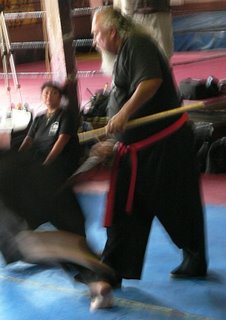
Students with blades
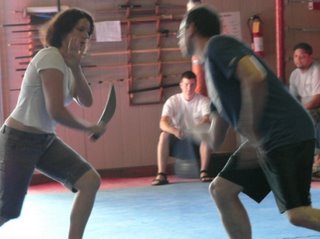

Sonny's youngest student

Joe Olivarez

Sonny and Joe with staffs ...
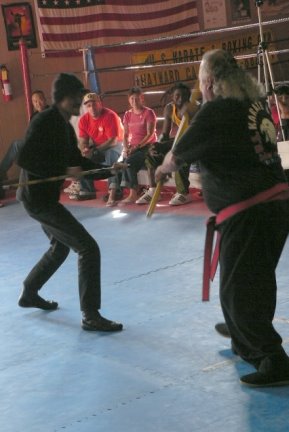
... and with knives
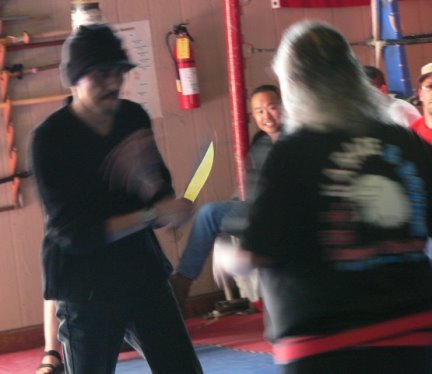
Joe introduces a student to the ground
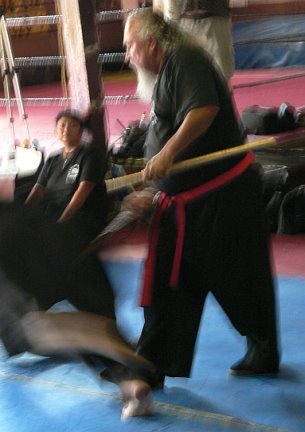
Students with blades

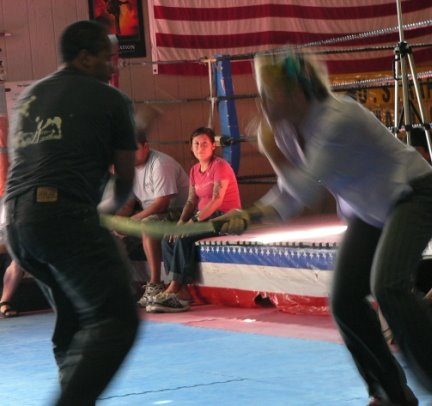
Sonny's youngest student

Sunday, June 25, 2006
Sonny's birthday promotion ceremony
Yesterday there was an event for Sonny Umpad at US Karate in Hayward, owned by Joe Olivarez, one of his longtime students and associates. This was both a certification ceremony for some of Sonny’s students in his Visayan Corto Cadena system, and also a 58th birthday party for him. As those of you who read here know, Sonny is dealing with cancer, and this was an opportunity to present some of the legacy of his style.
The list of guests in attendance was a tribute to Sonny’s presence in the martial arts community, with strong representations in particular from Kajukenbo, Jun Fan/JKD, Small Circle Jujitsu and FMA affiliations. A few of those present included grandmaster Felix Macias Sr., Gary Cagaanan, Greglon Lee, Greg Lagera, Robert Hodge, Wade Williams, Carlito Bonjoc, Ben Pagtanac, hosts Joe Olivarez and Crystal Suan-Olivarez, noted author Sid Campbell, and many others whom I’ve missed (my apologies!)
Things began with a short form by his youngest pupil. Next some of his students took turns in pairs, sparring with either barongs or sticks and demonstrating the flowing footwork that is a trademark of Sonny’s system. This was highlighted by a similar demonstration by Sonny Umpad and Joe Olivarez.
After the demos, students received certificates of rank denoting proficiency in his system. This was followed by an excellent buffet and chance for everyone to socialize. This is a region rich in martial arts heritage, with many practitioners from the 1960’s and 70’s, whose roots go back to the founding legends of martial arts in this country. It’s always an honor and a privilege to be around people like this.
Ours is a culture that places so much premium on newness and youth, but the martial arts continue to be a place where experience is a valued asset. An important part of this is the sense of community and brotherhood that is bonded over time through common interests and shared histories. Many who are new in martial arts see only the technical side, but it is in the cultivation of spirit that the art transforms its practitioners, deepening them as humans. We get to see not just how the man does the art, but how the art has grown the man.
Yip Man talked to his students about the “kung-fu life,” bringing them along to the teahouses to meet his contemporaries. To some this might be boring, hearing old men talk, but often in these exchanges are nuggets of wisdom to be learned. Knowing the history of the arts, how they evolved though various practitioners, creates roots by giving depth to what seems new and unique to each individual who comes to this path. It is those who stay and listen who grow to carry on the art to the next generation.
Simply being there is an opportunity to experience and learn. Once those moments are gone, they become a part of history, a bond for those who were there and something that can never be as complete an experience for those who were not. To those who make the martial arts a part of their life, the meaning of such connections becomes clearer with time. We are not alone in our learning; we do not progress solely on our own. As Silat teacher Roberto Torres used (and perhaps still does) in his online signature, this Sufi saying: “As iron sharpens iron, so man sharpens man.”
The list of guests in attendance was a tribute to Sonny’s presence in the martial arts community, with strong representations in particular from Kajukenbo, Jun Fan/JKD, Small Circle Jujitsu and FMA affiliations. A few of those present included grandmaster Felix Macias Sr., Gary Cagaanan, Greglon Lee, Greg Lagera, Robert Hodge, Wade Williams, Carlito Bonjoc, Ben Pagtanac, hosts Joe Olivarez and Crystal Suan-Olivarez, noted author Sid Campbell, and many others whom I’ve missed (my apologies!)
Things began with a short form by his youngest pupil. Next some of his students took turns in pairs, sparring with either barongs or sticks and demonstrating the flowing footwork that is a trademark of Sonny’s system. This was highlighted by a similar demonstration by Sonny Umpad and Joe Olivarez.
After the demos, students received certificates of rank denoting proficiency in his system. This was followed by an excellent buffet and chance for everyone to socialize. This is a region rich in martial arts heritage, with many practitioners from the 1960’s and 70’s, whose roots go back to the founding legends of martial arts in this country. It’s always an honor and a privilege to be around people like this.
Ours is a culture that places so much premium on newness and youth, but the martial arts continue to be a place where experience is a valued asset. An important part of this is the sense of community and brotherhood that is bonded over time through common interests and shared histories. Many who are new in martial arts see only the technical side, but it is in the cultivation of spirit that the art transforms its practitioners, deepening them as humans. We get to see not just how the man does the art, but how the art has grown the man.
Yip Man talked to his students about the “kung-fu life,” bringing them along to the teahouses to meet his contemporaries. To some this might be boring, hearing old men talk, but often in these exchanges are nuggets of wisdom to be learned. Knowing the history of the arts, how they evolved though various practitioners, creates roots by giving depth to what seems new and unique to each individual who comes to this path. It is those who stay and listen who grow to carry on the art to the next generation.
Simply being there is an opportunity to experience and learn. Once those moments are gone, they become a part of history, a bond for those who were there and something that can never be as complete an experience for those who were not. To those who make the martial arts a part of their life, the meaning of such connections becomes clearer with time. We are not alone in our learning; we do not progress solely on our own. As Silat teacher Roberto Torres used (and perhaps still does) in his online signature, this Sufi saying: “As iron sharpens iron, so man sharpens man.”
Tuesday, June 20, 2006
A similar martial blog
I just added a link to another martial arts blog, Martial Views. I'd like to thank John Vesia for leaving a comment on my previous post, leading me to his site. For those of you who enjoy my writing, you'll find his a similar mix of philosophy, history and practical insight. Enjoy!
Saturday, June 10, 2006
Coining Acronyms
I like making up nicknames and acronyms for my martial art teaching. It’s a fun way to help students remember key concepts, to say nothing of my retentive skills. Here, then, are a few samples. (Feel free to add any of your own in “Comments”)
****************************************************
TAOMA – The Art Of Making Adjustments: This is my overall perspective on martial arts. Regardless of what system, style, strategy or concept to which you may subscribe, good martial artists are usually adaptive. (The corollary to that might be “predictability can get you killed.”).
I’m not the biggest, fastest, tallest, strongest or youngest. I’m a pretty average athlete with some good training. Consequently I value strategy to deal with people who are superior in those attributes. I’m not likely to overpower someone stronger or outrun someone faster; it’s a matter of finding a counter-strategy that negates such advantages, and the key to this is a mind that can adjust quickly.
Combat moves quickly, so this isn’t about deep cogitation on the issues at hand. It’s about having guiding principles to help one stay in focus. One of the core concepts in Serrada is reversal. When you encounter resistance, flow around it rather than oppose it. This is consistent with my Tai Chi training too. The mind can only do one thing at a time, a precept of “chi follows yi” (energy follows the mind), so if an opponent is strong in one direction, he must be ignoring (and therefore weaker) in another. Thus, “go where he ain’t.” That keeps you from getting stuck attempting to force an ineffective technique and forces your opponent to deal with the changes you instigate.
I particularly apply this concept when working with joint locks or pressure points. For most of us, these don’t always work reliably. For instance, pressure points are what I call “80%” techniques. They may work 80% of the time, but 10% of people you try them on might feel these and resist the pain, and 10% won’t feel or respond at all. What are the odds your neighborhood psycho or druggie will be in that 20% range? If something isn’t working, move on to something else.
SIFNIS – Somewhere In Front, Nowhere In Sight: It’s a corollary to HIPS (Hidden In Plain Sight, which is like looking for the car keys that are right out on the countertop) but a bit more focused. SIFNIS means you can be looking in the appropriate direction but you still cannot spot what you seek.
In Escrima, you may know what strike is coming, but you will generally learn more from watching the body than the stick, since the latter can move too quickly to see. We know where it is, but by the time we see it has moved, the stick already can be somewhere else. Counters are really based on educated guesses, schemas (mental constructs) that anticipate reality. The advantage is a good schema can bias the odds in your favor. The disadvantage can be a time lag in adjusting when reality differs from assumptions.
Ultimately, of course, we’d like to match perception and reality so that we flow responsively. This is the goal of Zen, to empty the mind and just be present in the moment. This is how animals seem to experience life, being fully engaged through their senses in the Now. Chinese martial arts talk of “animal flavor” as a high form of expression. Learning to embody an animal style is really a metaphor for learning to immerse oneself fully in the experience of doing, so that it become integrated with the complete expression of who you are. Sense of separation of Self from the moment disappears.
Being self-realized isn’t about emulating anything; it is about allowing one’s inner potential or Spirit to become the guiding force for one’s actions. There is a sense of joyous freedom when that takes over. People often describe the experience in wonder, as though being a spectator to their own actions, which transcend usual boundaries or self-perceived limitations.
This is also the essence of TAOMA. To make adjustments in the moment is to become free of limitation and to experience that flow of energy. The Tao is the creative source of energy, the “mother” (ma) to the world of existence and karma. In Chinese “ma” also means “horse”, and so we ride the wave of energy, feeling ourselves a part of it. In some African and Caribbean based religions, those who invoke ecstatic rapture are described as the “horse” who is mounted by Spirit. Whether one drops into unconscious trance or is elevated to heightened sense of awareness (hyperempiria), there is an opening to a greater sense of connection than our everyday egoic separation and isolation from the world around us.
****************************************************
TAOMA – The Art Of Making Adjustments: This is my overall perspective on martial arts. Regardless of what system, style, strategy or concept to which you may subscribe, good martial artists are usually adaptive. (The corollary to that might be “predictability can get you killed.”).
I’m not the biggest, fastest, tallest, strongest or youngest. I’m a pretty average athlete with some good training. Consequently I value strategy to deal with people who are superior in those attributes. I’m not likely to overpower someone stronger or outrun someone faster; it’s a matter of finding a counter-strategy that negates such advantages, and the key to this is a mind that can adjust quickly.
Combat moves quickly, so this isn’t about deep cogitation on the issues at hand. It’s about having guiding principles to help one stay in focus. One of the core concepts in Serrada is reversal. When you encounter resistance, flow around it rather than oppose it. This is consistent with my Tai Chi training too. The mind can only do one thing at a time, a precept of “chi follows yi” (energy follows the mind), so if an opponent is strong in one direction, he must be ignoring (and therefore weaker) in another. Thus, “go where he ain’t.” That keeps you from getting stuck attempting to force an ineffective technique and forces your opponent to deal with the changes you instigate.
I particularly apply this concept when working with joint locks or pressure points. For most of us, these don’t always work reliably. For instance, pressure points are what I call “80%” techniques. They may work 80% of the time, but 10% of people you try them on might feel these and resist the pain, and 10% won’t feel or respond at all. What are the odds your neighborhood psycho or druggie will be in that 20% range? If something isn’t working, move on to something else.
SIFNIS – Somewhere In Front, Nowhere In Sight: It’s a corollary to HIPS (Hidden In Plain Sight, which is like looking for the car keys that are right out on the countertop) but a bit more focused. SIFNIS means you can be looking in the appropriate direction but you still cannot spot what you seek.
In Escrima, you may know what strike is coming, but you will generally learn more from watching the body than the stick, since the latter can move too quickly to see. We know where it is, but by the time we see it has moved, the stick already can be somewhere else. Counters are really based on educated guesses, schemas (mental constructs) that anticipate reality. The advantage is a good schema can bias the odds in your favor. The disadvantage can be a time lag in adjusting when reality differs from assumptions.
Ultimately, of course, we’d like to match perception and reality so that we flow responsively. This is the goal of Zen, to empty the mind and just be present in the moment. This is how animals seem to experience life, being fully engaged through their senses in the Now. Chinese martial arts talk of “animal flavor” as a high form of expression. Learning to embody an animal style is really a metaphor for learning to immerse oneself fully in the experience of doing, so that it become integrated with the complete expression of who you are. Sense of separation of Self from the moment disappears.
Being self-realized isn’t about emulating anything; it is about allowing one’s inner potential or Spirit to become the guiding force for one’s actions. There is a sense of joyous freedom when that takes over. People often describe the experience in wonder, as though being a spectator to their own actions, which transcend usual boundaries or self-perceived limitations.
This is also the essence of TAOMA. To make adjustments in the moment is to become free of limitation and to experience that flow of energy. The Tao is the creative source of energy, the “mother” (ma) to the world of existence and karma. In Chinese “ma” also means “horse”, and so we ride the wave of energy, feeling ourselves a part of it. In some African and Caribbean based religions, those who invoke ecstatic rapture are described as the “horse” who is mounted by Spirit. Whether one drops into unconscious trance or is elevated to heightened sense of awareness (hyperempiria), there is an opening to a greater sense of connection than our everyday egoic separation and isolation from the world around us.
Tuesday, June 06, 2006
PayPal, Politics and Martial Arts
Recently PayPal decided that my products for Filipino martial arts training are illicit. Or not. Only PayPal can determine what their policy means, and they aren't explaining.
My first inkling thatPayPal had an issue with the kind of training products I've sold through my website for years came recently in an email at 1am. It kindly noted that my account was being "limited" for violation of the "accepted use policies" (AUP) regarding firearms, blades and batons.
"Limitation" is Paypal's euphemism for freezing an account. I could not conduct any transactions whatsoever, including withdrawing funds that I had allowed to accumulate there. Since my business selling sticks involves buying industrial supplies to make sticks, freezing my account in effect meant I could not pay for supplies ordered until this was resolved.
Paypal's process is simple. You are directed to a webpage that basically says you have to comply with all their policies, and there is a box to click to say you are now in compliance. There is no room to discuss or dispute their opinion. It's their way or the highway.
Since the section of their "accepted use policy" is so vague and all-encompassing, it effectively meant that everything I sell, from Escrima sticks to pocket knives and tabaks, are illicit if they say so.
In order to comply with their definitions and restrictions, I was instructed to remove all references to Paypal from my website. I then posted a notice there for customers that I was no longer able to take payments through this service.
This satisfied Paypal and they unfroze (er, "unlimited") my account, saying I was now in compliance and free to use Paypal. In other words, I could use them if I didn't use them, but if I use them, then I cannot use them. Go figure.
At that point I wrote to them, pointing out that 1) I do not, and never have, sold firearms or firearms related materials; 2) I do not, and never have, sold switchblade knives; and 3) that Escrima sticks are sold commonly on the internet including through Paypal and Ebay.
This led to an interesting correspondence. I got one email stating that "Escrima sticks are exempt" followed by several others saying I was clearly in violation of their policies, specifically: "Your website has throwing knives, batons and switchblade knives available for sale. It is against PayPal's Acceptable Use Policy to accept payments for such items via the PayPal payment platform."
Now my website clearly and explicitly says "Escrima sticks" and points out that these are for "training purposes only" in the Filipino martial arts. Nowhere on my website does it say "baton", and my sticks do not meet the specifications for police or security batons, at least according to California codes. When I wrote to point this out, I got back emails directing me, once again, to the "accepted use policy" on firearms, switchblades and batons (the AUP says vendors must meet laws "everywhere").
At this point they also began mentioning that I sell switchblades (I emphatically do not!) and throwing knives (I advertise some but have never sold any), and throwing knives are not even mentioned in their AUP! If they had an issue with any particular product listed on my site, they could have just contacted me to inform me of this. Instead it's a heavy-handed approach of economic sanctions and control.
When I pointed out that Ebay allows sale of Escrima sticks and throwing knives, the reply was that Ebay has its own rules, and (once again) I'm selling batons! I then wrote to say that whether or not Ebay has its own policy, vendors were using Paypal "buy now" buttons and other Paypal tools to sell these goods. I included links to pages showing 38 auctions for Escrima sticks and 143 auctions for throwing knives, all using Paypal. The response to that was if I had a complaint against another vendor, I should forward their website link to Paypal. In other words, they weren't going to investigate themselves, in effect making me responsible for them to enforce their own policies.
I'm not their employee, nor am I interested in doing their work for them or causing problems for other sellers. My final point to them was that their policy is completely arbitrary and discriminatory. It is also clear, from the tone of various emails received over a day or so, that I was dealing with multiple people at Paypal. However, they never identify themselves so there is no accountability or any means of following up with someone already familiar with my case or complaint, or to ask for a supervisory opinion. If you look at their website, there is no phone number to call. Paypal is as anonymous as they come.
The best part is, by defining themselves as a "transaction facilitator" they avoid banking regulations, even though they take credit cards and pay interest on balances. Somehow they have positioned themselves outside laws of fiduciary responsibility. I've heard horror stories of Paypal freezing accounts for months with no recourse; I was lucky to get my money out as quickly as I did. Do I trust them to do business at this point? No, and until they can give me assurances that I am cleared to do business, I will not use them again.
Now how much of this ties into Homeland Security, and how much is it about the stranglehold of insurance company liability policies on activities in this country? The national anthem says we are the "land of the free and home of the brave" but we are increasingly swaddled in regulations that restrict our actions "for our own good."
A recent article on Wired.com talks of the police raid and legal tribulations of a couple running a respected online chemistry supply company, one which actually has Homeland Security as a client! Common supplies that can be gleaned from other products are now forbidden under the pretext of clamping down on illegal fireworks and methamphetamine manufacturing, and the article points out how insurance and legal constraints are barring students in schools from conducting the kind of experiments that were commonplace in high schools two decades ago.
Another article in the SF Chronicle described how a high school physics teacher in Mill Valley is in trouble for a demonstration he's done, with administration approval, for the past 15 years, because it "could traumatize the children". According to the article in Wired, the U.S. has slipped in the last 30 years worldwide in number of engineering and science degrees issued from #3 to #17 currently. We're intentionally dumbing down our educational system in the name of safety and security.
Now in my opinion all this is a smokescreen. Insurance liability and security concerns are excuses. PayPal can banish a small business like mine from using their services (and I'm not alone) but the fact that they allow free access to Ebay vendors tells me that, as usual, money is the bottom line. Sellers on Ebay give a cut to the site to list there, and Paypal takes a percentage of any transaction that goes through them. In other words, it's a double-dip. It seems probable to me that this is a way to limit outside vendors like myself, driving more business through their process to maximize profit. It's the American Way.
Am I cynical? Sure. I can find a work-around by getting a credit card account, but that is much more expensive. For business on the tiny scale I operate, it's probably worth the risk, but a handicap nonetheless. In the end, I simply feel like another piece of entrepreneurial roadkill on the highway of corporate greed.
My first inkling thatPayPal had an issue with the kind of training products I've sold through my website for years came recently in an email at 1am. It kindly noted that my account was being "limited" for violation of the "accepted use policies" (AUP) regarding firearms, blades and batons.
"Limitation" is Paypal's euphemism for freezing an account. I could not conduct any transactions whatsoever, including withdrawing funds that I had allowed to accumulate there. Since my business selling sticks involves buying industrial supplies to make sticks, freezing my account in effect meant I could not pay for supplies ordered until this was resolved.
Paypal's process is simple. You are directed to a webpage that basically says you have to comply with all their policies, and there is a box to click to say you are now in compliance. There is no room to discuss or dispute their opinion. It's their way or the highway.
Since the section of their "accepted use policy" is so vague and all-encompassing, it effectively meant that everything I sell, from Escrima sticks to pocket knives and tabaks, are illicit if they say so.
In order to comply with their definitions and restrictions, I was instructed to remove all references to Paypal from my website. I then posted a notice there for customers that I was no longer able to take payments through this service.
This satisfied Paypal and they unfroze (er, "unlimited") my account, saying I was now in compliance and free to use Paypal. In other words, I could use them if I didn't use them, but if I use them, then I cannot use them. Go figure.
At that point I wrote to them, pointing out that 1) I do not, and never have, sold firearms or firearms related materials; 2) I do not, and never have, sold switchblade knives; and 3) that Escrima sticks are sold commonly on the internet including through Paypal and Ebay.
This led to an interesting correspondence. I got one email stating that "Escrima sticks are exempt" followed by several others saying I was clearly in violation of their policies, specifically: "Your website has throwing knives, batons and switchblade knives available for sale. It is against PayPal's Acceptable Use Policy to accept payments for such items via the PayPal payment platform."
Now my website clearly and explicitly says "Escrima sticks" and points out that these are for "training purposes only" in the Filipino martial arts. Nowhere on my website does it say "baton", and my sticks do not meet the specifications for police or security batons, at least according to California codes. When I wrote to point this out, I got back emails directing me, once again, to the "accepted use policy" on firearms, switchblades and batons (the AUP says vendors must meet laws "everywhere").
At this point they also began mentioning that I sell switchblades (I emphatically do not!) and throwing knives (I advertise some but have never sold any), and throwing knives are not even mentioned in their AUP! If they had an issue with any particular product listed on my site, they could have just contacted me to inform me of this. Instead it's a heavy-handed approach of economic sanctions and control.
When I pointed out that Ebay allows sale of Escrima sticks and throwing knives, the reply was that Ebay has its own rules, and (once again) I'm selling batons! I then wrote to say that whether or not Ebay has its own policy, vendors were using Paypal "buy now" buttons and other Paypal tools to sell these goods. I included links to pages showing 38 auctions for Escrima sticks and 143 auctions for throwing knives, all using Paypal. The response to that was if I had a complaint against another vendor, I should forward their website link to Paypal. In other words, they weren't going to investigate themselves, in effect making me responsible for them to enforce their own policies.
I'm not their employee, nor am I interested in doing their work for them or causing problems for other sellers. My final point to them was that their policy is completely arbitrary and discriminatory. It is also clear, from the tone of various emails received over a day or so, that I was dealing with multiple people at Paypal. However, they never identify themselves so there is no accountability or any means of following up with someone already familiar with my case or complaint, or to ask for a supervisory opinion. If you look at their website, there is no phone number to call. Paypal is as anonymous as they come.
The best part is, by defining themselves as a "transaction facilitator" they avoid banking regulations, even though they take credit cards and pay interest on balances. Somehow they have positioned themselves outside laws of fiduciary responsibility. I've heard horror stories of Paypal freezing accounts for months with no recourse; I was lucky to get my money out as quickly as I did. Do I trust them to do business at this point? No, and until they can give me assurances that I am cleared to do business, I will not use them again.
Now how much of this ties into Homeland Security, and how much is it about the stranglehold of insurance company liability policies on activities in this country? The national anthem says we are the "land of the free and home of the brave" but we are increasingly swaddled in regulations that restrict our actions "for our own good."
A recent article on Wired.com talks of the police raid and legal tribulations of a couple running a respected online chemistry supply company, one which actually has Homeland Security as a client! Common supplies that can be gleaned from other products are now forbidden under the pretext of clamping down on illegal fireworks and methamphetamine manufacturing, and the article points out how insurance and legal constraints are barring students in schools from conducting the kind of experiments that were commonplace in high schools two decades ago.
Another article in the SF Chronicle described how a high school physics teacher in Mill Valley is in trouble for a demonstration he's done, with administration approval, for the past 15 years, because it "could traumatize the children". According to the article in Wired, the U.S. has slipped in the last 30 years worldwide in number of engineering and science degrees issued from #3 to #17 currently. We're intentionally dumbing down our educational system in the name of safety and security.
Now in my opinion all this is a smokescreen. Insurance liability and security concerns are excuses. PayPal can banish a small business like mine from using their services (and I'm not alone) but the fact that they allow free access to Ebay vendors tells me that, as usual, money is the bottom line. Sellers on Ebay give a cut to the site to list there, and Paypal takes a percentage of any transaction that goes through them. In other words, it's a double-dip. It seems probable to me that this is a way to limit outside vendors like myself, driving more business through their process to maximize profit. It's the American Way.
Am I cynical? Sure. I can find a work-around by getting a credit card account, but that is much more expensive. For business on the tiny scale I operate, it's probably worth the risk, but a handicap nonetheless. In the end, I simply feel like another piece of entrepreneurial roadkill on the highway of corporate greed.
Monday, June 05, 2006
Seminar with Guro Carlito Bonjoc Jr.
Bee Safe Martial Arts Presents:
A Seminar with Guro Carlito Bonjoc Jr.
(click link for full PDF flier for this event).
Guro Carlito Bonjoc Jr. is considered by many as a leading
authority in the Filipino martial arts. With his easy to follow instruction method you will learn the advanced combative applications of Serrada Escrima.
When: July 15th 2006, from 12 p.m. to 5 p.m.
Location:
BeeSafe Martial Arts
120 Church St.
Roseville, CA 95678
(916) 628-9885 (contact Sensei Bee Landrum to register)
or email BeeSafeMA@yahoo.com
A Seminar with Guro Carlito Bonjoc Jr.
(click link for full PDF flier for this event).
Guro Carlito Bonjoc Jr. is considered by many as a leading
authority in the Filipino martial arts. With his easy to follow instruction method you will learn the advanced combative applications of Serrada Escrima.
When: July 15th 2006, from 12 p.m. to 5 p.m.
Location:
BeeSafe Martial Arts
120 Church St.
Roseville, CA 95678
(916) 628-9885 (contact Sensei Bee Landrum to register)
or email BeeSafeMA@yahoo.com
Subscribe to:
Posts (Atom)