June really kicked off in the San Francisco Bay Area with successive weekends featuring FMA grandmasters doing seminars. The weekend of June 7 saw a gathering of talent at Eddie Solis’ school in Richmond, hosted by Modern Arnis GM Remy Presas Jr. Also on the bill were Max Pallen, Alfredo Bandalan and Vincent Cabales. I dropped by on Saturday morning to pay my respects and say hello to old acquaintances, but due to a scheduling conflict had to leave around noon, during which time I only was able to observe Max Pallen on the floor. This was billed as a two-day seminar, so I went back the next day only to find the place was closed and empty. I’d suspected this might happen, as that was a lot of high-powered talent to assemble in one place for a small event and several had to travel quite a distance to attend. Still, it was unfortunate, and there was no sign or notice posted to explain why. I doubt I was the only one caught off-guard as I’ve heard from one or two others that they’d planned to make it to the second day.
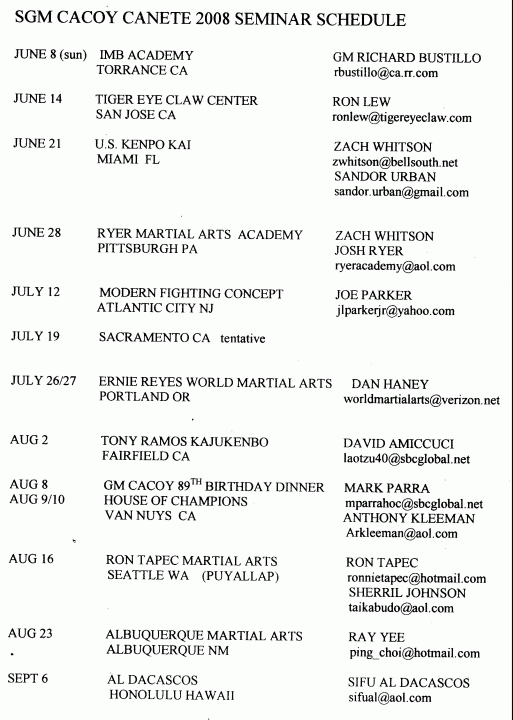
Yesterday was a seminar with GM Cacoy Canete at GM Ron Lew’s Tiger Eye Claw School in San Jose, which was well attended by Doce Pares students from several locations. It was amazing to see Cacoy in action again; here’s a guy who will be 89 on August 8 (birthday bash down south in Van Nuys) who is still traveling and teaching actively! The morning session consisted of double stick drills. Cacoy, seated, would show the drill to Ron Lew, who would then repeat the drill with his assistant for the class to follow. This was a fun format, based on adding the number of strikes with each drill. When I got there the class was doing a six-count, then seven, eight, up to 12. The patterns were similar but not exact repeats because they each had to end in the same position.
After the lunch break Cacoy delved more into tactical aspects of his art, explaining the differences between linear and curved strikes and why his style evolved to use more of the latter, as they are harder to block. He demonstrated a simple pattern combining both curved and linear strikes to the opponent’s left and right sides, showing both high and medium height applications. The latter part of his seminar was disarming, and he showed multiple variations using both Ron Lew and GM Anthony Kleeman, who arrived during the lunch break from L.A., as demonstration partners. The crowd got a kick out of seeing the old grandmaster effortlessly applying his techniques to Anthony, who is twice his size!
One of the highlights of this seminar took place in the overflow room, as the more experienced attendees filtered in to watch Ron Lew demonstrate joint-lock flow with sticks with some of his senior students and associates. Ron is amazingly adept at this form of hubad-lubod, defined in “Cebuano Eskrima: Beyond the Myth” (pg. 53) as “a manual interactive drill in eskrima where two training partners practice trapping and freeing from traps or any routine manual drill.” The speed at which Ron and his partners work is phenomenal, looking more like empty hand Wing Chun chi sao than typical impact-based stick fighting. Their skill is based on the ability to sense and reverse out of traps, often changing grips to exert maximum leverage resulting in throws.
Ron slowed down the action so everyone could see how this was performed, explaining his principle of finding nodes of contact. Every lock is based on the pressure that can be applied at such points, and the more nodes in a lock, the more potential to exploit leverage. For instance, a simple arm-bar might have three points: a wristlock, the stick across the opponent’s arm, and the tip locked against the chest. A more complex figure-4 armlock with a stick might have five or six points, such as: the hand holding the opponent’s wrist; the arm under the opponent’s tricep and the forearm against opponent’s forearm; the punyo (butt) of the stick locking in the opponent’s wrist; the end of the stick across the neck or under the jaw; and perhaps (though not necessary) a foot trap or leg immobilization.
Ron explained that this is learned by going slowly to be able to analyze what is happening at each point of the interaction, allowing both practitioners to see not only the advantage of each position but also the ways these can be reversed and countered. This is similar to how my old Tai Chi teacher, John Wong, would teach interactive technique. It is a common error for people to want to go too fast too quickly, which may allow them to overpower their training partner, but the key to developing skill is in deeper understanding, and that means taking time to see and feel things that are missed at higher speeds.
Yesterday was a seminar with GM Cacoy Canete at GM Ron Lew’s Tiger Eye Claw School in San Jose, which was well attended by Doce Pares students from several locations. It was amazing to see Cacoy in action again; here’s a guy who will be 89 on August 8 (birthday bash down south in Van Nuys) who is still traveling and teaching actively! The morning session consisted of double stick drills. Cacoy, seated, would show the drill to Ron Lew, who would then repeat the drill with his assistant for the class to follow. This was a fun format, based on adding the number of strikes with each drill. When I got there the class was doing a six-count, then seven, eight, up to 12. The patterns were similar but not exact repeats because they each had to end in the same position.
After the lunch break Cacoy delved more into tactical aspects of his art, explaining the differences between linear and curved strikes and why his style evolved to use more of the latter, as they are harder to block. He demonstrated a simple pattern combining both curved and linear strikes to the opponent’s left and right sides, showing both high and medium height applications. The latter part of his seminar was disarming, and he showed multiple variations using both Ron Lew and GM Anthony Kleeman, who arrived during the lunch break from L.A., as demonstration partners. The crowd got a kick out of seeing the old grandmaster effortlessly applying his techniques to Anthony, who is twice his size!
One of the highlights of this seminar took place in the overflow room, as the more experienced attendees filtered in to watch Ron Lew demonstrate joint-lock flow with sticks with some of his senior students and associates. Ron is amazingly adept at this form of hubad-lubod, defined in “Cebuano Eskrima: Beyond the Myth” (pg. 53) as “a manual interactive drill in eskrima where two training partners practice trapping and freeing from traps or any routine manual drill.” The speed at which Ron and his partners work is phenomenal, looking more like empty hand Wing Chun chi sao than typical impact-based stick fighting. Their skill is based on the ability to sense and reverse out of traps, often changing grips to exert maximum leverage resulting in throws.
Ron slowed down the action so everyone could see how this was performed, explaining his principle of finding nodes of contact. Every lock is based on the pressure that can be applied at such points, and the more nodes in a lock, the more potential to exploit leverage. For instance, a simple arm-bar might have three points: a wristlock, the stick across the opponent’s arm, and the tip locked against the chest. A more complex figure-4 armlock with a stick might have five or six points, such as: the hand holding the opponent’s wrist; the arm under the opponent’s tricep and the forearm against opponent’s forearm; the punyo (butt) of the stick locking in the opponent’s wrist; the end of the stick across the neck or under the jaw; and perhaps (though not necessary) a foot trap or leg immobilization.
Ron explained that this is learned by going slowly to be able to analyze what is happening at each point of the interaction, allowing both practitioners to see not only the advantage of each position but also the ways these can be reversed and countered. This is similar to how my old Tai Chi teacher, John Wong, would teach interactive technique. It is a common error for people to want to go too fast too quickly, which may allow them to overpower their training partner, but the key to developing skill is in deeper understanding, and that means taking time to see and feel things that are missed at higher speeds.

 Cacoy Canete demonstrating disarms on Anthony Kleeman