About a year ago I started noticing the number eleven. This was around the time my brother announced he had cancer. The first time or two the number came up in consciousness I just marked it as coincidence; random association.
When it kept happening, though, elevens became synchronistic, seemingly unrelated events that are somehow connected. I began to make note of each occurrence, and just by the act of so doing they became more significant.
Whether or not this means anything to the universe, it takes on meaning through the subjective value we associate with it. This is the nature of symbols, which have to be interpreted according to our individual awareness. If we ignore things, there are no messages. What messages exist, well up from within our own unconscious mind. Just that fact alone creates context, allowing us to gain deeper insight into our nature and our circumstances.
Most of the elevens I saw were on clocks. It always seemed to be eleven minutes after the hour. That, to me, was more portentous than if I were merely seeing the number fixed somewhere. This was my internal clock driving me to look at the time eleven minutes after each hour, and too consistently to be mere coincidence. So what did it mean to me?
Well, eleven is right before twelve, which is the end of each hour. The “Atomic Watch” by concerned scientists often shows the time as five minutes (or less) before midnight, and so pointing towards the “11”.
In terms of minutes, it’s an odd marker. Ten minutes is a common theme but eleven doesn’t fit. It’s the number after, and so for me it came to represent the meaning that “it’s later than you think.”
Eleven is a double digit, which is a doubled digit: 11. It is like two individuals standing together; relationship.
Eleven also has a space between the digits, so the number actually consists of three elements; triad of mind, body and spirit. The spirit is largely invisible to us. Our nature as humans is also that we can make choices, and so we stand in the middle between the yin and yang of that nature.
When I think on the nature of this, it makes me realize the preciousness of time. What have I done that I wanted to do? What is still left to do? Too many people say “someday” and that day never comes.
I thought elevens would fade away after my brother died, but they kept coming up. Today I called my kid and left a message; the time of the call was 1:11. I then walked into another room and checked the time; 4:11. I guess I keep reminding myself to live each moment in this way, and so recently I accepted a new challenge.
Two years ago I started learning flamenco guitar. It’s about as huge a challenge on that instrument as there is, and I’m not very good at it yet. Anyway, my teacher contacted me two weeks ago and asked if I wanted to do a piece in a recital. At first I said no (very firmly). I hadn’t gone to a lesson since December and I’d had my hands injured in February, so I hadn’t played in nearly two months. It’s been 25 years since I was on stage, and that was with a punk-funk band.
Then I thought about it. How many chances to do I get to step out of my comfort zone in a meaningful way? To go sit onstage alone is a test of inner resources.
My hands were stiff when I started practicing. That passed, but now my fingers are swollen and sore, limiting how much more I can work. I know the piece, but I can use more practice than the pain will allow. Technical errors creep in, but the reason they do is mental inconsistency, not playing the whole piece with full attention to the music section by section, second by second. I know the piece at my simple level of performance, but maintaining conscious focus on each note is the tricky part. When my mind lingers anywhere, the next bit loses coherence. It’s all about the music and staying in the flow; I don’t have the luxury to think of anything else.
This is exactly the kind of thing I talk about in martial arts. It is that Zen awareness in the moment, the ability to focus intently without wavering. Playing music solo is very revealing; there is no place to hide, and whatever happens is all your doing, and so I practice, I run through the music in my head, and I visualize the entire experience from walking on stage until I leave, hearing it run as perfectly as possible. This is a use of self-programming or self-hypnosis. I’m also using some performance-enhancing tapes to help prepare myself.
In a way this is scarier than when I prepared to go to the Philippines to fight in ’89 because it seemed easier not to have expectations in that bigger event. In another way, however, this is very similar. I’m not testing myself because I know I can do this. Quite the opposite, I’m doing it because I don’t know the outcome. That is the nature of a test; one is questioned and whatever happens, good or bad, is the answer. In that regard it helps to look at this not as a destination but just a point in time. Whether I ever perform like this again or not, this is nothing more than a sign, a place along the road to help refine goals.
Thursday, April 20, 2006


Thursday, April 13, 2006
Tempus Rerum Imperator
“Time commands all things.” And so it is that a few hours ago I had to say a final farewell to one of the best companions I’ve ever known.
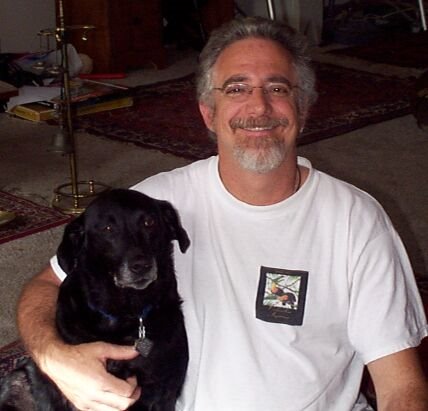
Pepper was my old Labrador, and the dog whose life I saved just over 2 months ago when she was choking. We cheated the grim reaper a couple of times, she and I, but I’d known for some time that this day was coming.
She was full of life and love right to the end. Our last 24 hours together were as good as could be, a beautiful farewell, but her belly, increasingly distended from disease, was clearly causing her pain. At 15, I couldn’t see putting her through the kind of intrusive medical interventions that, in the end, would probably have done little to prolong her life. At some point quality of life is more important than merely marking time, and she deserved to go peacefully and with dignity.
This was one of the hardest decisions I’ve had to make. Sometimes the right thing just feels like crap, but we all knew it was time. She told me in many ways over the past several weeks that she was ready to let go, and all of us close to her were in agreement.
In the end, a prick of the needle, and in seconds she was gone ….
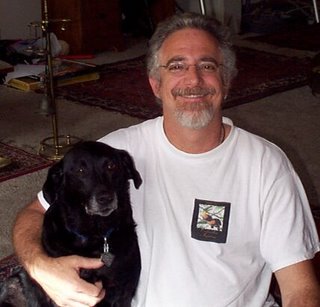
Pepper was my old Labrador, and the dog whose life I saved just over 2 months ago when she was choking. We cheated the grim reaper a couple of times, she and I, but I’d known for some time that this day was coming.
She was full of life and love right to the end. Our last 24 hours together were as good as could be, a beautiful farewell, but her belly, increasingly distended from disease, was clearly causing her pain. At 15, I couldn’t see putting her through the kind of intrusive medical interventions that, in the end, would probably have done little to prolong her life. At some point quality of life is more important than merely marking time, and she deserved to go peacefully and with dignity.
This was one of the hardest decisions I’ve had to make. Sometimes the right thing just feels like crap, but we all knew it was time. She told me in many ways over the past several weeks that she was ready to let go, and all of us close to her were in agreement.
In the end, a prick of the needle, and in seconds she was gone ….
Monday, April 10, 2006
#1 – The Mother of All Angles
One of the things that attracted me to Escrima is the use of angles as a template for grouping attacks and various defenses against them. To me this seemed more scientific than randomly grouping techniques according to subjective criteria such as testing material for belt promotions.
There are many schemes for numbering these angles, but almost all weapon-based FMA systems share a similar #1 angle, the high right forehand. It is the most primal strike for most humans, utilizing lots of big muscles and gravity. The Dog Brothers refer to it as "the Caveman". By prioritizing it as the threat most likely to be encountered, a substantial proportion of one’s self-defense capabilities are instilled very quickly.
I think a lot of students overlook the value of that first angle. To many, it seems as though it is just a first baby step towards the real goal of learning higher, more “advanced” angles. In reality those are less common, and perhaps the sign of a more sophisticated attack. Duels between equals is rare; self-defense tends towards more basic and uneven scenarios.
I've seen students who excel at later angles because their skill was better when they got there, yet the basic angles that laid the foundation have not been polished to at least an equivalent level. In fact, one should excel at the basics because they have been practiced the longest and most often, a part of every session. One needs to be mindful not to look past these as merely warm-ups for the "good stuff". That is a waste of valuable learning opportunity. "A rising tide lifts all boats," and so skill should be applicable across the board.
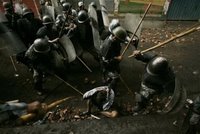
Study pictures of riots whenever they are in the news, and what one sees is the same thing repeatedly - the #1 strike - whether by trained personnel or civilians. These are from today's news.
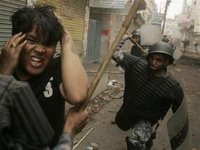
AP photo, 4/10/2006 - A policeman using a #1 strike on a protestor in Nepal.
Even as early as the second angle, systems diverge in priority. For many it is a high right backhand strike, forming the other half of a downward figure-8 with the first strike. Others might emphasize a low horizontal forehand strike. The choice of weapon might dictate which is preferred. A horizontal forehand might be more natural with a long swinging weapon like a baseball bat or the rattan staffs of these Nepalese police, than using a high backhand as with a shorter club.
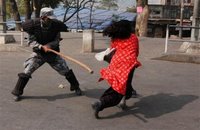
Another AP photo in the news today. Interesting shin guards.
Another reason the horizontal forehand (#3 in Serrada) might be common in police tactics is if a shield is used. Depending on equipment, that might tactically limit or even interfere somewhat with cross-body backhand strikes. Also, this group is so close together, only vertical strikes can be used without hitting their own people.
Know how to defend a few angles well and you are covered for most contingencies. As Angel Cabales used to say, the advanced angles are more for recognizing an unusual attack and using what you already know. The basic skill set will still be effective if you've learned it well. The training for those angles refines those skills, more than being anything completely new and different.
There are many schemes for numbering these angles, but almost all weapon-based FMA systems share a similar #1 angle, the high right forehand. It is the most primal strike for most humans, utilizing lots of big muscles and gravity. The Dog Brothers refer to it as "the Caveman". By prioritizing it as the threat most likely to be encountered, a substantial proportion of one’s self-defense capabilities are instilled very quickly.
I think a lot of students overlook the value of that first angle. To many, it seems as though it is just a first baby step towards the real goal of learning higher, more “advanced” angles. In reality those are less common, and perhaps the sign of a more sophisticated attack. Duels between equals is rare; self-defense tends towards more basic and uneven scenarios.
I've seen students who excel at later angles because their skill was better when they got there, yet the basic angles that laid the foundation have not been polished to at least an equivalent level. In fact, one should excel at the basics because they have been practiced the longest and most often, a part of every session. One needs to be mindful not to look past these as merely warm-ups for the "good stuff". That is a waste of valuable learning opportunity. "A rising tide lifts all boats," and so skill should be applicable across the board.
Study pictures of riots whenever they are in the news, and what one sees is the same thing repeatedly - the #1 strike - whether by trained personnel or civilians. These are from today's news.
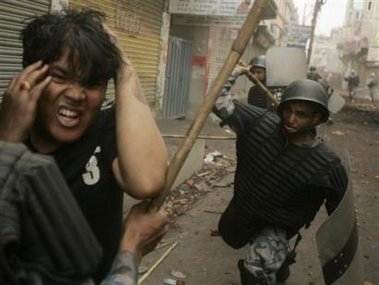
AP photo, 4/10/2006 - A policeman using a #1 strike on a protestor in Nepal.
Even as early as the second angle, systems diverge in priority. For many it is a high right backhand strike, forming the other half of a downward figure-8 with the first strike. Others might emphasize a low horizontal forehand strike. The choice of weapon might dictate which is preferred. A horizontal forehand might be more natural with a long swinging weapon like a baseball bat or the rattan staffs of these Nepalese police, than using a high backhand as with a shorter club.
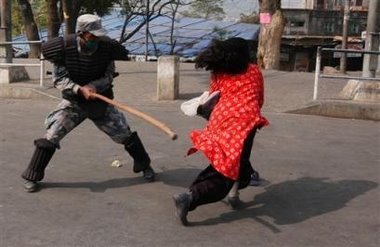
Another AP photo in the news today. Interesting shin guards.
Another reason the horizontal forehand (#3 in Serrada) might be common in police tactics is if a shield is used. Depending on equipment, that might tactically limit or even interfere somewhat with cross-body backhand strikes. Also, this group is so close together, only vertical strikes can be used without hitting their own people.
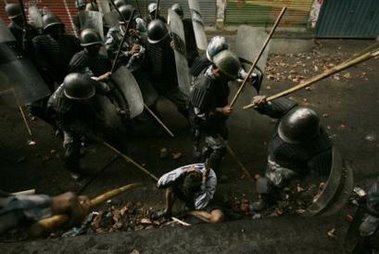
Know how to defend a few angles well and you are covered for most contingencies. As Angel Cabales used to say, the advanced angles are more for recognizing an unusual attack and using what you already know. The basic skill set will still be effective if you've learned it well. The training for those angles refines those skills, more than being anything completely new and different.
Wednesday, April 05, 2006
Higher Awareness
Higher consciousness isn’t just an abstract theory, it’s a part of us, something that we experience from time to time as a little voice of wisdom. Usually it is hidden below our threshold of awareness. Those that are more attuned to it are sometimes labeled either mystics or madmen, though the distinction may say as much about the person making it as the one being judged.
The concept of levels of the mind is nothing new. It exists in most cultures, from ancient times right up into our present one. Whether we give obeisance in a house of worship or through pursuit of the grail of holistic health, the trinity of mind, body and spirit is such an embedded paradigm because it reflects the range of human experience.
Most of us only experience it directly at times of peak experience, which is part of the allure for climbing mountains or running marathons. It is more than endorphins, though that is certainly a manifestation at the physical level. We have bodies, we have minds. What affects one, affects the other. Books have been written about the rhythmic effects of running creating trance-like states similar to shamanic drumming, chanting or meditation.
Most people think of themselves just as their identity, but that is something we create as a way of adapting to experience, and many of those processes are operating on far too subtle levels for our minds to grasp. Freud popularized the notion of the unconscious mind, but perhaps his real innovation was the idea of defense mechanisms, which are often vital coping strategies rather than the pathologies most people imagine them to be. Defenses, however, are not the mind. They are merely edifices erected by the mind as a way of protecting the deeper self.
There’s a lot I could say about the subconscious, especially from a perspective of training the body through programming the mind. I come at it from a more spiritual angle rather than the psychological, but that will be for another blog. I’m diverging from my original intent, which was to tell a story that embodies a higher consciousness experience for me. I’m sure many of you will recognize this for yourselves.
The story itself would be unremarkable except for this element. It happened about twenty years ago, in the bar area of a friend’s restaurant in Berkeley which had some of the best Mexican food in the Bay Area. It was the first place I ever had nachos; this past Christmas as a favor my friend made me some, and I almost weep because his are so good … but again I digress … I met my friend through two different connections. A lot of rock ‘n rollers I knew frequented the restaurant, then later I discovered he had been the California junior grand champion in Kajukenbo as well as a trained gymnast. Eventually we trained at the same Kenpo school, where he was one of the top fighters, second only to the head instructor.
So all this leads me to that day when I went there for a beer and nachos, and my buddy was at the bar with his two brothers and a waitress from a place next door, who used to come by to flirt with him. I remember she was a skinny young gal from Hong Kong who had a brash attitude. For some reason that day she started play fighting with me, which I thought was cool. We were just throwing light finger taps when suddenly for no reason (and I can hear Freud laughing) she dropped low and punched me in the groin as hard as she could.
I remember that I grabbed her and spun her around, pulling her into a bear hug to restrain her, and probably to help hold me up at that moment. I shouted at my friend “What the (expletive deleted) is wrong with her?” She then grabbed my arm and bit it! I pushed her away; she took a step and turned towards me, cocking her hand back in a fist to punch me, and that is when the magic happened.
As soon as I saw her right fist coming forward, my left hand began moving on its own with a jab towards her face. Everything was in slow motion, almost deliberate. Halfway through the punch I was startled when a voice whispered in my left ear: “Don’t hit the glasses!” My hand did a spontaneous loop up and over them, smacking her in the forehead. She staggered back and her friends caught her. That’s when time shifted back to a more normal perspective.
Now I certainly do not advocate hitting women. I dislike violence, and I don’t like the look of fear in someone’s eyes because I’m too empathetic and I feel it too. Nevertheless, there are circumstances where morality dictates action. I’ve hit women three other times. Two times I’ve stopped large women from assaulting a smaller one, and as a ten-year-old kid I was attacked by an adult. All four incidents ended with a single determined action to stop the violence.
Anyway, after this incident I was upset and left. I went back a couple of days later to apologize to everyone and see how she was doing. Apparently she had a headache for three days, and the upshot was we never spoke again. My friend, however, was excited to see me. How, he asked, did I throw that punch?
Now here was a guy who pretty much created his own style of monkey kung fu. He could nail you with a flying kick, roll on landing, then come up into a leap off the wall that would launch him horizontally across the room to punch you on the other side of your head while you were still figuring out where that first kick came from. He was a magician, and he’d been to enough Chinatown cinemas to have seen the best moves of the genre, yet he was asking me, a relative novice, how I’d done something of which I was barely aware.
“What do you mean?” I asked in innocence. According to his observation, the punch flicked out lightning-quick, yet somehow completely changed direction in mid-air. He was amazed anything moving so quick could do that. To me the punch had felt slow, as though time was standing still, and I felt as though I had been more a witness than a participant. I was also quite surprised to hear the effect it had, since it felt no harder than a skin-deep tap. Even the witnesses said it looked like a light pop.
What changed, though, was a complete shift of consciousness. While the play leading up to this had been in a daily mode of awareness, the escalation to violence shifted that paradigm. Training ingrains the subconscious mind with patterns of behavior, but it was a higher level of the psyche that was able to change the flow of time and interject the command to do less harm.
I’ve had this kind of time distortion a few other times, such as during a motorcycle accident where I somehow guided myself to a flat landing rather than into a wall that would have crushed me. I’ve heard that inner voice a few other times too, such as a warning not to buy a particular truck, and I’ve learned that ignoring the advice usually comes at a cost. My old Tai Chi teacher came from a Kahuna family, and he talked a lot about paying attention to these kinds of things. That inner guidance is always there; it is up to us to learn how to hear it.
The concept of levels of the mind is nothing new. It exists in most cultures, from ancient times right up into our present one. Whether we give obeisance in a house of worship or through pursuit of the grail of holistic health, the trinity of mind, body and spirit is such an embedded paradigm because it reflects the range of human experience.
Most of us only experience it directly at times of peak experience, which is part of the allure for climbing mountains or running marathons. It is more than endorphins, though that is certainly a manifestation at the physical level. We have bodies, we have minds. What affects one, affects the other. Books have been written about the rhythmic effects of running creating trance-like states similar to shamanic drumming, chanting or meditation.
Most people think of themselves just as their identity, but that is something we create as a way of adapting to experience, and many of those processes are operating on far too subtle levels for our minds to grasp. Freud popularized the notion of the unconscious mind, but perhaps his real innovation was the idea of defense mechanisms, which are often vital coping strategies rather than the pathologies most people imagine them to be. Defenses, however, are not the mind. They are merely edifices erected by the mind as a way of protecting the deeper self.
There’s a lot I could say about the subconscious, especially from a perspective of training the body through programming the mind. I come at it from a more spiritual angle rather than the psychological, but that will be for another blog. I’m diverging from my original intent, which was to tell a story that embodies a higher consciousness experience for me. I’m sure many of you will recognize this for yourselves.
The story itself would be unremarkable except for this element. It happened about twenty years ago, in the bar area of a friend’s restaurant in Berkeley which had some of the best Mexican food in the Bay Area. It was the first place I ever had nachos; this past Christmas as a favor my friend made me some, and I almost weep because his are so good … but again I digress … I met my friend through two different connections. A lot of rock ‘n rollers I knew frequented the restaurant, then later I discovered he had been the California junior grand champion in Kajukenbo as well as a trained gymnast. Eventually we trained at the same Kenpo school, where he was one of the top fighters, second only to the head instructor.
So all this leads me to that day when I went there for a beer and nachos, and my buddy was at the bar with his two brothers and a waitress from a place next door, who used to come by to flirt with him. I remember she was a skinny young gal from Hong Kong who had a brash attitude. For some reason that day she started play fighting with me, which I thought was cool. We were just throwing light finger taps when suddenly for no reason (and I can hear Freud laughing) she dropped low and punched me in the groin as hard as she could.
I remember that I grabbed her and spun her around, pulling her into a bear hug to restrain her, and probably to help hold me up at that moment. I shouted at my friend “What the (expletive deleted) is wrong with her?” She then grabbed my arm and bit it! I pushed her away; she took a step and turned towards me, cocking her hand back in a fist to punch me, and that is when the magic happened.
As soon as I saw her right fist coming forward, my left hand began moving on its own with a jab towards her face. Everything was in slow motion, almost deliberate. Halfway through the punch I was startled when a voice whispered in my left ear: “Don’t hit the glasses!” My hand did a spontaneous loop up and over them, smacking her in the forehead. She staggered back and her friends caught her. That’s when time shifted back to a more normal perspective.
Now I certainly do not advocate hitting women. I dislike violence, and I don’t like the look of fear in someone’s eyes because I’m too empathetic and I feel it too. Nevertheless, there are circumstances where morality dictates action. I’ve hit women three other times. Two times I’ve stopped large women from assaulting a smaller one, and as a ten-year-old kid I was attacked by an adult. All four incidents ended with a single determined action to stop the violence.
Anyway, after this incident I was upset and left. I went back a couple of days later to apologize to everyone and see how she was doing. Apparently she had a headache for three days, and the upshot was we never spoke again. My friend, however, was excited to see me. How, he asked, did I throw that punch?
Now here was a guy who pretty much created his own style of monkey kung fu. He could nail you with a flying kick, roll on landing, then come up into a leap off the wall that would launch him horizontally across the room to punch you on the other side of your head while you were still figuring out where that first kick came from. He was a magician, and he’d been to enough Chinatown cinemas to have seen the best moves of the genre, yet he was asking me, a relative novice, how I’d done something of which I was barely aware.
“What do you mean?” I asked in innocence. According to his observation, the punch flicked out lightning-quick, yet somehow completely changed direction in mid-air. He was amazed anything moving so quick could do that. To me the punch had felt slow, as though time was standing still, and I felt as though I had been more a witness than a participant. I was also quite surprised to hear the effect it had, since it felt no harder than a skin-deep tap. Even the witnesses said it looked like a light pop.
What changed, though, was a complete shift of consciousness. While the play leading up to this had been in a daily mode of awareness, the escalation to violence shifted that paradigm. Training ingrains the subconscious mind with patterns of behavior, but it was a higher level of the psyche that was able to change the flow of time and interject the command to do less harm.
I’ve had this kind of time distortion a few other times, such as during a motorcycle accident where I somehow guided myself to a flat landing rather than into a wall that would have crushed me. I’ve heard that inner voice a few other times too, such as a warning not to buy a particular truck, and I’ve learned that ignoring the advice usually comes at a cost. My old Tai Chi teacher came from a Kahuna family, and he talked a lot about paying attention to these kinds of things. That inner guidance is always there; it is up to us to learn how to hear it.
Sunday, March 26, 2006
Guro George Brewster, R.I.P.
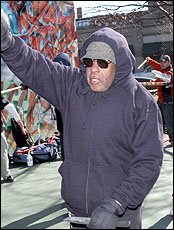
The FMA community is fairly small. Those of us who participate actively hear about or come in contact with each other from time to time, though it’s hard to keep up with the growth of the art and all the new people who are coming up. The elders in the art, however, are a dwindling group, just as steadily leaving us to make way for the new.
The first thing I learned this morning was of the passing of Guro George Brewster back in Boston, Massachusetts. I never met Mr. Brewster, but about 15 years ago or so we corresponded and talked on the phone a few times. One of my goal in doing Stickman Escrima Products was to create a matrix that would put me in touch with other people doing FMA (this was before the internet was the staple it is today) and Mr. Brewster was the kind of person I was most pleased to get to know, a real gentleman and a pioneer in teaching this art here in the U.S.A.
There were one or two transactions where he bought some sticks from me, but mostly I remember our conversations. I asked a few questions, mostly listened. Guro Brewster taught Lanada Arnis, originally starting in the ‘70’s under Amante Marinas Sr. and then continuing as Grandmaster Lanada’s representative in New England after Marinas formed his own association. Mr. Brewster also knew something of Serrada through both GM Angel Cabales and Master JC Cabiero.
There was an article in the Boston Herald just a month ago, showing him leading a class outdoors in the cold at age 81. He was a tough old guy, a veteran of the Battle of the Bulge, who would carry a shovel on the bus (along with his training gear) to clear a space in the snow to train in the park with his students.
George passed away quietly in his sleep after a typical day of training hard with his students. It’s good to see he was active so long, sharing what he loved to the end. It’s unfortunate that, like so many instructors, he only had a few dedicated students, and then towards the end there was a sudden upsurge of interest.
It’s funny how some people make a strong impression in just a few moments. I’m sorry I never got to meet him in person, but he is someone I never forgot about over the years. Those who knew and trained with him have lost not just a mentor but also a friend. Train strong and keep his legacy alive. I’m sure that would make him proud.
Update: I just had a long conversation with sensei/guro Peter Freedman, who is the designated successor as head of the Boston Arnis Club. He can be reached through his website for the Ketsugo Jujutsu schools and George Brewster's Arnis in Boston and Weare, New Hampshire.
Saturday, March 25, 2006
Footwork angles
Something I’ve been pondering these past few days after viewing fights on the Dog Brothers clips is directness, and in particular how it relates to the male and female triangles. On one level these symbols are a map of efficient movement, though on a practical level they are perhaps better as metaphors for moving to an optimal position, wherever that may be.
For anyone here who is not clear on what these represent, the male triangle has a point in front, on the centerline in the direction one is facing. The female triangle has the triangle pointing towards the rear, so forward movement is angled off the centerline.
Conversely, in retreating the forward triangle moves offline, the female triangle moves in towards the center.
Both directions (forward and backward) are worth considering.
Most FMA schools emphasize the female triangle, yet the prototypical FMA symbol is represented by a male triangle inside a circle. Why this paradox, and what might it meaning?
For anyone here who is not clear on what these represent, the male triangle has a point in front, on the centerline in the direction one is facing. The female triangle has the triangle pointing towards the rear, so forward movement is angled off the centerline.
Conversely, in retreating the forward triangle moves offline, the female triangle moves in towards the center.
Both directions (forward and backward) are worth considering.
Most FMA schools emphasize the female triangle, yet the prototypical FMA symbol is represented by a male triangle inside a circle. Why this paradox, and what might it meaning?

Watching the Dog Brothers clips, what I noticed was how fights arrive at point of directness. Fighters may circle, looking to time an entry or snipe a peripheral shot on the fly, but at some point the aggressor takes control and goes after his opponent. Subtlety of angle is out; finishing is about taking it right at the other guy. Maybe my perception is skewed, but that’s how it generally appears to me. So how and why do different triangles theories work?
In talking about entries, it’s about setting up the position from where to attack. We can come straight in by defeating defenses or go around them to a less defended point. Theory often stresses the latter, but experience seems to favor the former.
I’ll start with the female triangle, as training it is more familiar to most people. It is useful in several ways. One can evade a direct attack while countering forward; it zones away from the opposite hand (unless one stays inside between the hands and simply opens up the stance, not my favorite concept) and it allows one to get to the opponent’s backside.
The male triangle has a different set of attributes. It can cut the opponent’s balance and energy by bisecting his baseline. Being direct gets point-to-point faster than longer circling, plus it more readily attacks vital targets on the centerline rather than the periphery. Taking the center redirects the opponent’s energy towards the outside of the circle while staying compact, like the hub of the wheel.
This is only for the forward direction of these triangles. Moving away from an opponent the qualities are reversed. The yin triangle pulls in towards the center, the male triangle steps outwards. People typically backpedal in a straight line when charged, as can be seen frequently in the Dog Brothers clips. It takes a bit more awareness to move offline effectively, a task made more difficult because a forward fast moving attacker may overwhelm one’s response, or be able to adapt so quickly as to re-align on his target.
This is a point frequently made by Marc “Animal” MacYoung in his seminars, where he demonstrates a realistic street attack as opposed to the kind of squared-off dueling practiced in many martial art schools. In the face of something that intense, shifting off the line of attack can be critical, and not everybody can do it well.
Is there a difference in a self-defense situation compared to a ring fight, even one as open as the Dog Brothers? Perhaps. In self-defense one may have an element of surprise on the part of either party. An attack could be a surprise, or perhaps the counter catches the attacker unawares. It is less likely that both parties are equally primed to fight or armed with similar weaponry. Thus there can be variable mismatches to overcome.
Ultimately the value of any footwork is positioning. Whether the goal is to get to an opponent’s weak spot or prevent him from finding yours, one has to have an awareness of these as prerequisite to any plan or strategy. The purpose of tactics is simply a means to an end, and as such it is limiting to think only of them in terms of a single triangle. I think it better to see them as a continuum within larger forms.
Consider that the angles of a triangle must add up to 180º. Many people step at a 45º angle on the female triangle, which works for largo counters at longer distance (mostly towards the limbs) but may veer too wide for deeper strikes or grapples. Entering from greater distance decreases deflective angle and vice versa. The tighter 60º angles of the FMA logo might be a more accurate roadmap for many applications. At closer range, one may need more angle of deflection, but then the counter angle back towards the center is a sharper turn.
A common training aid is to cross two lines in an “x”, creating both male and female triangles. Along with the lines, however, one can step to the quadrants thus formed, and those steps are like a “+”. This creates the “eight directions” which is a popular strategy of direction in Japanese and Korean martial arts, among others. Draw lines connecting the tips of the “x” and “+” shapes to form a square and diamond, and overlaid together these form an 8-pointed star, a common motif in Moslem art.
If you look at the inside lines, triangles are but half squares or rectangles. In this shape each triangle is a 90º angle and two 45º angles. Compare it to the 60º angles of the FMA logo above. That triangle, overlaid in male/female duality, creates a six pointed star, which creates a different pattern of movement. You can lay tape on the ground to practice stepping; each has it’s own logic and lessons to teach. Don’t you wish geometry had been this interesting in high school?
Monday, March 20, 2006
My shortest blog
Something I read today that resonated; simple and elegant:
Learning is taking on...mastery is letting go.
- Anon.
Learning is taking on...mastery is letting go.
- Anon.
Low Strikes
This weekend I browsed the excellent Dog Brothers website to view their video clips. I get asked questions about things people see on there from time to time, so I thought I should refresh my memory and see what is new. For anyone who is not familiar with the Dog Brothers, they promote a highly realistic version full-contact stick fighting, the closest thing to street reality that can be practiced. Under the direction of Marc Denny, they have developed a very comprehensive format of training that incorporates elements from many martial arts, ranging from FMA to Silat, Muay Thai/Krabi Krabong and Brazilian Jujitsu.
The initial reason I was viewing clips was to look at knee shots. My first FMA training was back around 1978, from a guy named Bob Flores who grew up with Leo Gaje on Negros, Philippines. He taught me a Pekiti Tirsia drill that included a knee strike. When I first got to Stockton in 1985, I showed this to a couple of advanced students who scoffed at the attack, even though we have our low angles (#9 and #11) in Serrada. Their reasoning was that they would take the hit to the knee in exchange for delivering one to the head; better to crawl away from your downed opponent than vice versa.
I’ve since encountered that response many times, and while it has the ring of truism, I’ve always felt it a bit glib. It depreciates the value of timing and deception. Any technique can succeed if done right, or fail if done inappropriately. It also looks past the value of a strike – any strike - to be effective.
It is not uncommon in martial arts, and I include boxing, to see a seemingly innocuous blow end a fight, while powerfully delivered shots are absorbed with little effect. A blow can be delivered with full intent and strength but be off by a tiny margin in target, timing or angle, while I’ve heard Cacoy Canete talk of incidental taps in training that caused injuries. These bring to mind Yoda’s saying to young Luke Skywalker: “No try; DO!” Hard shots often are too contrived whereas something thrown naturally and un-self-consciously might engage one’s innate resources more fully.
Whatever the case, though, a good shot is a good shot, and anything that can hurt enough is a respectable target. A strategy I learned from Samoan fighters is to strike to the feet. This may not be a fight-stopper by itself, but it is useful for slowing down big, fast, powerful guys and expands the field of target opportunity by making them defend more space, akin to throwing a long pass in football to stretch the field underneath. Sonny Umpad is another source who’s taught me about this strategy.
Limb destruction is a cornerstone of FMA, and the armbar is a staple in every martial art not playing by restricted rules. The knee might not be as common a target for hand/weapon oriented arts, but conversely it is more vulnerable by element of surprise, and perhaps not as well defended by one not well versed in low strikes or street kicking arts.
There are a couple of good examples of effective knee shots on the Dog Brothers clips. In “Dogzilla’s First Day” he takes a nerve strike from Marc Denny to the back of the leg. The effect is instantaneous. On the “Dog Brothers Promo Clip” a guy gets his kneecap split; fight over. In neither case did the person delivering the strike take a significant hit back. Both got in cleanly, and getting out was simplified by the fact that the person hit was reacting to a new reality.
I’ve experienced firsthand the numbing effect of a hit to the nerves in the back of the knee, and in the course of life I’ve had a couple of painful bruises to the kneecap. While the degree to which individuals react to pain may vary, one cannot dismiss something just because you think it will not work on you, a dangerous illusion in which to indulge. Often our blind spots work two ways; what we can’t do, we think can’t be done. If you don’t think it can work, you won’t learn how, reinforcing the belief it isn’t useful.
Interestingly, it seems to work well to hit someone with what he uses against you. Our choice of targeting is a window to what we believe to be effective. If we think it will work on someone else, that is an internalized belief. On some level we respect that target because we wouldn’t want to be hit there ourselves.
Examples of psychological reversal happen in all sports. In the recent NCAA basketball postseason, Cal hit a big shot but North Carolina nailed their own similar 3 pointer 12 seconds later. Both sides described this as the turning point in the game. Cal thought it had momentum but was deflated immediately, shifting the flow of energy to the other team.
In the movie “Game of Death,” the opening of the fight between Bruce Lee and Dan Inosanto provides a classic of this strategy. Dan hits Bruce with a surprise shot, and while he’s boasting, Bruce smacks him back with the same thing, silencing him with not just the action but also the attitude behind it.
It’s surprising to me how many of the younger generation of martial artists have never taken the time to watch Bruce Lee’s films. I think this is a shame because he was such a dynamic presence and a phenomenal martial artist. Even if his film work was exaggerated for the camera, they are teaching vehicles for the arts, demonstrating values on a multitude of levels.
Some of this lack of awareness of Bruce’s work is perhaps due to the passage of time; these are older films and the hype is gone. There are other issues at work as well, so for those of you who have not seen Bruce Lee movies, hie thee to whatever video emporium still carries them and watch while you still can. They ain’t classics for nuthin’.
The initial reason I was viewing clips was to look at knee shots. My first FMA training was back around 1978, from a guy named Bob Flores who grew up with Leo Gaje on Negros, Philippines. He taught me a Pekiti Tirsia drill that included a knee strike. When I first got to Stockton in 1985, I showed this to a couple of advanced students who scoffed at the attack, even though we have our low angles (#9 and #11) in Serrada. Their reasoning was that they would take the hit to the knee in exchange for delivering one to the head; better to crawl away from your downed opponent than vice versa.
I’ve since encountered that response many times, and while it has the ring of truism, I’ve always felt it a bit glib. It depreciates the value of timing and deception. Any technique can succeed if done right, or fail if done inappropriately. It also looks past the value of a strike – any strike - to be effective.
It is not uncommon in martial arts, and I include boxing, to see a seemingly innocuous blow end a fight, while powerfully delivered shots are absorbed with little effect. A blow can be delivered with full intent and strength but be off by a tiny margin in target, timing or angle, while I’ve heard Cacoy Canete talk of incidental taps in training that caused injuries. These bring to mind Yoda’s saying to young Luke Skywalker: “No try; DO!” Hard shots often are too contrived whereas something thrown naturally and un-self-consciously might engage one’s innate resources more fully.
Whatever the case, though, a good shot is a good shot, and anything that can hurt enough is a respectable target. A strategy I learned from Samoan fighters is to strike to the feet. This may not be a fight-stopper by itself, but it is useful for slowing down big, fast, powerful guys and expands the field of target opportunity by making them defend more space, akin to throwing a long pass in football to stretch the field underneath. Sonny Umpad is another source who’s taught me about this strategy.
Limb destruction is a cornerstone of FMA, and the armbar is a staple in every martial art not playing by restricted rules. The knee might not be as common a target for hand/weapon oriented arts, but conversely it is more vulnerable by element of surprise, and perhaps not as well defended by one not well versed in low strikes or street kicking arts.
There are a couple of good examples of effective knee shots on the Dog Brothers clips. In “Dogzilla’s First Day” he takes a nerve strike from Marc Denny to the back of the leg. The effect is instantaneous. On the “Dog Brothers Promo Clip” a guy gets his kneecap split; fight over. In neither case did the person delivering the strike take a significant hit back. Both got in cleanly, and getting out was simplified by the fact that the person hit was reacting to a new reality.
I’ve experienced firsthand the numbing effect of a hit to the nerves in the back of the knee, and in the course of life I’ve had a couple of painful bruises to the kneecap. While the degree to which individuals react to pain may vary, one cannot dismiss something just because you think it will not work on you, a dangerous illusion in which to indulge. Often our blind spots work two ways; what we can’t do, we think can’t be done. If you don’t think it can work, you won’t learn how, reinforcing the belief it isn’t useful.
Interestingly, it seems to work well to hit someone with what he uses against you. Our choice of targeting is a window to what we believe to be effective. If we think it will work on someone else, that is an internalized belief. On some level we respect that target because we wouldn’t want to be hit there ourselves.
Examples of psychological reversal happen in all sports. In the recent NCAA basketball postseason, Cal hit a big shot but North Carolina nailed their own similar 3 pointer 12 seconds later. Both sides described this as the turning point in the game. Cal thought it had momentum but was deflated immediately, shifting the flow of energy to the other team.
In the movie “Game of Death,” the opening of the fight between Bruce Lee and Dan Inosanto provides a classic of this strategy. Dan hits Bruce with a surprise shot, and while he’s boasting, Bruce smacks him back with the same thing, silencing him with not just the action but also the attitude behind it.
It’s surprising to me how many of the younger generation of martial artists have never taken the time to watch Bruce Lee’s films. I think this is a shame because he was such a dynamic presence and a phenomenal martial artist. Even if his film work was exaggerated for the camera, they are teaching vehicles for the arts, demonstrating values on a multitude of levels.
Some of this lack of awareness of Bruce’s work is perhaps due to the passage of time; these are older films and the hype is gone. There are other issues at work as well, so for those of you who have not seen Bruce Lee movies, hie thee to whatever video emporium still carries them and watch while you still can. They ain’t classics for nuthin’.
Thursday, March 16, 2006
Some thoughts on unity
Since the gathering in Sacramento two weeks ago, there’s been a lot of positive chatter about both the event and the possibility of some sort of unification within Serrada. While it’s certainly premature to make any forecasts, the buzz alone is noteworthy, if for no other reason than to bring this topic up once again on the radar screens of those involved in this art.
I suspect those in leadership positions are monitoring the pulse of things. In politics this would be called taking a poll. While there is no electorate to satisfy here, the big guys have their own desires and agendas, and many have an appreciation of both the advantages of working in unity and the downside that the schism within the Serrada family has had in terms of general public view of this art. While controversy might be music to the sales departments of magazines, in the boots-on-the-ground world of teaching martial arts, it probably turns away more students than are attracted by it.
Like anything in the world of politics, a lot happens behind the scenes to set the stage for the main actors to appear. Whether or not the various heads of organizations are talking to each other privately or not, those of us on second and third level tiers are kicking around ideas, and it sounds like a lot of similar views are coming up. Hopefully this kind of thing filters up to loftier elevations, or perhaps like the Hundredth Monkey theorem, if enough people begin to believe a change will happen, eventually it will become part of the consciousness of the group through morphic resonance.
The following is essentially a repost of a response I made on a Serrada newsletter. All this may come to naught, but for what it’s worth, here’s one possible way to go about things. This is essentially the same advice I (and others) have been giving (usually unsolicited) for the past 15 years.
**********************************
I don't necessarily envision a Serrada unification as a single entity, but rather an association of related organizations. A model for this might be Kajukenbo, which despite differences retains an umbrella identity. Within Kajukenbo are several formally recognized and distinct styles that have evolved, and within each of them are member organizations consisting of businesses started and run by entrepreneurial teachers, each with their own following of students.
If Serrada were to try to organize into a larger body, I certainly don't see the present organizations dissolving themselves. The model I'd envision would base itself on a board of directors consisting of heads of various member bodies and perhaps others elected at large according to a charter. This isn't unlike corporations whose boards are populated by representatives of other businesses that hold large blocks of voting shares.
Under such an arrangement, Vincent could operate like the president or chairman of the board. The CEO does all the real work of running the business, so someone who is motivated to be involved in that capacity could help move things forward. In fact, many countries run like this too, with a President at the head for ceremonial purposes and a Prime Minister to carry out policies and to maintain coalitions of political parties.
What benefits might come from such an arrangement?
First and foremost is the question of qualifications for ranking both instructors and students. An association can set standards by which members of different participating organizations would be recognized. This alone would alleviate a sticking point within the art. Testing could take place within schools for student ranks, much like is done now on whatever basis the head instructor chooses, but if a formal structure is used, teachers from other schools could be invited to sit as witnesses on promotion boards.
A larger organization can draw on the energy of membership to host a variety of events through the course of the year. For instance, there could be a commemorative tournament on Angel’s birthday and an awards banquet on the anniversary of his passing. Testing boards could convene periodically for those seeking teaching rank, in conjunction with seminars for the benefit of all instructors.
There are other possibilities that could eventually come up as part of the growth of an art, such as reworking a ranking system. For instance, the 12 angles in Serrada are each promotions within the art, but these are akin to kyu ranks in karate. Any diligent student can learn the angles. What takes place beyond that, though? Not all who graduate will teach. Some great fighters are temperamentally not qualified to teach or simply have no interest, and not all great teachers are the best fighters. Nevertheless, our society is a meritocracy where people expect to be rewarded for time and effort. There could be separate recognition for both teaching and non-teaching members, rewarding skill and dedication for those who are committed to the art. Few who train will become masters, but there should be a way to acknowledge the difference between a teenager who has just graduated from the 12 angles and a teacher who has decades of experience.
Right now such a proposal sounds controversial, especially since there is no precedent within Serrada for these things, and nobody would recognize such innovations outside the school that did this. Nevertheless, if there were an organizational body, changes such as these could help expand the art. What works well for a small academy might not be the right model for creating a network of schools across the country or the globe. Many small businesses in all fields have learned that it takes different skills to operate on a larger scale.
Perhaps this isn’t the right direction for Serrada. Maybe this is an art that will stay close to home, or spread underground organically, beneath the radar of public awareness. There are those who think it should stay this way, held secretively in private. There are other possibilities, however. This is a beautiful and exciting art with the potential to move out in the world. Angel didn’t promote guros and masters just to have Serrada go back into hiding; he was proud of his art and his students and encouraged those of us with the desire to continue to propagate it. How we do so is up to us, whether each by our own designs or by working together towards larger goals.
**********************************
A quick aside to those who might think I’m yearning for the good old days yet to come. I am not a fan of big schools, organizations, or even big parties. I’ve done the bulk of my training in martial arts in small schools, often one-to-one with the instructor. I generally teach small classes, much the way I learned. Escrima is an art that is generally taught in a highly intensive manner like this, using direct transmission of experience from teacher to student. As much as I enjoy this, however, I realize that it takes a lot of students to develop one expert. Many teachers only find one or two willing and able to achieve true success. Angel was lucky. He had the reputation to attract many who were already successful in martial arts. For those of us still in mid-career, it’s a numbers game to find those student gems. Remember the old daffy-nition of overnight success: twenty years of hard work!
OK, I promise I’m working on a blog about the art itself. Too much politics is bad for the digestion anyway. Ask any politician who’s been on the “rubber chicken” banquet circuit!
I suspect those in leadership positions are monitoring the pulse of things. In politics this would be called taking a poll. While there is no electorate to satisfy here, the big guys have their own desires and agendas, and many have an appreciation of both the advantages of working in unity and the downside that the schism within the Serrada family has had in terms of general public view of this art. While controversy might be music to the sales departments of magazines, in the boots-on-the-ground world of teaching martial arts, it probably turns away more students than are attracted by it.
Like anything in the world of politics, a lot happens behind the scenes to set the stage for the main actors to appear. Whether or not the various heads of organizations are talking to each other privately or not, those of us on second and third level tiers are kicking around ideas, and it sounds like a lot of similar views are coming up. Hopefully this kind of thing filters up to loftier elevations, or perhaps like the Hundredth Monkey theorem, if enough people begin to believe a change will happen, eventually it will become part of the consciousness of the group through morphic resonance.
The following is essentially a repost of a response I made on a Serrada newsletter. All this may come to naught, but for what it’s worth, here’s one possible way to go about things. This is essentially the same advice I (and others) have been giving (usually unsolicited) for the past 15 years.
**********************************
I don't necessarily envision a Serrada unification as a single entity, but rather an association of related organizations. A model for this might be Kajukenbo, which despite differences retains an umbrella identity. Within Kajukenbo are several formally recognized and distinct styles that have evolved, and within each of them are member organizations consisting of businesses started and run by entrepreneurial teachers, each with their own following of students.
If Serrada were to try to organize into a larger body, I certainly don't see the present organizations dissolving themselves. The model I'd envision would base itself on a board of directors consisting of heads of various member bodies and perhaps others elected at large according to a charter. This isn't unlike corporations whose boards are populated by representatives of other businesses that hold large blocks of voting shares.
Under such an arrangement, Vincent could operate like the president or chairman of the board. The CEO does all the real work of running the business, so someone who is motivated to be involved in that capacity could help move things forward. In fact, many countries run like this too, with a President at the head for ceremonial purposes and a Prime Minister to carry out policies and to maintain coalitions of political parties.
What benefits might come from such an arrangement?
First and foremost is the question of qualifications for ranking both instructors and students. An association can set standards by which members of different participating organizations would be recognized. This alone would alleviate a sticking point within the art. Testing could take place within schools for student ranks, much like is done now on whatever basis the head instructor chooses, but if a formal structure is used, teachers from other schools could be invited to sit as witnesses on promotion boards.
A larger organization can draw on the energy of membership to host a variety of events through the course of the year. For instance, there could be a commemorative tournament on Angel’s birthday and an awards banquet on the anniversary of his passing. Testing boards could convene periodically for those seeking teaching rank, in conjunction with seminars for the benefit of all instructors.
There are other possibilities that could eventually come up as part of the growth of an art, such as reworking a ranking system. For instance, the 12 angles in Serrada are each promotions within the art, but these are akin to kyu ranks in karate. Any diligent student can learn the angles. What takes place beyond that, though? Not all who graduate will teach. Some great fighters are temperamentally not qualified to teach or simply have no interest, and not all great teachers are the best fighters. Nevertheless, our society is a meritocracy where people expect to be rewarded for time and effort. There could be separate recognition for both teaching and non-teaching members, rewarding skill and dedication for those who are committed to the art. Few who train will become masters, but there should be a way to acknowledge the difference between a teenager who has just graduated from the 12 angles and a teacher who has decades of experience.
Right now such a proposal sounds controversial, especially since there is no precedent within Serrada for these things, and nobody would recognize such innovations outside the school that did this. Nevertheless, if there were an organizational body, changes such as these could help expand the art. What works well for a small academy might not be the right model for creating a network of schools across the country or the globe. Many small businesses in all fields have learned that it takes different skills to operate on a larger scale.
Perhaps this isn’t the right direction for Serrada. Maybe this is an art that will stay close to home, or spread underground organically, beneath the radar of public awareness. There are those who think it should stay this way, held secretively in private. There are other possibilities, however. This is a beautiful and exciting art with the potential to move out in the world. Angel didn’t promote guros and masters just to have Serrada go back into hiding; he was proud of his art and his students and encouraged those of us with the desire to continue to propagate it. How we do so is up to us, whether each by our own designs or by working together towards larger goals.
**********************************
A quick aside to those who might think I’m yearning for the good old days yet to come. I am not a fan of big schools, organizations, or even big parties. I’ve done the bulk of my training in martial arts in small schools, often one-to-one with the instructor. I generally teach small classes, much the way I learned. Escrima is an art that is generally taught in a highly intensive manner like this, using direct transmission of experience from teacher to student. As much as I enjoy this, however, I realize that it takes a lot of students to develop one expert. Many teachers only find one or two willing and able to achieve true success. Angel was lucky. He had the reputation to attract many who were already successful in martial arts. For those of us still in mid-career, it’s a numbers game to find those student gems. Remember the old daffy-nition of overnight success: twenty years of hard work!
OK, I promise I’m working on a blog about the art itself. Too much politics is bad for the digestion anyway. Ask any politician who’s been on the “rubber chicken” banquet circuit!
Sunday, March 05, 2006
Images from Sacramento Gathering
The pictures speak for themselves ....

Group Photo (partial)
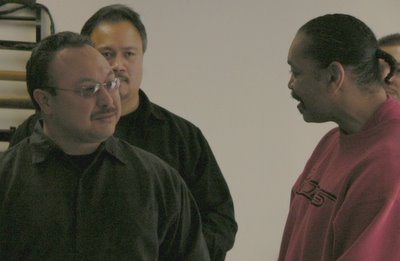
Vincent Cabales, Darren Tibon and Anthony Davis
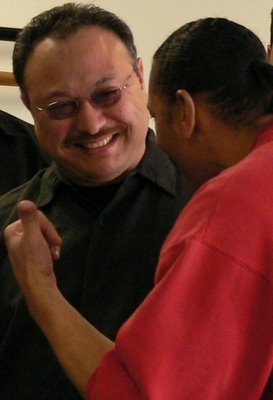
Vincent and Anthony
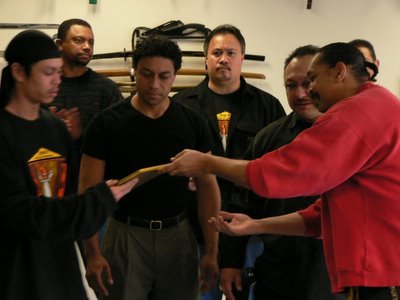
Gelmar, Jerry Preciado, Vincent Jr., Darren, Vincent, Anthony
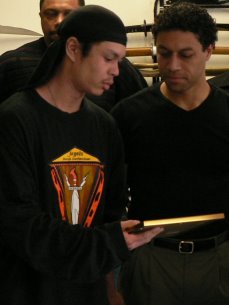
Gelmar Cabales and Vincent Cabales Jr.
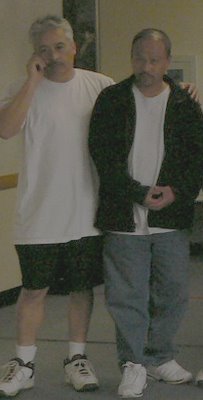
Ronnie Saturno and Jojo Soribel

Carlito Bonjoc, Wade Williams, Jeff Finder
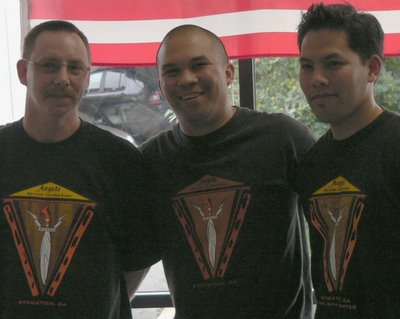
Elrik Jundis and crew
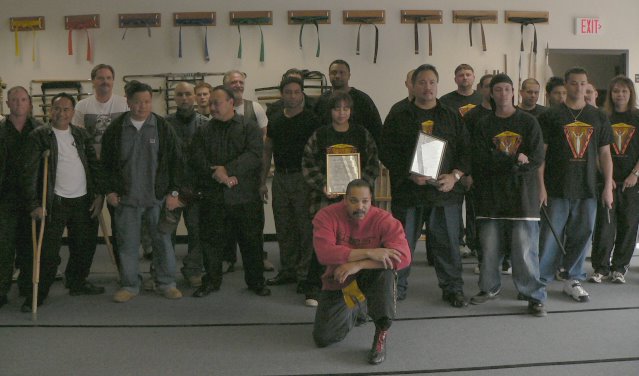
Group Photo (partial)
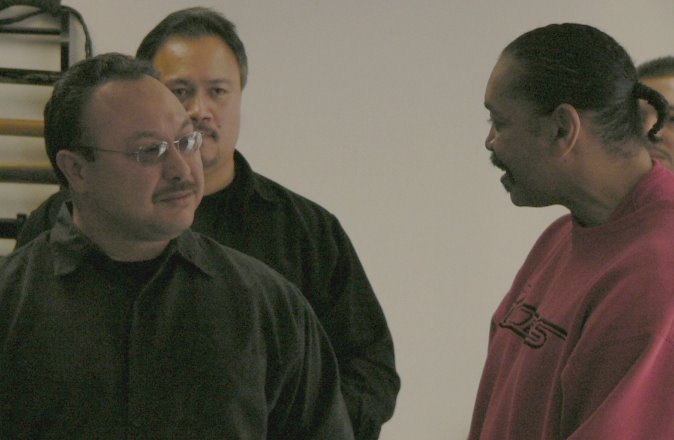
Vincent Cabales, Darren Tibon and Anthony Davis
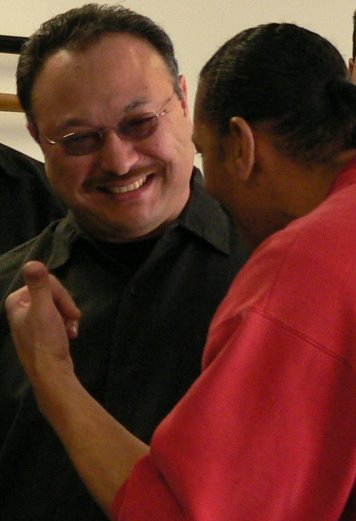
Vincent and Anthony
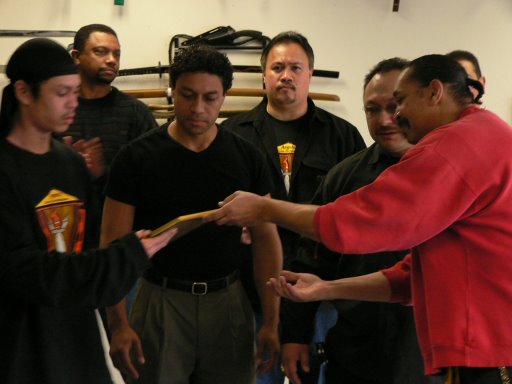
Gelmar, Jerry Preciado, Vincent Jr., Darren, Vincent, Anthony
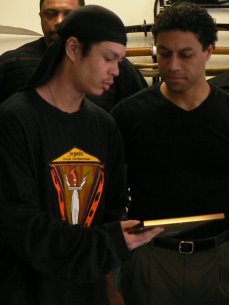
Gelmar Cabales and Vincent Cabales Jr.
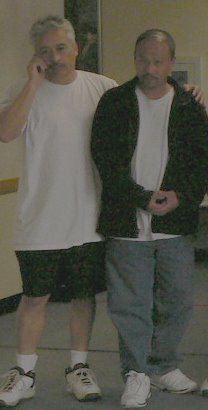
Ronnie Saturno and Jojo Soribel
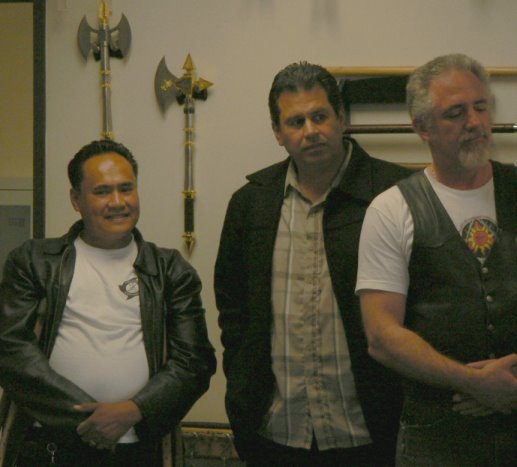
Carlito Bonjoc, Wade Williams, Jeff Finder
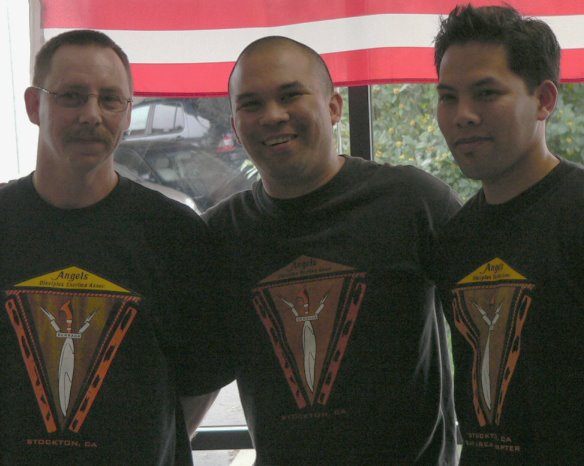
Elrik Jundis and crew
An Historic Moment In Serrada
Something remarkable happened in the world of Serrada today. There was a gathering of historic proportions, and everybody got along! Those who were there will testify to what transpired, and hopefully that energy will touch those who could not attend.
Friday, March 3, was the 15th anniversary of grandmaster Angel Cabales’ passing. To commemorate this Anthony Davis organized and hosted a seminar up in Sacramento by Darren Tibon and his organization, Angel’s Disciples, who put on an exciting demo followed by a short but excellent training session.
Through most of this event four of Angel’s old students were present: Darren Tibon, Jerry Preciado, Anthony Davis and myself. I hadn’t seen Jerry during the past 15 years and at first didn’t even recognize the muscular figure from the skinny kid I’d known. Also present were Angel’s widow Tess and Angel’s two youngest, Marigel and Gelmar, who are children no more.
If that had been the extent of things, it would have been a good event. I had a handful of students present, as did Anthony, and Darren had enough students to provide assistance to every pair of attendees training in the room. Elrik Jundis showed up from the Bay Area with several associates. He and I touched sticks years ago and it was great to see him again.
There were some folks missing, though, that we’d hoped to see, and so it was electrifying when during Anthony’s closing remarks in walked Carlito Bonjoc, Ronnie Saturno and Wade Williams! (An apology to any whose name I cannot recall, particularly this late at night!)
Then something completely unexpected happened. As we were finishing greetings with this group, in walked Vincent Cabales with a contingent that included his son and a number of guros who train with him. For a second there was a huge pause as the significance of his appearance sank in, but whatever tension existed dissipated almost instantly with the recognition of the historic perspective of what was taking place. As Vincent stated simply and eloquently, he was there to honor his father, and we in turn were all honored that he joined us in this event.
This was probably the most significant gathering of the Serrada clan since Angel passed away. The wake after his funeral and the tournament held in his honor shortly thereafter also brought a lot of people together, but back then there was a lot of tension in the air, uncertainty as to the directions the art and its various proponents would take. Time has passed and people have grown in their lives and careers, raising families and expanding the Serrada lineage through their diligence and hard work. The energy now was quite different, a coming together from volition rather than the confusion of necessity.
What was apparent to me, and I believe to all who were there, was that for all the alleged animosity that has existed between people, there is a love for Serrada, and for Angel, that transcends all the conflicts of personality. All I felt in that room was a genuine spirit of aloha, as people who hadn’t spoken directly in years broke the ice with warm greetings. There were so many people in that room with whom I haven’t trained in years, it is hard to even recall all of them, but there was a glow of recognition in familiar faces.
I sincerely hope that this proves to be a watershed in improved relationships between the various Serrada groups and associations. We truly share more in common than whatever differences have been perceived. I recall the words of Gilbert Tenio at Angel’s wake, where he talked about the arts as a way to survive adversity through unity. Though the old manongs didn’t always see eye to eye either, they knew that there were common interests that transcended their differences. I think such understanding is finally settling into the generation that has succeeded them; this is a blessing to us all.
Here is a belated link to some photos I just received from a student who was there.
Friday, March 3, was the 15th anniversary of grandmaster Angel Cabales’ passing. To commemorate this Anthony Davis organized and hosted a seminar up in Sacramento by Darren Tibon and his organization, Angel’s Disciples, who put on an exciting demo followed by a short but excellent training session.
Through most of this event four of Angel’s old students were present: Darren Tibon, Jerry Preciado, Anthony Davis and myself. I hadn’t seen Jerry during the past 15 years and at first didn’t even recognize the muscular figure from the skinny kid I’d known. Also present were Angel’s widow Tess and Angel’s two youngest, Marigel and Gelmar, who are children no more.
If that had been the extent of things, it would have been a good event. I had a handful of students present, as did Anthony, and Darren had enough students to provide assistance to every pair of attendees training in the room. Elrik Jundis showed up from the Bay Area with several associates. He and I touched sticks years ago and it was great to see him again.
There were some folks missing, though, that we’d hoped to see, and so it was electrifying when during Anthony’s closing remarks in walked Carlito Bonjoc, Ronnie Saturno and Wade Williams! (An apology to any whose name I cannot recall, particularly this late at night!)
Then something completely unexpected happened. As we were finishing greetings with this group, in walked Vincent Cabales with a contingent that included his son and a number of guros who train with him. For a second there was a huge pause as the significance of his appearance sank in, but whatever tension existed dissipated almost instantly with the recognition of the historic perspective of what was taking place. As Vincent stated simply and eloquently, he was there to honor his father, and we in turn were all honored that he joined us in this event.
This was probably the most significant gathering of the Serrada clan since Angel passed away. The wake after his funeral and the tournament held in his honor shortly thereafter also brought a lot of people together, but back then there was a lot of tension in the air, uncertainty as to the directions the art and its various proponents would take. Time has passed and people have grown in their lives and careers, raising families and expanding the Serrada lineage through their diligence and hard work. The energy now was quite different, a coming together from volition rather than the confusion of necessity.
What was apparent to me, and I believe to all who were there, was that for all the alleged animosity that has existed between people, there is a love for Serrada, and for Angel, that transcends all the conflicts of personality. All I felt in that room was a genuine spirit of aloha, as people who hadn’t spoken directly in years broke the ice with warm greetings. There were so many people in that room with whom I haven’t trained in years, it is hard to even recall all of them, but there was a glow of recognition in familiar faces.
I sincerely hope that this proves to be a watershed in improved relationships between the various Serrada groups and associations. We truly share more in common than whatever differences have been perceived. I recall the words of Gilbert Tenio at Angel’s wake, where he talked about the arts as a way to survive adversity through unity. Though the old manongs didn’t always see eye to eye either, they knew that there were common interests that transcended their differences. I think such understanding is finally settling into the generation that has succeeded them; this is a blessing to us all.
Here is a belated link to some photos I just received from a student who was there.
Monday, February 27, 2006
Quick Update on Sonny
I just heard a short while ago that Sonny was out of a coma and conscious, so I tried reaching him at the hospital in case he could answer the phone. I didn't get an answer but I did speak to the nursing station on his floor and they say he's doing well. Thanks for all those who are thinking of him. I'll keep posting his progress here.
Sunday, February 26, 2006
Khalid’s Seminar
This weekend Khalid Khan did a seminar in Oakland at Kenny Pitt’s school on Lakeshore Blvd., sponsored through the auspices of Professor James Hundon who teaches an innovative program there which combines Escrima with Wally Jay’s Small Circle Jujitsu and other arts.
In some ways this event reminded me of the White Tiger seminar Angel Cabales did in Oakland back in 1967. Both events were well attended by students from the school, lending an air of friendly camaraderie to the proceedings. Also reminiscent was attendance by some of the more senior instructors in this art, bringing together several generations of practitioners.
I was invited by Master Khan to assist in his class, and as it opened there were also half a dozen second generation instructors under Khalid. The treat for me was when early into the program two of our seniors from Stockton showed up.
Ronnie Saturno and Carlito Bonjoc are two of my role models in Serrada. I’ve known Carlito since my earliest training in this art back in 1985, and his skills and knowledge never cease to amaze me. Ronnie is someone I’ve had the privilege to meet far too infrequently, and his style and movement impressed me once again, reminding me how explosive and deadly this art can be. Both these men are articulate, intelligent teachers, and I got to feel like a beginner in the art once more as I let myself soak in what they have to offer.
What amazed me after I got home was realizing the cumulative experience there was of Angel’s students in that room today. Ronnie has at least 27 years in Serrada, Carlito about 25. I have 20 years myself with Khalid just a couple of years behind. All together we represented nearly 90 years of training in Serrada. Time spent like this matures the basic skills, nurturing each person through experience.
It was just as nice to see the younger generation of instructors starting to step up and show what they can do; Khalid’s top assistants have some nice skills. There is a lot of talent in this art, and it’s good to see it spreading. Today there was no politics, just the art itself, enjoyed for its own sake. I could feel Angel smiling in that room.
In some ways this event reminded me of the White Tiger seminar Angel Cabales did in Oakland back in 1967. Both events were well attended by students from the school, lending an air of friendly camaraderie to the proceedings. Also reminiscent was attendance by some of the more senior instructors in this art, bringing together several generations of practitioners.
I was invited by Master Khan to assist in his class, and as it opened there were also half a dozen second generation instructors under Khalid. The treat for me was when early into the program two of our seniors from Stockton showed up.
Ronnie Saturno and Carlito Bonjoc are two of my role models in Serrada. I’ve known Carlito since my earliest training in this art back in 1985, and his skills and knowledge never cease to amaze me. Ronnie is someone I’ve had the privilege to meet far too infrequently, and his style and movement impressed me once again, reminding me how explosive and deadly this art can be. Both these men are articulate, intelligent teachers, and I got to feel like a beginner in the art once more as I let myself soak in what they have to offer.
What amazed me after I got home was realizing the cumulative experience there was of Angel’s students in that room today. Ronnie has at least 27 years in Serrada, Carlito about 25. I have 20 years myself with Khalid just a couple of years behind. All together we represented nearly 90 years of training in Serrada. Time spent like this matures the basic skills, nurturing each person through experience.
It was just as nice to see the younger generation of instructors starting to step up and show what they can do; Khalid’s top assistants have some nice skills. There is a lot of talent in this art, and it’s good to see it spreading. Today there was no politics, just the art itself, enjoyed for its own sake. I could feel Angel smiling in that room.
Prayers for Sonny
Sonny Umpad has always been one of my favorite people in the martial arts. He’s always been generous with his knowledge, and as one of the most creative people I’ve ever known, he’s expanded the skill set for many of us with his innovative tactics. In particular his centerline roll for double sticks has had an impact, not just by combining concepts from Wing Chun and Escrima but expanding the effective elements within both arts by integrating FMA stick work with simple dynamics from Wing Chun’s punching.
This past Wednesday Sonny had a stroke. A student got him to the hospital, where doctors found a tumor in his brain. To save his life they performed surgery. He’s not out of the woods yet, with other complications still to be addressed, so right now he can use all the prayers and best wishes we can send him.
This past Wednesday Sonny had a stroke. A student got him to the hospital, where doctors found a tumor in his brain. To save his life they performed surgery. He’s not out of the woods yet, with other complications still to be addressed, so right now he can use all the prayers and best wishes we can send him.
Friday, February 17, 2006
Buddha and the Tiger
One day the Buddha was sitting under his favorite tree, teaching to those assembled as was his wont, when a tiger entered the park. People began fleeing.
One monk looked over at the person running alongside him and was astonished to see it was the Buddha himself. He asked "Why are you running like the rest of us, when you teach that reality is an illusion?"
Replied the Buddha "Sometimes you must treat a tiger as a tiger."
One monk looked over at the person running alongside him and was astonished to see it was the Buddha himself. He asked "Why are you running like the rest of us, when you teach that reality is an illusion?"
Replied the Buddha "Sometimes you must treat a tiger as a tiger."
Wednesday, February 15, 2006
Perception and Reality
So, back to Consciousness 101. Whoa! You thought this was supposed to be an Escrima blog! Y’know, how many ways to do an inside block with a high pass to the outside then a takedown with a pizza. Oops, make that pizzazz.
Yup. At some point I’ll be doing that writing, but if you look at lots of my previous posts, I think understanding our mental processes is the key to fine tuning our physical ones.
A tip of the hat here to Portascat’s blog, which talks about Dick Cheney’s shooting incident in relation to gun safety practices. Real world events demonstrate points about the mind/body connection, so it’s all the Veep’s fault that you’re reading this! ;)
******************************************************
When the Indian monk Ta Mo began incorporating physical movement into the Shaolin monastery, it was from understanding how the mind and body interact. Discipline in movement allows discipline in stillness, controlled motion the flip side of the non-movement of sitting in meditation. Integration means the inner and outer focus become melded into a single unified expression of one’s self. The conscious mind pays attention to the unconscious mind, together performing more effectively when not struggling for control.
Currently I’m reading “Animals In Translation” by Temple Grandin, a highly regarded professor and consultant on animal behavior. She’s also autistic, and her research into how autistic people see the world has led her to insights about how both people and animals perceive the world. Animals tend to live through their senses. They see, hear, smell. People create schemas, which are thoughts about how the world should be, and so we frequently operate through assumptions. These can be valuable shortcuts created through heuristic learning processes in which we build expectations based on previous experience.
A classic example of a schema is a pencil dropped 99 times will be expected to also fall to the floor when dropped the 100th time. However, there are flaws when we get trapped in seeing the big picture without identifying the details.
In her work Grandin refers to the book “Inattentional Blindness”, the premise of which is that people do not consciously see something unless they are actively paying attention to it. She cites a NASA study where commercial airline pilots were asked to practice routine landings on a simulator. At some point another jetliner is placed across the landing runway, and 25% of the pilots failed to see it! Untrained people of course saw the plane, but the professionals were flying on autopilot, so to speak, even though they were in manual control of the plane, in touch with the control tower, etc.
In the real world, this has consequences, which returns us to the news. Cheney is an experienced hunter, but perhaps he got too complacent about reviewing basic rules. He neglected to get a bird stamp, which in itself is a small discrepancy but perhaps symptomatic of those sort of breeches of consciousness that allow error to seep in. It’s worse if it was a deliberate act of omission because that could invite further relaxation of attentiveness and oversight.
As a kid I read (and reread many times) “Fate Is The Hunter” about early aviation. Plane crashes attributable to pilot error usually don’t just happen randomly. There are often a series of errors accumulating to a tipping point. Responsibility asks a lot of us; hence the title of the book. Entropy can be defined as an “inevitable and steady deterioration of a system.” It takes energy to overcome entropy, the opposite of complacency. As my old Kenpo teacher used to say, “Things always change and so there is no standing still. You are either moving forward or slipping back.”
W.B. Yeats expressed this well in The Second Coming with the lines “Things fall apart; the centre cannot hold; Mere anarchy is loosed upon the world.”
Martial arts are about mastering chaos. We control others from our own center. How can we shape an external reality except by ownership of what is inherently within our purview? If we do not control ourselves, then we are out of control, or within the control of another. Either way, it is not our best option.
As training expands our options, it deepens our perception into them. Simply put, we can see more. Too much information can cause paralysis – one attempts to make sense of an overwhelming amount of data. Heuristic learning organizes our material, but we need to constantly monitor data against the template of expectations. That way, at least we can see when there is a deviation, allowing us to kick into greater focus so that we can modify our response appropriately.
Like the saying says, “The difference between theory and practice is, in theory there is no difference.” Think about it.
I call Escrima “the art of making adjustments” because done well it flows relationally. Through sensitivity we can discern changes to basic patterns of movement, thereby adapting fresh responses. Going pattern to pattern is a lattice through which we weave, a template to engage our opponent, not rigid rules that constrain us.
An attack is a question: “Can you deal with this?” Our reaction is both an answer and a counter-question. Movement becomes dialog. Talking in clichés can be boring and repetitive, but when conversation flows, it can become illuminative, enlightening and entertaining. It is in the nature of unpredictability that we discover what is new, hence interesting. We can use common words (or movements) to create our expression.
So where do we find the balance between control and freedom, and how can it be possible for dialog, whether verbal or martial arts, to resolve this polarity? Like the old adage, one must know the rules to be able to break them. If you don’t know them, it is just anarchy. How can you take credit for doing what you don’t know? On the other hand, progress is rarely achieved without stepping into the unknown. Knowledge is just our base, what we’ve already covered and examined. It is the platform from which to jump into a sea of possibilities, and there to support us when we need to find our bearings again.
Examining this stuff is like layers of an onion, always something to peel off. It is not easy keeping the mind engaged on the bigger picture, which puts us in situations where things happen. When Cheney shot Whittington he didn’t see the forest for the trees, being so locked in on his sight picture that he lost track of the environment. Tunnel vision like this is also common under stress such as in a self-defense situation. In both cases it’s too much attention to the wrong thing, focus being placed on success in a single frame, forgetting the larger context.
Temple Grandin points out that it is our animal nature which perceives things as they are, directly through the senses. Use your mind to direct your actions well, but let the actions flow from that sense of awareness.
Sigh … and this was going to be a short post!
Yup. At some point I’ll be doing that writing, but if you look at lots of my previous posts, I think understanding our mental processes is the key to fine tuning our physical ones.
A tip of the hat here to Portascat’s blog, which talks about Dick Cheney’s shooting incident in relation to gun safety practices. Real world events demonstrate points about the mind/body connection, so it’s all the Veep’s fault that you’re reading this! ;)
******************************************************
When the Indian monk Ta Mo began incorporating physical movement into the Shaolin monastery, it was from understanding how the mind and body interact. Discipline in movement allows discipline in stillness, controlled motion the flip side of the non-movement of sitting in meditation. Integration means the inner and outer focus become melded into a single unified expression of one’s self. The conscious mind pays attention to the unconscious mind, together performing more effectively when not struggling for control.
Currently I’m reading “Animals In Translation” by Temple Grandin, a highly regarded professor and consultant on animal behavior. She’s also autistic, and her research into how autistic people see the world has led her to insights about how both people and animals perceive the world. Animals tend to live through their senses. They see, hear, smell. People create schemas, which are thoughts about how the world should be, and so we frequently operate through assumptions. These can be valuable shortcuts created through heuristic learning processes in which we build expectations based on previous experience.
A classic example of a schema is a pencil dropped 99 times will be expected to also fall to the floor when dropped the 100th time. However, there are flaws when we get trapped in seeing the big picture without identifying the details.
In her work Grandin refers to the book “Inattentional Blindness”, the premise of which is that people do not consciously see something unless they are actively paying attention to it. She cites a NASA study where commercial airline pilots were asked to practice routine landings on a simulator. At some point another jetliner is placed across the landing runway, and 25% of the pilots failed to see it! Untrained people of course saw the plane, but the professionals were flying on autopilot, so to speak, even though they were in manual control of the plane, in touch with the control tower, etc.
In the real world, this has consequences, which returns us to the news. Cheney is an experienced hunter, but perhaps he got too complacent about reviewing basic rules. He neglected to get a bird stamp, which in itself is a small discrepancy but perhaps symptomatic of those sort of breeches of consciousness that allow error to seep in. It’s worse if it was a deliberate act of omission because that could invite further relaxation of attentiveness and oversight.
As a kid I read (and reread many times) “Fate Is The Hunter” about early aviation. Plane crashes attributable to pilot error usually don’t just happen randomly. There are often a series of errors accumulating to a tipping point. Responsibility asks a lot of us; hence the title of the book. Entropy can be defined as an “inevitable and steady deterioration of a system.” It takes energy to overcome entropy, the opposite of complacency. As my old Kenpo teacher used to say, “Things always change and so there is no standing still. You are either moving forward or slipping back.”
W.B. Yeats expressed this well in The Second Coming with the lines “Things fall apart; the centre cannot hold; Mere anarchy is loosed upon the world.”
Martial arts are about mastering chaos. We control others from our own center. How can we shape an external reality except by ownership of what is inherently within our purview? If we do not control ourselves, then we are out of control, or within the control of another. Either way, it is not our best option.
As training expands our options, it deepens our perception into them. Simply put, we can see more. Too much information can cause paralysis – one attempts to make sense of an overwhelming amount of data. Heuristic learning organizes our material, but we need to constantly monitor data against the template of expectations. That way, at least we can see when there is a deviation, allowing us to kick into greater focus so that we can modify our response appropriately.
Like the saying says, “The difference between theory and practice is, in theory there is no difference.” Think about it.
I call Escrima “the art of making adjustments” because done well it flows relationally. Through sensitivity we can discern changes to basic patterns of movement, thereby adapting fresh responses. Going pattern to pattern is a lattice through which we weave, a template to engage our opponent, not rigid rules that constrain us.
An attack is a question: “Can you deal with this?” Our reaction is both an answer and a counter-question. Movement becomes dialog. Talking in clichés can be boring and repetitive, but when conversation flows, it can become illuminative, enlightening and entertaining. It is in the nature of unpredictability that we discover what is new, hence interesting. We can use common words (or movements) to create our expression.
So where do we find the balance between control and freedom, and how can it be possible for dialog, whether verbal or martial arts, to resolve this polarity? Like the old adage, one must know the rules to be able to break them. If you don’t know them, it is just anarchy. How can you take credit for doing what you don’t know? On the other hand, progress is rarely achieved without stepping into the unknown. Knowledge is just our base, what we’ve already covered and examined. It is the platform from which to jump into a sea of possibilities, and there to support us when we need to find our bearings again.
Examining this stuff is like layers of an onion, always something to peel off. It is not easy keeping the mind engaged on the bigger picture, which puts us in situations where things happen. When Cheney shot Whittington he didn’t see the forest for the trees, being so locked in on his sight picture that he lost track of the environment. Tunnel vision like this is also common under stress such as in a self-defense situation. In both cases it’s too much attention to the wrong thing, focus being placed on success in a single frame, forgetting the larger context.
Temple Grandin points out that it is our animal nature which perceives things as they are, directly through the senses. Use your mind to direct your actions well, but let the actions flow from that sense of awareness.
Sigh … and this was going to be a short post!
Monday, February 13, 2006
Mastering Mastery
I once read a quote by Aikido founder Morihei Ueshiba which said in essence that anyone who is reasonably competent can learn to wave their hands around in the air, but the true nature of the art was to be found in meditation.
I later read an interview by Kenpo grandmaster Ed Parker, in which he stated the main purpose of training was to learn to keep one’s hands out of each others’ way so they wouldn’t hit each other by accident; after all, that could be as injurious as being hit by an opponent. When then asked if he’d ever used his art for self-defense, he said that he’d experienced three attempted muggings in Los Angeles, and each time he’d simply hit the person before he could think, dropping them immediately. Each time his subsequent reaction was “Darn! I could have done something fancy!”
I’ve often quipped that for all my years in martial arts, the best examples of how they’ve saved my life have been knowing how to fall, or in one case crossing an icy parking lot while carrying skis, how not to fall by using a strong stance. Other times I’ve used awareness to avoid trouble, sensing something subliminally and only recognizing the nature of the danger after it had been avoided. I’ve had very few fights. Most of those have been coming to the aid of others, and the actual skirmishes (a word related in origins to Escrima) were very brief within the context of each incident.
Finally, I-Chuan practitioners were reputed to be devastating fighters, yet their main focus of training was standing in universal post.
So what is going on here? Why do we train endless hours in countless techniques? Certainly we gain skill in waving our hands in the air, learning not to hit ourselves, but then we’ve also trained alongside others who practice diligently and are technically competent but who are not particularly effective in using what they know.
It’s that inner game.
My two previous posts about dog incidents were to illustrate presence of mind under duress, which I believe are key attributes to cultivate through martial art training. Those incidents had nothing to do with the external art, but everything to do with the essence of being present and aware within the moment.
GM Anthony Davis once did an article back in the 80’s about mastering Escrima. Some folks took offense that he was claiming to be a master, when in fact he was still training under Angel Cabales in the 12 angles at that time. Anthony pointed out that he had never claimed in that piece to be a master of the art, but that “mastering” is a process of working towards mastery. At the time I thought his explanation a bit disingenuous, but in fact he hit the nail on the head.
Mastery can be defined as “possession of consummate skill” or as “full command of a subject of study.” Yes, there is also the meaning of “status of master or ruler,” which is based on social roles, but the first two definitions are based solely on competency within the individual. One can have status as a leader without having self-mastery, and so we are free to examine the actual process of inner development separate from issues of hierarchy.
Within Anthony Davis’ use of the term, we spend our whole lives mastering skills, something GM Angel Cabales exemplified. As skillful and accomplished as he was, he was continually refining his art and himself, a process that I believe one can see in the lineage of his students. Those who trained with him earlier have a robust aggressiveness, reflecting Angel’s energy at that time. Later students show a more refined approach to the art. This is not to say earlier trainees lack understanding or that later ones are not as strong, but rather that as students take on qualities from their teacher, this shows how Angel’s approach to teaching his art evolved over time from a more direct experiential method to one that became more analytic in attention to fine details.
I really saw this process of inner development the last time I worked out with Angel in 1991. I took a group of students to meet him; Angel was already very ill at this time. He sat in a chair, looking tired, but as we went through angles for him he became more and more animated, finally insisting we help him to his feet. He turned to one guy, a burly Filipino who was ex-military, with high skills in Kenpo and Wing Chun, and told the guy to punch him. Mack looked at me questioningly, and knowing Angel, I said “Do what he says.” Mack threw a punch and Angel did a takedown.
Now here was a guy (Angel) who could barely stand - we’d had to help him out is his chair – dropping a guy half his age and twice his size, using a technique I’d seen countless times in a way I’d never seen before. Generally in the past he would step into his opponent, ducking under their arm and pinning their centerline with his outstretched arm while trapping their knee with his. In doing this, he would often visibly adjust his own balance to catch their weight. This time he couldn’t move that much. He couldn’t make adjustments when merely standing was so difficult. Instead, he simply did the technique with perfect alignment, and with a light touch sent Mack crashing to the ground.
Angel proceeded to demonstrate this technique on each of us (six in all) and the power he manifested was undeniable. He reminded me that day of a candle whose flame may flare brighter just before going out. I knew in that moment that we were witnessing the culmination of his art. He had perfected it, and his life’s work was done. He died 22 days later.
If a legendary fighter and teacher can constantly investigate the nature of his art, continually refining it to ever-higher levels, that is the best example we can take for our own development within the art. It is not about rank, because that is a social construct. It is something awarded to us by others as a form of recognition, and it can be taken away or disputed, all part of the politics of the arts. On the other hand, our knowledge is something we own, a part of ourselves. It is in taking ownership of our own self that we become powerful. External mastery is only the shell, but it is up to us to embody the meaning.
I recently heard from a former student who called to discuss a rank he’d been awarded in another system. He didn’t feel he was ready for it. If he cannot feel it, then there is still work to be done. I pointed out that it is not a lack of knowledge that holds him back, because he’s trained a long time with competent teachers, but it is a lack of belief that keeps him from accepting his own competency.
I reminded him of something I was told long ago by John Wong, my late Tai Chi teacher. Some people don’t want to accept responsibility for their own growth, and so remain students forever. Sometimes they become dojo gypsies, traveling from school to school in search of that elusive missing “something.” This has nothing to do with technical ability, because sometimes these people can be very good, though it seems the longer they search for answers outside themselves, the less competent they become as self-doubt drives down their confidence.
The most common phrase in the Filipino martial arts (FMA) is “we have that too,” and really that can be extended to almost all the arts. There are only so many basic techniques, though many ways of expressing them. One can learn how to do an arm bar, for example, from many teachers, and each might add a flavor or nuance to the technique, but until you are able to do an arm bar that expresses who you are, you have not internalized the experience and made it your own.
That is mastery. Work on mastering it!
I later read an interview by Kenpo grandmaster Ed Parker, in which he stated the main purpose of training was to learn to keep one’s hands out of each others’ way so they wouldn’t hit each other by accident; after all, that could be as injurious as being hit by an opponent. When then asked if he’d ever used his art for self-defense, he said that he’d experienced three attempted muggings in Los Angeles, and each time he’d simply hit the person before he could think, dropping them immediately. Each time his subsequent reaction was “Darn! I could have done something fancy!”
I’ve often quipped that for all my years in martial arts, the best examples of how they’ve saved my life have been knowing how to fall, or in one case crossing an icy parking lot while carrying skis, how not to fall by using a strong stance. Other times I’ve used awareness to avoid trouble, sensing something subliminally and only recognizing the nature of the danger after it had been avoided. I’ve had very few fights. Most of those have been coming to the aid of others, and the actual skirmishes (a word related in origins to Escrima) were very brief within the context of each incident.
Finally, I-Chuan practitioners were reputed to be devastating fighters, yet their main focus of training was standing in universal post.
So what is going on here? Why do we train endless hours in countless techniques? Certainly we gain skill in waving our hands in the air, learning not to hit ourselves, but then we’ve also trained alongside others who practice diligently and are technically competent but who are not particularly effective in using what they know.
It’s that inner game.
My two previous posts about dog incidents were to illustrate presence of mind under duress, which I believe are key attributes to cultivate through martial art training. Those incidents had nothing to do with the external art, but everything to do with the essence of being present and aware within the moment.
GM Anthony Davis once did an article back in the 80’s about mastering Escrima. Some folks took offense that he was claiming to be a master, when in fact he was still training under Angel Cabales in the 12 angles at that time. Anthony pointed out that he had never claimed in that piece to be a master of the art, but that “mastering” is a process of working towards mastery. At the time I thought his explanation a bit disingenuous, but in fact he hit the nail on the head.
Mastery can be defined as “possession of consummate skill” or as “full command of a subject of study.” Yes, there is also the meaning of “status of master or ruler,” which is based on social roles, but the first two definitions are based solely on competency within the individual. One can have status as a leader without having self-mastery, and so we are free to examine the actual process of inner development separate from issues of hierarchy.
Within Anthony Davis’ use of the term, we spend our whole lives mastering skills, something GM Angel Cabales exemplified. As skillful and accomplished as he was, he was continually refining his art and himself, a process that I believe one can see in the lineage of his students. Those who trained with him earlier have a robust aggressiveness, reflecting Angel’s energy at that time. Later students show a more refined approach to the art. This is not to say earlier trainees lack understanding or that later ones are not as strong, but rather that as students take on qualities from their teacher, this shows how Angel’s approach to teaching his art evolved over time from a more direct experiential method to one that became more analytic in attention to fine details.
I really saw this process of inner development the last time I worked out with Angel in 1991. I took a group of students to meet him; Angel was already very ill at this time. He sat in a chair, looking tired, but as we went through angles for him he became more and more animated, finally insisting we help him to his feet. He turned to one guy, a burly Filipino who was ex-military, with high skills in Kenpo and Wing Chun, and told the guy to punch him. Mack looked at me questioningly, and knowing Angel, I said “Do what he says.” Mack threw a punch and Angel did a takedown.
Now here was a guy (Angel) who could barely stand - we’d had to help him out is his chair – dropping a guy half his age and twice his size, using a technique I’d seen countless times in a way I’d never seen before. Generally in the past he would step into his opponent, ducking under their arm and pinning their centerline with his outstretched arm while trapping their knee with his. In doing this, he would often visibly adjust his own balance to catch their weight. This time he couldn’t move that much. He couldn’t make adjustments when merely standing was so difficult. Instead, he simply did the technique with perfect alignment, and with a light touch sent Mack crashing to the ground.
Angel proceeded to demonstrate this technique on each of us (six in all) and the power he manifested was undeniable. He reminded me that day of a candle whose flame may flare brighter just before going out. I knew in that moment that we were witnessing the culmination of his art. He had perfected it, and his life’s work was done. He died 22 days later.
If a legendary fighter and teacher can constantly investigate the nature of his art, continually refining it to ever-higher levels, that is the best example we can take for our own development within the art. It is not about rank, because that is a social construct. It is something awarded to us by others as a form of recognition, and it can be taken away or disputed, all part of the politics of the arts. On the other hand, our knowledge is something we own, a part of ourselves. It is in taking ownership of our own self that we become powerful. External mastery is only the shell, but it is up to us to embody the meaning.
I recently heard from a former student who called to discuss a rank he’d been awarded in another system. He didn’t feel he was ready for it. If he cannot feel it, then there is still work to be done. I pointed out that it is not a lack of knowledge that holds him back, because he’s trained a long time with competent teachers, but it is a lack of belief that keeps him from accepting his own competency.
I reminded him of something I was told long ago by John Wong, my late Tai Chi teacher. Some people don’t want to accept responsibility for their own growth, and so remain students forever. Sometimes they become dojo gypsies, traveling from school to school in search of that elusive missing “something.” This has nothing to do with technical ability, because sometimes these people can be very good, though it seems the longer they search for answers outside themselves, the less competent they become as self-doubt drives down their confidence.
The most common phrase in the Filipino martial arts (FMA) is “we have that too,” and really that can be extended to almost all the arts. There are only so many basic techniques, though many ways of expressing them. One can learn how to do an arm bar, for example, from many teachers, and each might add a flavor or nuance to the technique, but until you are able to do an arm bar that expresses who you are, you have not internalized the experience and made it your own.
That is mastery. Work on mastering it!
Sunday, February 12, 2006
Presence
The last story of my dog’s near fatal moment brings back another experience from my past. This took place almost 25 years ago, but there are some parallels.
Back then I had two Alaskan Malamutes, big strong sled dogs from my sister’s kennels. Like now, I had one old dog and a young one. It’s a good thing to have an old dog help socialize a pup, both to being a dog and how to relate to us as humans. As much as we may try to be alpha and dominate the pack, dogs still recognize our innate difference. They may accept their place as subordinate to us, but we still speak different languages at a superficial level through different bodies and minds.
There's another precognition in this parallel, that I’ve recently caught myself calling my young dog by the name of the young one back then. I suppose it’s that I see a similar bright and independent spirit in their behaviors. My name-calling preceded the choking incident and I noted it as unusual when it happened. I’m only now seeing how a pattern in my life is repeating itself, and wondering how it might be that we relive even seemingly random accidental events because we manifest a need for learning through experience. Down the rabbit hole ….
Anyway, back then my dogs had regular collars for their tags, and choke chains for being on leash. I left the chains on because I didn’t see any reason to take them off. Wrong.
First I came home one day and my old Malamute was lying on the rear porch. When I called the dogs into the house, he struggled but didn’t get up. I started to freak out, ran to see what was wrong with him. It turns out the loop on the end of the chain had fallen into the gap between two of the boards of the deck and gotten stuck. The dog simply was being held down. It was an easy fix, but a warning these were not safe. I may have started removing the chains in between walks, but eventually I got lazy and forgot about it.
Some time thereafter, I had a stray young Husky stay with us briefly until we found the owner. She and my young male Malamute were good play companions and loved to wrestle. Well, one day they were wrestling in my living room, and fortunately I was present because my Malamute somehow slipped a paw through the choke chain of the Husky as she stood over him. When she turned her body around, however, the chain wrapped a loop around his paw. The Malamute screamed in pain and began fighting to get loose.
The Husky panicked and began trying to get away. When she couldn’t pull loose, she turned again, the same direction as before, tightening the loop even further. Plus, she was now starting to choke herself.
They began fighting ferociously.
I tried to control them to untangle the trap but they were too desperate so I simply grabbed both their heads and pinned them to the floor, just totally taking control of them. I couldn’t let go of one to loosen the chain because it would simply resume attacking the other. There I was, pinning the heads of two dogs weighing a cumulative 150 lbs, their bared teeth inches apart.
Fortunately I had a friend visiting that afternoon, and I yelled at her to get the bolt cutters from the shed in the back. Now here was a miracle in itself, because 1) she didn’t know the layout of my house; 2) the shed was hidden behind another building in the rear of the property; and 3) she didn’t even know what bolt cutters were.
She was back with them in about 30 seconds! Since I couldn’t let go, I told her what to do. Two seconds and the chain was cut. The best part was she didn’t even know how she had found the cutters or what she had done with them. It all felt to her as though she had been in a trance. In fact, both of us acted completely from a sense of “doing” in the moment, driven by necessity beyond hesitation.
Those two dogs never played together again. In fact, they had to be kept separate from that point forward until the Husky was reunited with her owners. My dog limped badly for a while, and it never really went away for the rest of his short life. Since then I’ve never left a chain on a dog when I wasn’t using it on leash.
As for premonitions, here’s a quick count:
There was the thought about chains being unsafe after the first incident. Though I noted it, it didn’t make enough impression to change my actions.
In the second incident, there was the thought of the rawhide being unsafe for my old dog, but somehow it wasn’t quite enough to change my actions.
In both cases the second incident not only reinforced the earlier perception but also accelerated the consequences to a dramatic level. Somewhere my unconscious mind caught the parallel and began trying to bring it forward to consciousness, such as calling my young dog by my previous one’s name.
The mind works symbolically, using representational models. Everything that arises is a product of consciousness at some level. We employ filters to make sense of our information stream, and we call that reality. The trick is to open our filters enough to make sense of data, whether from internal or external sources; it is all perception.
How well we recognize things is the consequence of sensitivity and awareness. Filters need to be selective enough to turn down the volume of data, else we become overwhelmed, but also permeable enough to allow through sufficient bandwidth to enable us to function effectively. At the threshold between unconscious and conscious is a filter we call intuition. Everyone has it, but not everyone knows how to separate the signal from the background noise, and so things get overlooked.
In these incidents I can see the messages popping through, not as a special psychic sense but as an innate awareness available to us all. My subconscious simply rolled combinations of data based on my own patterns of behavior and resources to come up with plausible future scenarios. Whether the picture already existed in my head and I perceived it or whether thinking it created the picture that I then enacted, but in each case warnings ignored portended outcomes that could have been avoided.
But then, I wouldn’t be able to share these things with you. Such is experience.
Back then I had two Alaskan Malamutes, big strong sled dogs from my sister’s kennels. Like now, I had one old dog and a young one. It’s a good thing to have an old dog help socialize a pup, both to being a dog and how to relate to us as humans. As much as we may try to be alpha and dominate the pack, dogs still recognize our innate difference. They may accept their place as subordinate to us, but we still speak different languages at a superficial level through different bodies and minds.
There's another precognition in this parallel, that I’ve recently caught myself calling my young dog by the name of the young one back then. I suppose it’s that I see a similar bright and independent spirit in their behaviors. My name-calling preceded the choking incident and I noted it as unusual when it happened. I’m only now seeing how a pattern in my life is repeating itself, and wondering how it might be that we relive even seemingly random accidental events because we manifest a need for learning through experience. Down the rabbit hole ….
Anyway, back then my dogs had regular collars for their tags, and choke chains for being on leash. I left the chains on because I didn’t see any reason to take them off. Wrong.
First I came home one day and my old Malamute was lying on the rear porch. When I called the dogs into the house, he struggled but didn’t get up. I started to freak out, ran to see what was wrong with him. It turns out the loop on the end of the chain had fallen into the gap between two of the boards of the deck and gotten stuck. The dog simply was being held down. It was an easy fix, but a warning these were not safe. I may have started removing the chains in between walks, but eventually I got lazy and forgot about it.
Some time thereafter, I had a stray young Husky stay with us briefly until we found the owner. She and my young male Malamute were good play companions and loved to wrestle. Well, one day they were wrestling in my living room, and fortunately I was present because my Malamute somehow slipped a paw through the choke chain of the Husky as she stood over him. When she turned her body around, however, the chain wrapped a loop around his paw. The Malamute screamed in pain and began fighting to get loose.
The Husky panicked and began trying to get away. When she couldn’t pull loose, she turned again, the same direction as before, tightening the loop even further. Plus, she was now starting to choke herself.
They began fighting ferociously.
I tried to control them to untangle the trap but they were too desperate so I simply grabbed both their heads and pinned them to the floor, just totally taking control of them. I couldn’t let go of one to loosen the chain because it would simply resume attacking the other. There I was, pinning the heads of two dogs weighing a cumulative 150 lbs, their bared teeth inches apart.
Fortunately I had a friend visiting that afternoon, and I yelled at her to get the bolt cutters from the shed in the back. Now here was a miracle in itself, because 1) she didn’t know the layout of my house; 2) the shed was hidden behind another building in the rear of the property; and 3) she didn’t even know what bolt cutters were.
She was back with them in about 30 seconds! Since I couldn’t let go, I told her what to do. Two seconds and the chain was cut. The best part was she didn’t even know how she had found the cutters or what she had done with them. It all felt to her as though she had been in a trance. In fact, both of us acted completely from a sense of “doing” in the moment, driven by necessity beyond hesitation.
Those two dogs never played together again. In fact, they had to be kept separate from that point forward until the Husky was reunited with her owners. My dog limped badly for a while, and it never really went away for the rest of his short life. Since then I’ve never left a chain on a dog when I wasn’t using it on leash.
As for premonitions, here’s a quick count:
There was the thought about chains being unsafe after the first incident. Though I noted it, it didn’t make enough impression to change my actions.
In the second incident, there was the thought of the rawhide being unsafe for my old dog, but somehow it wasn’t quite enough to change my actions.
In both cases the second incident not only reinforced the earlier perception but also accelerated the consequences to a dramatic level. Somewhere my unconscious mind caught the parallel and began trying to bring it forward to consciousness, such as calling my young dog by my previous one’s name.
The mind works symbolically, using representational models. Everything that arises is a product of consciousness at some level. We employ filters to make sense of our information stream, and we call that reality. The trick is to open our filters enough to make sense of data, whether from internal or external sources; it is all perception.
How well we recognize things is the consequence of sensitivity and awareness. Filters need to be selective enough to turn down the volume of data, else we become overwhelmed, but also permeable enough to allow through sufficient bandwidth to enable us to function effectively. At the threshold between unconscious and conscious is a filter we call intuition. Everyone has it, but not everyone knows how to separate the signal from the background noise, and so things get overlooked.
In these incidents I can see the messages popping through, not as a special psychic sense but as an innate awareness available to us all. My subconscious simply rolled combinations of data based on my own patterns of behavior and resources to come up with plausible future scenarios. Whether the picture already existed in my head and I perceived it or whether thinking it created the picture that I then enacted, but in each case warnings ignored portended outcomes that could have been avoided.
But then, I wouldn’t be able to share these things with you. Such is experience.
Wednesday, February 08, 2006
Tuning in to another premonition
Premonitions are quirky things. Often we miss them completely, then after something happens we think “Ya know …” Skeptics could chalk that up to coincidence, though I prefer Jung’s synchronicity which sees relationship in seemingly coincidental events. Other times, however, we actually feel a vague sense of something impending. While I’d prefer to get those sort of messages about dating fabulous women, my own experiences more commonly signal more mundane things, like death and dying. I had one of those this week, and it wasn’t much fun.
Saturday night I went to see some old friends play a gig at a small British-style pub in Kensington (California). These guys have been professional rockers for decades, and for fun they put together an occasional power trio called “The Hoo”, a tribute to the famous British band “The Who.” I’ve still got my old vinyl records, but this is as close as I’ve ever been to their live shows. It was loud, true to the original music, lots of fun. They started with really old stuff and worked their way up.
The next to last song they did was the hit “Behind Blue Eyes” which includes the line “and if I swallow anything evil, put your fingers down my throat.” Now I’d been grinning and singing along with lots of the music (hey, it’s “my generation”) but when they did that line, I got a really funny feeling. I started singing along with it and stopped, and yes, I noted it at the time.
Fast forward to Monday afternoon. An old friend called to take me to lunch. I put my dogs out in the back yard and I cut a large rawhide chewie in half to keep them occupied while I was gone. Now one of my dogs is young and loves to chew, so she’s good to work the thing for days. My other dog, however, is an old food hound (15 years, but still with her teeth) and I had a bit of an intuitive flashback to the song. I wasn’t sure about giving her a piece of rolled rawhide, though she’d been chomping on them for years, so I gave her a slightly smaller piece, something about the size of half my forearm.
When I got home the young dog came running to show off the progress she’d made on her chew toy. The older dog didn’t come and I got an uneasy feeling. I went in the yard, and she was ok, still chewing on the rawhide and so didn’t want to come. I thought of taking it from her at that point, but knowing her obsession with food, I figured I needed a bribe to get her to let it go.
I went in the house, and a minute later she came running in, but she was making a really ugly choking, gasping sound. I immediately realized she must have either tried swallowing too big a piece of the stuff, or inhaled it by accident coming up the stairs. I ran into the living room after her and saw her trying hard to cough up the obstruction. It took me about half a second to realize she wasn’t having any luck, and in fact things were quickly accelerating out of control as she was starting to foam at the mouth from the exertion.
I ran over and stuck my hand in her mouth to see if I could pull the rawhide out. I could touch it, but unfortunately it was well chewed, so it was soft and slimy, plus now it was getting coated with the foam and phlegm from her efforts to cough it up. I simply couldn’t get a grip. I ran to a toolbox and grabbed some hemostats, but those didn’t work either, and the rawhide seemed lodged further back in her throat now, where I couldn’t see it, even holding her jaw open. By now she was getting desperate and starting to thrash a bit, so I was now attempting to immobilize a 60 pound dog while holding open her jaws and reaching down her throat.
A couple of times I managed to get my hands out of the way just in time as she bit down, either in desperation or to try to swallow to clear the phlegm building up in her throat. She finally chomped down on my left thumb, at which point I grabbed a tennis ball and put in her teeth to save myself. It as about this point I realized I was bleeding from numerous cuts to both hands.
Up to this point was phase one, but now we entered phase two as she collapsed on her side. The sound of her desperate attempts to gasp air was horrible. I realized how badly things were going when her bowels let go; that was when I started to really fear I was going to lose her. The sounds of her breathing were getting weaker and the object seemed lodged even deeper. I tried Heimlich on her, but it didn’t work either. I tried the hemostats again, but I just couldn’t feel where I was going. At this point I actually had to reach deep into her throat and press the rawhide down on her tongue several times just to clear enough room for any air to get in at all. Her eyes started to glaze and her tongue became flaccid and started looking purple. She’d been struggling almost 10 minutes by then, and I realized I had only a minute or so left before she’d be dead.
Perhaps it was because her muscles were relaxing as she started checking out, but at this point I began massaging her throat, trying to push the rawhide up, and darned if it didn’t work. Suddenly I could see enough of it to grasp with my fingertips, and pinching with all my strength and a prayer, I pulled the slimy rawhide tube out!
The poor dog was so exhausted she just lay there. I cleaned up her mess and washed my bloody, slimed hands, then brought her some water. She couldn’t even drink at that point so I just wet my fingers and put some water on her lips. Finally she rolled over onto her belly and began drinking, which was the point where I began to hope she was ok.
The upshot is she was able to eat dinner that night, though she was too weak to get up stairs without being carried. Today she was up and about as though nothing had happened, managing a good walk. The scratches on my right hand are already healing nicely, but the lacerations on my left thumb are deeper and will take more time. I’m grateful I had the knowledge of how to control her jaws enough to even attempt the rescue, and that I had the fortitude to stay with it. There have been many occasions in my life where I had to dig down to persevere through a difficult time, and I credit martial arts to helping me stay focused. I also appreciate my teachers (especially John Wong, my Tai Chi teacher) for introducing me to the healing side of the arts. Without that, there is no balance, and at times like yesterday, there would be a tragic ending.
As for the rawhide, I’m throwing the rest of the package away.
Saturday night I went to see some old friends play a gig at a small British-style pub in Kensington (California). These guys have been professional rockers for decades, and for fun they put together an occasional power trio called “The Hoo”, a tribute to the famous British band “The Who.” I’ve still got my old vinyl records, but this is as close as I’ve ever been to their live shows. It was loud, true to the original music, lots of fun. They started with really old stuff and worked their way up.
The next to last song they did was the hit “Behind Blue Eyes” which includes the line “and if I swallow anything evil, put your fingers down my throat.” Now I’d been grinning and singing along with lots of the music (hey, it’s “my generation”) but when they did that line, I got a really funny feeling. I started singing along with it and stopped, and yes, I noted it at the time.
Fast forward to Monday afternoon. An old friend called to take me to lunch. I put my dogs out in the back yard and I cut a large rawhide chewie in half to keep them occupied while I was gone. Now one of my dogs is young and loves to chew, so she’s good to work the thing for days. My other dog, however, is an old food hound (15 years, but still with her teeth) and I had a bit of an intuitive flashback to the song. I wasn’t sure about giving her a piece of rolled rawhide, though she’d been chomping on them for years, so I gave her a slightly smaller piece, something about the size of half my forearm.
When I got home the young dog came running to show off the progress she’d made on her chew toy. The older dog didn’t come and I got an uneasy feeling. I went in the yard, and she was ok, still chewing on the rawhide and so didn’t want to come. I thought of taking it from her at that point, but knowing her obsession with food, I figured I needed a bribe to get her to let it go.
I went in the house, and a minute later she came running in, but she was making a really ugly choking, gasping sound. I immediately realized she must have either tried swallowing too big a piece of the stuff, or inhaled it by accident coming up the stairs. I ran into the living room after her and saw her trying hard to cough up the obstruction. It took me about half a second to realize she wasn’t having any luck, and in fact things were quickly accelerating out of control as she was starting to foam at the mouth from the exertion.
I ran over and stuck my hand in her mouth to see if I could pull the rawhide out. I could touch it, but unfortunately it was well chewed, so it was soft and slimy, plus now it was getting coated with the foam and phlegm from her efforts to cough it up. I simply couldn’t get a grip. I ran to a toolbox and grabbed some hemostats, but those didn’t work either, and the rawhide seemed lodged further back in her throat now, where I couldn’t see it, even holding her jaw open. By now she was getting desperate and starting to thrash a bit, so I was now attempting to immobilize a 60 pound dog while holding open her jaws and reaching down her throat.
A couple of times I managed to get my hands out of the way just in time as she bit down, either in desperation or to try to swallow to clear the phlegm building up in her throat. She finally chomped down on my left thumb, at which point I grabbed a tennis ball and put in her teeth to save myself. It as about this point I realized I was bleeding from numerous cuts to both hands.
Up to this point was phase one, but now we entered phase two as she collapsed on her side. The sound of her desperate attempts to gasp air was horrible. I realized how badly things were going when her bowels let go; that was when I started to really fear I was going to lose her. The sounds of her breathing were getting weaker and the object seemed lodged even deeper. I tried Heimlich on her, but it didn’t work either. I tried the hemostats again, but I just couldn’t feel where I was going. At this point I actually had to reach deep into her throat and press the rawhide down on her tongue several times just to clear enough room for any air to get in at all. Her eyes started to glaze and her tongue became flaccid and started looking purple. She’d been struggling almost 10 minutes by then, and I realized I had only a minute or so left before she’d be dead.
Perhaps it was because her muscles were relaxing as she started checking out, but at this point I began massaging her throat, trying to push the rawhide up, and darned if it didn’t work. Suddenly I could see enough of it to grasp with my fingertips, and pinching with all my strength and a prayer, I pulled the slimy rawhide tube out!
The poor dog was so exhausted she just lay there. I cleaned up her mess and washed my bloody, slimed hands, then brought her some water. She couldn’t even drink at that point so I just wet my fingers and put some water on her lips. Finally she rolled over onto her belly and began drinking, which was the point where I began to hope she was ok.
The upshot is she was able to eat dinner that night, though she was too weak to get up stairs without being carried. Today she was up and about as though nothing had happened, managing a good walk. The scratches on my right hand are already healing nicely, but the lacerations on my left thumb are deeper and will take more time. I’m grateful I had the knowledge of how to control her jaws enough to even attempt the rescue, and that I had the fortitude to stay with it. There have been many occasions in my life where I had to dig down to persevere through a difficult time, and I credit martial arts to helping me stay focused. I also appreciate my teachers (especially John Wong, my Tai Chi teacher) for introducing me to the healing side of the arts. Without that, there is no balance, and at times like yesterday, there would be a tragic ending.
As for the rawhide, I’m throwing the rest of the package away.
Friday, February 03, 2006
The Inner Game
People always have their own internalized reasons for anything they do, and this is as true of martial arts as anything else. There are some broad categories of interest in the arts, such as health, sports or self-defense that attract people to different styles, but there is usually an underlying theme of self-image. Whether someone wants to lose weight, win trophies or feel more secure, there is a desire for positive change and to take more control over one’s life.
Self-esteem is how we value ourselves. If it is low, we may seek out experiences that validate a negative self-image, perhaps resorting to self-sabotage or destructive behaviors. It is often difficult to identify these patterns in ourselves, even if we can see them in others. Self-reflection is important, taking the time to assess our own inner thoughts and feelings. There are various tools for this, including meditation, counseling, even dialog with trusted associates. Ultimately, though, change comes from within. No one can fix us except ourselves.
An example of a negative self-image cycle might be someone who gets into martial arts because they were bullied as a kid. Learning self-defense makes them feel stronger, but does it really change their way of looking at the world? Similarly, someone might become a tournament champion because it makes them feel better than other people, but if it is a way of compensating externally for an inner lack of self-worth, then all the trophies in the world ultimately won’t fill that void.
These are not uncommon scenarios, by the way. I’m sure that many of us (since I assume this is being read mostly by members of the martial art community) have encountered others who seem to be overcompensating. For instance, some fighters like to win by intimidation. Part of their strategy is to psyche out their opponent pre-emptively. Their vulnerability is if their opponent simply doesn’t respond to intimidation, or is simply better at that game. This turns the table, exposing their attitude as bravado, a band-aid for their psyche. Now they may be a great fighter and get away with this for a long time, but without inner growth, it is simply a dead-end, because they haven’t developed deeper inner resources to cope with adversity.
Another type of individual may be a hero-worshipper. Such a person may put their teacher on a pedestal and engage in excessive adulation. It’s one thing to admire someone for qualities they possess, and to model behaviors as a way to learn and integrate these qualities. If one gets stuck in a mode of feeling inferior or incapable of reaching such a state, then it is a negative behavior pattern.
Some teachers or schools feed on such energy, creating cults around personality or a mystique of being unique and special. Notice at the end of the first paragraph I spoke of taking control of one’s life. I believe that people approach martial arts with the goal of feeling free, free from whatever fear or oppression they perceive in their life. Martial arts hold out the premise of building strong individuals. If, however, a person falls under the sway of someone controlling, they subsume their original desires to the purposes of yet another manipulator. A grouping of people who are strong individuals is an association based on equality. Create a heirarchy based on feeding into the needs of those seeking truth and it is emotional vampirism. Cults and gangs are based on absorbing the individual into such channels; the group becomes strong by promising what the individual feels they cannot achieve on their own.
So how does one go about changing internal states? Some of it happens naturally through life experiences, but that can be random, and of course one can be stuck repeating the past. Training in a discipline such as martial arts should encourage positive values, strengthening determination, fortitude and goal-setting through positive achievement. One encounters obstacles and plateaus, but learns to persevere and overcome them.
In its broadest sense, martial arts are touted to give one greater self-esteem through accomplishment. This is often advertising aimed at parents for their kids, and in truth such benefits might be well received by a young and impressionable audience. Older individuals, however, usually have more fixed personalities, having had more life experience to set a pattern. This group might do well to look beyond just the training to understand and analyze areas where they could stand improvement.
I’m going to shift gears here now and point away from martial arts to another area, which are interpersonal relationships. You might have noticed an advertisement asking “Think You’ve Got Game?” with a picture of a pretty girl on the sidebar of this blog. A few months ago a book came out called “The Game” by Neil Strauss, a writer for Rolling Stone magazine. He went on assignment to cover the internet sub-culture of seducers and became one of the stars in that world. His book is a first-person exposé of that lifestyle, including some of the negative aspects of inflated egos and manipulation. He himself, however, becomes transformed in positive ways that should resonate with many men in our society. After reading this book, I began looking at online material by the gurus he mentioned in this field, to see what messages they have to offer.
While many in “the game” seem young and have adolescent attitudes towards sex and women, there is a deeper truth that some such as Neil seem to have found, which is discovering their own inner confidence and ability to create their own reality on a higher functioning level. Just as martial arts uses physical training to inculcate mental and even spiritual qualities, the ability to overcome interpersonal inhibitions ultimately resolves around changing inner patterns of negativity and self-doubt. I have that advertisement there because, quite frankly, I have met many martial artists who feel insecure or unfulfilled in important parts of their lives. The fact that some prominent teachers have gone to prison over the years for sexual abuse within their schools only highlights the ways in which their psychological development has not kept pace with other aspects of their lives. If their martial training has not created inner balance, then clearly other approaches need to be considered.
What these “seduction gurus” have done is researched many fields of psychological study, from NLP (neurolinguistic programming) to hypnotherapy to kinesthetics (body language) and more. One can study these things individually (as I have for years) and yet the information might remain abstract and intellectual. Since the goal of this community is to take action (meeting women) all of this has been fine-tuned to translating thought into action. Just as in martial arts, many of those who enter this realm are focused on the external results, resulting in what Neil Strauss referred to at one point as armies of clones mimicking behavior. Ultimately, though, if one pays attention to the message, it is about becoming real, being able to express oneself freely and without the inhibition of negative self-talk. Taken in that way, this is no different than the lessons I was learning in my graduate studies in transpersonal psychology, or the kind of social experimentations of gestalt therapy or in the liberation teachings of Rajneesh.
The “Mystery Method” is one of the best known schools of seduction, but a bit formulaic to my taste. Another proponent of the “inner game” is David DeAngelo, who teaches a playful “cocky and funny” attitude; there are others out there as well, with varying levels of sophistication and awareness. While some may be put off by the “seduction” label, the lessons these guys have applies not just to meeting women but to keeping relationships alive and vital, and also expands into other areas of life by providing inner tools for relating to people in general. I see the value in the information these guys provide as a synthesis that cuts directly to the application of theory. Sure their websites are written in the ubiquitous hype of internet marketing, but you can sign up for their free newsletters and get a good idea of the material right there. What you’ll learn is that money, looks, age, and even fame are unimportant. Though such things can be assets, confidence and positive belief in the inner self are ultimately the tools that help create the life we would choose for ourselves.
Just my $.02 …
Self-esteem is how we value ourselves. If it is low, we may seek out experiences that validate a negative self-image, perhaps resorting to self-sabotage or destructive behaviors. It is often difficult to identify these patterns in ourselves, even if we can see them in others. Self-reflection is important, taking the time to assess our own inner thoughts and feelings. There are various tools for this, including meditation, counseling, even dialog with trusted associates. Ultimately, though, change comes from within. No one can fix us except ourselves.
An example of a negative self-image cycle might be someone who gets into martial arts because they were bullied as a kid. Learning self-defense makes them feel stronger, but does it really change their way of looking at the world? Similarly, someone might become a tournament champion because it makes them feel better than other people, but if it is a way of compensating externally for an inner lack of self-worth, then all the trophies in the world ultimately won’t fill that void.
These are not uncommon scenarios, by the way. I’m sure that many of us (since I assume this is being read mostly by members of the martial art community) have encountered others who seem to be overcompensating. For instance, some fighters like to win by intimidation. Part of their strategy is to psyche out their opponent pre-emptively. Their vulnerability is if their opponent simply doesn’t respond to intimidation, or is simply better at that game. This turns the table, exposing their attitude as bravado, a band-aid for their psyche. Now they may be a great fighter and get away with this for a long time, but without inner growth, it is simply a dead-end, because they haven’t developed deeper inner resources to cope with adversity.
Another type of individual may be a hero-worshipper. Such a person may put their teacher on a pedestal and engage in excessive adulation. It’s one thing to admire someone for qualities they possess, and to model behaviors as a way to learn and integrate these qualities. If one gets stuck in a mode of feeling inferior or incapable of reaching such a state, then it is a negative behavior pattern.
Some teachers or schools feed on such energy, creating cults around personality or a mystique of being unique and special. Notice at the end of the first paragraph I spoke of taking control of one’s life. I believe that people approach martial arts with the goal of feeling free, free from whatever fear or oppression they perceive in their life. Martial arts hold out the premise of building strong individuals. If, however, a person falls under the sway of someone controlling, they subsume their original desires to the purposes of yet another manipulator. A grouping of people who are strong individuals is an association based on equality. Create a heirarchy based on feeding into the needs of those seeking truth and it is emotional vampirism. Cults and gangs are based on absorbing the individual into such channels; the group becomes strong by promising what the individual feels they cannot achieve on their own.
So how does one go about changing internal states? Some of it happens naturally through life experiences, but that can be random, and of course one can be stuck repeating the past. Training in a discipline such as martial arts should encourage positive values, strengthening determination, fortitude and goal-setting through positive achievement. One encounters obstacles and plateaus, but learns to persevere and overcome them.
In its broadest sense, martial arts are touted to give one greater self-esteem through accomplishment. This is often advertising aimed at parents for their kids, and in truth such benefits might be well received by a young and impressionable audience. Older individuals, however, usually have more fixed personalities, having had more life experience to set a pattern. This group might do well to look beyond just the training to understand and analyze areas where they could stand improvement.
I’m going to shift gears here now and point away from martial arts to another area, which are interpersonal relationships. You might have noticed an advertisement asking “Think You’ve Got Game?” with a picture of a pretty girl on the sidebar of this blog. A few months ago a book came out called “The Game” by Neil Strauss, a writer for Rolling Stone magazine. He went on assignment to cover the internet sub-culture of seducers and became one of the stars in that world. His book is a first-person exposé of that lifestyle, including some of the negative aspects of inflated egos and manipulation. He himself, however, becomes transformed in positive ways that should resonate with many men in our society. After reading this book, I began looking at online material by the gurus he mentioned in this field, to see what messages they have to offer.
While many in “the game” seem young and have adolescent attitudes towards sex and women, there is a deeper truth that some such as Neil seem to have found, which is discovering their own inner confidence and ability to create their own reality on a higher functioning level. Just as martial arts uses physical training to inculcate mental and even spiritual qualities, the ability to overcome interpersonal inhibitions ultimately resolves around changing inner patterns of negativity and self-doubt. I have that advertisement there because, quite frankly, I have met many martial artists who feel insecure or unfulfilled in important parts of their lives. The fact that some prominent teachers have gone to prison over the years for sexual abuse within their schools only highlights the ways in which their psychological development has not kept pace with other aspects of their lives. If their martial training has not created inner balance, then clearly other approaches need to be considered.
What these “seduction gurus” have done is researched many fields of psychological study, from NLP (neurolinguistic programming) to hypnotherapy to kinesthetics (body language) and more. One can study these things individually (as I have for years) and yet the information might remain abstract and intellectual. Since the goal of this community is to take action (meeting women) all of this has been fine-tuned to translating thought into action. Just as in martial arts, many of those who enter this realm are focused on the external results, resulting in what Neil Strauss referred to at one point as armies of clones mimicking behavior. Ultimately, though, if one pays attention to the message, it is about becoming real, being able to express oneself freely and without the inhibition of negative self-talk. Taken in that way, this is no different than the lessons I was learning in my graduate studies in transpersonal psychology, or the kind of social experimentations of gestalt therapy or in the liberation teachings of Rajneesh.
The “Mystery Method” is one of the best known schools of seduction, but a bit formulaic to my taste. Another proponent of the “inner game” is David DeAngelo, who teaches a playful “cocky and funny” attitude; there are others out there as well, with varying levels of sophistication and awareness. While some may be put off by the “seduction” label, the lessons these guys have applies not just to meeting women but to keeping relationships alive and vital, and also expands into other areas of life by providing inner tools for relating to people in general. I see the value in the information these guys provide as a synthesis that cuts directly to the application of theory. Sure their websites are written in the ubiquitous hype of internet marketing, but you can sign up for their free newsletters and get a good idea of the material right there. What you’ll learn is that money, looks, age, and even fame are unimportant. Though such things can be assets, confidence and positive belief in the inner self are ultimately the tools that help create the life we would choose for ourselves.
Just my $.02 …
Subscribe to:
Posts (Atom)