Tuesday, January 31, 2006

High blocks: Cross and Umbrella

In Serrada we do our high blocks differently than many other styles. Our weapon is generally 18-24 inches, shorter than the typical 28” escrima stick but similar to many bolos, machetes, krisses, etc. The length we choose should be proportionate to the reach from our armpit to our wrist, allowing the weapon to be concealed under an arm. This shorter length also brings the balance point closer to the hand so the weapon has a natural feeling of balance, not tip-heavy. This allows us to more easily control the angle of the weapon. With a long stick, for instance, rising blocks such as the umbrella or cross block are often done with the hand leading the motion and the tip of the weapon pointed downwards in a classic “wing” position. In Serrada, however, we keep the tip of the weapon up.

Sticks give us two things, extension and leverage. By raising the tip we project our weapon in front of the motion to get to our point of contact faster. For example, if we have to raise our hand all the way to the top of our head to protect it, that may mean moving it 2 feet or further. However, if our weapon is angled upwards, we might only have to move 18 inches. Reducing the distance we have to travel in effect makes us 25% faster!


The generic FMA logo of a triangle inside a circle is an actual physical map to help analyze structure of movement. In this case, visualize the upward angle of the triangle as the angle of the stick.

Another way to figure this out is to hold the stick so it touches your shoulder and your head. This is the critical line, because what is below the stick is protected by it, whereas anything above it is an open target.

A common mistake is to bring the hands up in front of the face then opening them up too early. I call this a “windshield wiper” because it sweeps the stick across the face, rather than framing the head. It won’t be effective against a powerful blow and even if it does deflect it could result in dragging the opponent’s weapon across your face.

In every technique I emphasize three aspects – weapon, check hand, body angle/positioning. One of our tricks is to let the opponent come in, thereby making him commit to his attack. We move our body so the intended target is not where he is aiming, but we bring our defense to that point to make our interception. The opponent feels contact where he expects it, but it isn’t what he had hoped to hit. Thus against a high strike we slightly lower our center. By moving out of the target zone we decrease the odds of getting hit, at the same time allowing us to move our hands an even shorter distance to cover up against the attack. This increases our apparent speed yet again, though in fact we are not moving any faster. It just seems that way because the distances and angles are tighter.

One tip, particularly on an umbrella, is to listen to the impact. If the sticks chatter, the tip was down, resulting in multiple taps. If the sound is clear and crisp, the tip was up, driving through the opponent’s strike. A cross block is quieter, since it’s a “trap door,” allowing the opponent to fall through his intended point of contact. Advanced players may not seem to raise their hands as much in the cross block, but that’s because, as Angel Cabales used to say, they know how to make shortcuts work. First, however, it’s important to learn the safest and most secure way to use these techniques; getting hit is a mistake!

For the umbrella, it is imperative to drive upward into the attack, clearing the head. Our footwork generates force through the papeet, a quick drop with the lead foot to ground us and create an upward shock wave at the moment of impact.

Notice in the following photos how I play "peek-a-boo" under my hands. Note the triangular structure of the arms and stick, and that I'm not leaving my head exposed to the incoming angle (slight variation between the two below on that basis). Also notice that my knees are bent, lowering my center for stability and moving the target zone. Though my weight is shifted forward, my hips are balanced.

Finally, check how my front foot is aligned on my opponent's centerline, utilizing the male triangle. The rear foot is aligned with the line of force of the incoming blow, a difference you can see between angle #1 and angle #2. The last two photos show how similarly I set up for both the cross and umbrella on angle #2, though I do tend to squeeze my thighs a bit tighter together on the latter to make the counter more explosive.

- Jeff
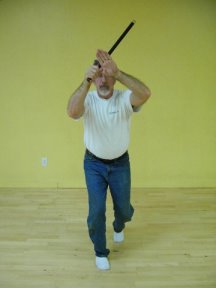


Against angle #1


Against angle #2
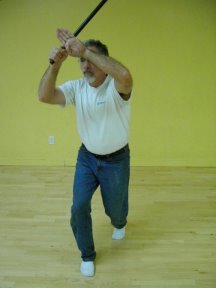


Another view of the cross block vs. angle #2
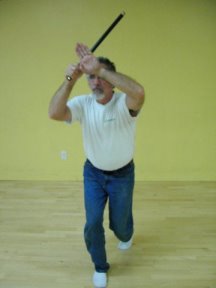


This was from an umbrella against angle #2

Tuesday, January 24, 2006

Ong Bak movie clip

If you haven't seen Tony Jaa in action, here is a clip of his break-out movie "Ong Bak" which features traditional Muay Thai (not the ring version). Warning - even with high-speed internet, this is a long download.

This scene shows him fighting two opponents (sequentially) after returning to the bar where he first briefly displayed his talents. It's too bad the third fight is cut off in the middle because things get REALLY crazy, but maybe that'll be incentive to rent the film. This is the English language dub, which has a different soundtrack. I think I liked it in Thai better because I got to make up my own dialog!

Tuesday, January 17, 2006

FMA Digest - Serrada Special Edition

The January 2006 edition of the online publication FMA Digest is a special on Serrada, including an interview with GM Vincent Cabales and others, plus a couple of good articles by Guro Dennis Servaes. In the legacy of earlier specialty publications like "The Eskrima Review," the FMA Digest is a great community resource, providing great in-depth coverage to these arts. Each issue tends to focus on a particular style or aspect of the art. If you are not a subscriber, I suggest you go to the link above to see what this is about.

Monday, January 16, 2006

Stick Control / Modulating Power

One of the things I consider to be an important step in the progress of learning a weapon is development of control. By this I mean not only hitting an intended target or generating power, but also the subtle control that allows one to flow responsively and modulate power according to the requirements of the moment.

The great Japanese swordsman Miyamoto Musashi was also a renowned painter and calligrapher, his work hanging in national museums in Japan. He once said (paraphrasing) that the sword gave a bold stroke to his pen, but the pen gave him control of the tip of his sword. I read this nearly 30 years ago, and the comment has resonated with me to this day.

One place I insist on control is in class. My first rule, and a primary rule of my teacher Angel Cabales, was safety in training. If you hurt people unnecessarily, they won’t continue training with you. They lose time to injury, and you lose the benefit of a training partner.

Lack of control is not necessarily a hard hit. People often have no perception of the result of a stick’s impact anyway. Repetitive hits to the same target “hamburgerize” that point, each strike compounding the effect of previous ones. Even light taps can have this effect. Years ago I realized that if I were to teach on a daily basis, I had to take care to preserve myself. Small injuries don’t heal if you continue doing the same things without a break.

In Serrada, we have a standard follow-up pattern to our basic techniques, most commonly used on the inside (between the opponent’s hands) against a right-handed attack. Using a weapon in our own right, we strike under the wrist, then spin and hit to the top of the wrist. Even if this is done without much power, the effect of getting hit to the same spot over and over by students, day after day, gets old.

Back when I taught Kenpo, we would tell the class to spar “half speed, half power.” We could leave to go to the front of the dojo to take care of business and still monitor the class by ear. If we started to hear louder footfalls, we could yell back “HALF speed, HALF power!” It was a simple formula; the harder one goes, the stronger the step, the louder the sound.

The same thing applies with the stick. I learned to gauge the power of movement and of hits by various sounds. Let’s start with the hit. If I can hear the hit, my partner can feel it. If my stick makes a tap sound on his arm, it’s an impact. It might be light, but if in the course of a class the same spot on the bone gets hit a few hundred times, it can be annoying. Pretty soon you can get annoyed guys taking more serious whacks at each other.

There’s a demo I do to get my point across. I will do the under-over hit combination with power, which can be registered by the “whoosh” that the stick makes in motion. Sticks only make this sound when moving fast. I can do this and yet at the point of contact, my stick will only kiss the person’s arm with the lightest touch, barely making a sound. I then ask the person to hold out their stick and I do the same thing. There is a whoosh followed by a light tap. I then (usually) warn them to get a good grip then repeat this, only this time I don’t modulate my power; I let it go. Most often their stick will fly out of their hand, or they will hold on but feel the shock all the way up their arm. I’ll look at them and ask if that would hurt if it were their wrist. The point is made.

When I practice, I want to develop consistent movement. A light strike is not done differently from a powerful one except for my intention at the point of impact. Otherwise the mechanics are the same. This gives me the ability to dial my power up or down the scale as desired in a split second decision. It’s a simple trick which everyone can and should know how to do.

When a light touch is appropriate, I simply relax my grip a few inches before impact. I let my hand soften. I’m not so much putting on the brakes (mechanically holding back the movement) as I am letting the energy bleed off before impact. If I want to hit with power, on the other hand, I just tighten my grip (particularly the ring and little fingers) to focus through the point of impact. In either case, my stick will follow the same arc of motion and will “whoosh” with the same intensity of power. The only difference is how I execute choice.

Back to Musashi: During my first year of serious Escrima training I recalled his comment about the sword and brush, so I began doing a simple exercise. This was to walk around my house with a stick and simply touch things: doorknobs, dishes, light switches, windows (save that for last!) My idea was to develop control, building spatial awareness of my stick and sensitivity to the sense of touch coming through it.

Another exercise I did was florettas (little flowers), circling a doorknob as closely as possible with the tip of my stick, without touching it.

There is great benefit to learning this kind of control. Effective martial arts require many skills, and some of those found in stick fighting include quickness, responsiveness, sticking ability (including sticky stick), accuracy and power, to name a few. If one only has off and on, the range of control is very limited.

Here’s an analogy. Imagine if you have a powerful car that can do 175 miles per hour. You still have to park it in the garage or drive through traffic without hitting anything. Using your weapon is the same. You have to guide it with accuracy, adjusting speed, power and direction with as much experience as you can command, so don’t overlook subtlety in your repertoire of training skills.

Thursday, January 12, 2006

Linear vs. intuitive teaching progressions

It must be a product of New Year’s resolutions, but I’ve been fielding a lot of questions lately from both students and prospective students about the teaching progression in the art of Serrada. What I have to say is just from my own experience and preferences based on 20 years teaching this art. What other instructors do may or may not be similar.

It’s a valid question for people to ask, wanting to see where they are heading, but it has more than one possible valid answer. Like any road it can forge straight ahead, or it can twist and turn through scenic detours. Indeed, one should expect changes along the way, and as in any journey, the destination (should it truly even exist) is but one point along the path.

My short answer is “of course there is a steady progression.” We have the 12 angles of attack and the defenses for each angle. As one progresses, however, the trunk of the tree begins to have branches. Within the 12 angles we have the basic angles, which I consider 1-5, that form the core of the system. From those angles we can subdivide even further: outside or inside, left or right, high or low, cut or thrust. Single stick, empty handed, espada y daga, knife, double sticks, disarms, takedowns etc., all stem from the same core probabilities.

Every nuance can be studied in depth, whole subsystems to understand and master within the greater whole. This is why even an apparently simple art like Escrima can be so rich and complex. The art is in making simple what seems complex, by revealing the consistent underlying structure.

I can list the basics I teach, in sequence for each angle. It’s essentially the order in which I learned them, and I keep that progression mostly so I know what I’ve covered with whom, and to recall what I myself have practiced lately (or not). It makes it easier also for my students to know the knowledge base (regardless of skill) of those with whom they’re practicing.

Students who attend a large commercial school may find themselves restricted to very specific formats, aimed at keeping classes of students on track for belt promotions. Everyone works only on what they need for that goal; orange belts don’t get to learn purple belt material. A lot of people have been in those schools, and if they come to something like the Filipino arts later, they might have certain expectations of how things are done.

Private teachers or schools may have more flexible lesson plans, allowing what arises in class to be the basis of instruction for that session. For instance, I may walk into class thinking I want to work on outside blocks, but once we’re into the material, I can’t say in advance if we’re going to go into disarms, passes, a combination of the two, or something completely different which might arise.

Sometimes mistakes are the most interesting avenues to explore. I often call Escrima “the art of making adjustments.” One must acknowledge everything that happens, adapting to the changing environment. If mistakes occur, it’s better to know how to recover and respond than to train oneself to always stop and try again. The real world doesn’t allow such luxury, whether fighting, driving a car or riding a bike.

There is a stage of wanting to learn everything, followed by a stage of learning to feel everything you've learned. You know it is there, but it has to be realized in the body, not just recognized in one’s head. Then after you feel with your body, you learn to feel with your feelings, knowing what is happening before there is physical confirmation.

By teaching intuitively to follow the energy of each encounter, I try to get students past the cognitive stage and into these body-centered states of being. By learning to pay attention to the body, we come closer to perfecting our movement by sharpening our self-awareness. Mind/body growth is symbiotic.

For those who really want to know, my basic progression emphasizes the first 5 angles. Make them strong and the advanced angles will be learned quickly. If you know “this” then you will understand how “that” is different. Without retention, growth isn’t progressive.

Angle one is the foundation of the whole system and rightfully so, as it is the angle of attack most commonly encountered. It should constantly be improving, not just stagnating as “old stuff” in order to learn newer material. Angle 2 already starts lock-and-block with my “matrix of 16” progression. Angles 3 and 4 teach low passing attacks and are the foundation for angle #5. Joint locks and disarms may come up anywhere, but are certainly a formal part of the curriculum by the end of angle #4.

Angles 6 and 7 are thrusts to similar target areas as angles 1 and 2, but thrusts require modifications of timing. Angle 8 is like a high 4, and 9 is like an upwardly diagonal 4 from a very low position. 10 is a jab/cross combination, essentially angles 7 and 6. 11 is an upward angle 3 from a very low position, forming an upward slashing figure-8 with angle 9. 12 is a simultaneous 6/7 thrust combination, or perhaps a front two-handed choke.

All of these higher angles are based on materials learned in the first four, so one can see why the basics are so important. They provide the general roadmap to get from one point to another. Eventually you start to see between the angles, or how angles are themselves deceptions. It’s possible to throw a strike from what looks to be the setup position for something completely different. As Angel often said, “When it comes to for-real, forget about the name of a technique or number of the angle; just react.” At that point it’s like a game of high-speed chess, thinking strategically while countering intuitively; things happen spontaneously and you can only watch in amazement at what has just happened by your hand.

PS: If you read this far and haven't yet signed the guestbook or left a comment here, please do so! I like to know who's reading this stuff. - JF

Tuesday, January 03, 2006

Commitment to Training

When someone starts training in an art, they are often not sure of what it is they seek. The overt reasons, such as desire for physical safety or to get in shape, are often expressions of deeper underlying issues. Too often students quit when their superficial needs are met, allowing them to return to the previous patterns of their lives, or the challenge to go through real inner development proves too daunting.

Like all instructors in martial arts, I have experienced the coming and goings of students. I have experienced the pain of watching someone begin to grow into their potential, only to lose them at just the point where their training should really start to get interesting, to themselves, other students, and to myself as a growing martial artist. As teachers we pour ourselves into our students, often struggling to find ways to help them see what is transparent to us.

Martial arts training is a commitment to oneself, a process that is ever unfolding.
I just read the 2005 year-end greeting of Patrick Augé sensei of Yoseikan Budo Aikido, which addresses these issues better and more completely than what I can add. The following two paragraphs are an exerpt from the whole article, which I strongly urge everyone to read.

"when a student reaches the next level, he not only encourages those under him who see the possibility for them to improve, but he also contributes to the development of those above him who helped him get there. When a student abandons the school, he hurts everyone. He hurts those who helped him; they ask themselves, "What did I do wrong?"And he hurts those who are delayed in their progress because of a partner who is missing and won't share what he learned. The higher the rank and/or the more attention one has received, the greater the damage he causes by abandoning his practice."

"The same thing applies to absenteeism. When we miss classes or drop out, we often think only of our own conditions and convenience. But do we think that other students' practice might get affected due to our stalling the group upon our return to the dojo? When a student needs assistance, other students will help as part of their training if they know that that student is responsible and doesn't take that help for granted. That is why we ask students to notify their teachers of their absences and make up missed classes. Notifying one's teacher should never be regarded as a ritual or an obligation: it must be done with the mind of training oneself in acknowledging one's intentions; it's the first step toward assuming responsibility for oneself. However, dealing with all kinds of people is part of the study for teachers and students alike. It teaches us that motivation results from sustained concentration. Concentration is the ability to maintain one's attention on one object only, to the exclusion of anything that is irrelevant. Concentration is not inborn. It has to be cultivated."

Friday, December 30, 2005

KEEPING CHILDREN SAFE IN AND AROUND VEHICLES

15 HELPFUL TIPS FOR KEEPING CHILDREN SAFE IN AND AROUND VEHICLES

This is from a newsletter sent today by an old associate, Janette Fennell of Kids and Cars, an advocacy organization she founded after she and her husband were imprisoned in the trunk of their car in a widely publicized incident years ago. She has lobbied tirelessly and successfully about vehicle safety issues that seem to fall through the cracks. For the past couple of years she has tracked deaths of children in non-collision vehicle incidents, particularly drive-over incidents in driveways. Here, then, is her basic list of safety tips to help protect kids around cars. These are worth knowing and sharing with friends and family members.


1. Walk around and behind a vehicle prior to moving it.

2. Know where your kids are. Make children move away from your vehicle to a place where they are in full view before moving the car and know that another adult is properly supervising children before moving your vehicle.

3. Teach your children to never stand behind vehicles, even if the car is parked. And teach children that “parked” vehicles might move. Let them know that they can see the vehicle; but the driver might not be able to see them.

4. Teach your children to never play in, around or behind a vehicle; enforce this rule by keeping toys and sport equipment out of the garage and driveway.

5. Consider installing cross view mirrors, audible collision detectors, rear view video camera and/or some type of back up detection device.

6. Measure the size of your blind zone (area) behind the vehicle(s) you drive. A 5-foot-1-inch driver in a pickup truck can have a rear blind zone of approximately 8 feet wide by 50 feet long. A driver’s blind zone in a large SUV is up to 40 feet long and 7 feet wide - the approximate size of a kindergarten class.

7. Be aware that steep inclines and large SUVs, vans and trucks add to the difficulty of seeing behind a vehicle.

8. Hold children’s hands when leaving the vehicle.

9. Homeowners should trim landscaping around the driveway to ensure they can see the sidewalk, street and pedestrians clearly when backing out of their driveway. Pedestrians also need to be able to see a vehicle pulling out of the driveway.

10. Never leave children alone in or around cars; not even for a minute.

11. Keep vehicles locked at all times; even in the garage or driveway and always set your parking brake.

12. Keys and/or remote openers should never be left within reach of children.

13. Make sure all child passengers have left the car after it is parked.

14. Be especially careful about keeping children safe in and around cars during busy times, schedule changes and periods of crisis or holidays.

15. Teach children that riding in a car is no safer than a carnival ride - sticking their hands, heads or any body part outside of the window is dangerous.

Friday, December 23, 2005

Every Touch Counts

Many people go for joint locks or disarms with a preconception of what move they want to make. It’s good to have a clear goal, but sometimes that mindset means they overlook many possibilities along the way.

Another problem I see is people giving up on a technique when it is 99% complete, thinking it is a failure and looking for another option without seeing the opportunity to secure what they already have. The trick is to follow your opponent’s move until there is no more slack to take up.

A goal I have for my students (and myself) is to be able to respond naturally and intuitively using all our senses, so that we lose the notion of trying to “do a technique” but rather allow our opponent to lead us to whatever technique organically presents itself through his own direction. Bruce Lee talked of having “no technique as technique” and this was his point. If you preconceive what you want to do, it means trying to force that onto whatever is really happening, whether or not it is appropriate to the circumstance. It might fit, but could require more force than absolutely necessary. Work smarter, not harder.

An exercise I’ve been practicing lately is making every touch the opening for something to happen. For example, against a right-handed strike (such as angle #1) people often do a double block (left inward/right outward combination) while moving outside to their left, using their right hand to establish control for a lock or disarm. That’s fine, but how many realize what could have been done from the first contact of the left hand as well? It could grab and reverse with a high outward twist or parry inward to snake down and around into a lock.

Each hand has different moves available, so it’s good to develop aptitude with as many of those options as possible. To this end, take a single attack and practice all the ways each hand can set up joint locks. Some locks are single-handed; some bring both into play. However you set up your opening, you should recognize familiar positions along the way. Eventually all attacks begin to look similar, because once you touch, you are going to go left or right with it using either hand, and that becomes completely intuitive.

One way we practice this is continuous flowing disarms with our eyes closed. You feel a movement, you control with whatever touch is available, you finish. Your counterstrike is the entry for your partner to reverse the disarm on you. We never just hand a weapon back to our partner; we offer him opportunity to do a move.

I call Escrima “the art of making adjustments,” so if something doesn’t work, just move on to the next opportunity. This might sound like a contradiction, but really it is about being unattached to the particular outcome of any specific action. Wristlocks can transition into arm locks or finger controls; arm locks can flow into wristlocks or body locks. Wherever you are, you should know how to flow through whatever changes occur naturally until you are able to lead your opponent into a position from which he cannot easily escape.

At the rodeo, cowboys on bucking horses or bulls don’t direct the powerful animal beneath them; they just try to ride whichever way it moves. Practice with this in mind and see what you might learn.

Longitudinal Joint Lock Exercise

I just came up with an exercise to demonstrate a subtlety in applying certain joint locks, in particular a wing lock. The wing lock is a variation on a figure-4 (particularly evident when both arms are used to secure the hold) except whereas the figure-4 bends the opponent's arm back over his shoulder, in the wing lock the opponent's arm is bent up behind his back. It's called a wing lock because it resembles folding a chicken wing so it stays in place during cooking.

First, the setup for the lock:

The way to execute this lock is using the opposing arm to control the opponent. In other words, use your left arm to control his right, or your right arm to control his left; a mirror approach. Most people do this wrong, reaching across the centerline to grab right with right or left with left. This is both ineffective and leaves the lead side of the body exposed to counters. Thus if you enter from a forward position (face to face), simply slide your closest hand between the opponent's arm and body.

Once you enter, the focus of the wing lock is on the elbow. A common mistake is to slide the hand up the arm, putting pressure on the shoulder. This loses leverage and makes it easier for the opponent to resist and counter. As your hand slides under the opponent's arm, you should concentrate on feeling the crease of the inner elbow with your thumb. You can practice this right now by bending your right arm slightly and then sliding the back of your left hand up the inside of your right forearm.

If you lift slightly as you snake your thumb around the elbow towards the tricep tendon nerve (the slight hollow spot an inch or two above the elbow) you will feel the control. Keep focused in this area rather than reaching with your fingers towards the shoulder. You should also notice as you do this that your left elbow will be lifting the right hand. This is good, because it secures the hold. On an opponent, that allows your upper arm to press his hand towards his spine; this is where the pressure is applied to his shoulder while securing his centerline.

One can simply snake the elbow with the thumb, lifting the opponent's arm to get it to bend, and then press the hand to the spine with your upper arm. That works in an expedient manner. However, Angel Cabales sometimes demonstrated a subtle yet powerful twist of his forearm during this maneuver, using the length of his forearm as a worm gear to force the rotation of the opponent's arm. This is what my new exercise is designed to demonstrate.

Grasp the back of your right wrist with your left hand. Next hook your right hand over the back of the left wrist, a typical joint maneuver to counter the grab. Now if you just press down with the blade of your right hand, there is little effect. If you press while extending your fingers downward, there is a slight increase in pressure, but still not a lot. However, if you point your fingers forward and reach to touch your left bicep while turning the palm downward (pronate) you should notice how the rotation of your right forearm powerfully (and painfully) applies pressure to your left wrist while requiring relatively little force.

This longitudinal torque is probably familiar to many jujitsu-ists, particularly small circle adepts. A Wing Chun person might recognize this as tan sao/bong sau, using a bit of forward grinding or extension as though blocking low rather than an elbow lift for a higher defense.

There are other applications for this forearm torque, most notably for a snaking lock against an opponent's kick. Again the left vs. right (and vice versa) applies, snaking from inside the leg, going under and around. The twist/extension rotates the opponent's leg, which turns his body. As with the wing lock above, this allows you to get to his backside, a position affording you the advantage.

Developing a feel for this technique has several benefits. First, in the wing lock it can allow you to gain control using only one arm, keeping your other hand free. Second, it develops your sticky-hand energy, which increases your awareness and ability to respond to an opponent by touch.

Just remember when working with training partners that joint locks can cause injury. Go slowly enough that your partner can tap out in time, and when the locks are practiced on your, do not resist with force, as that will encourage your partner to begin wrenching harder on you in response. The key to learning locks is communication and observation. When applying locks to the arms, you'll see your control when your partner's shoulder moves. It can be subtle, but once you've taken up the slack you have all the control you'll need.

Thursday, November 03, 2005

Scientists Say Everyone Can Read Minds

Angel Cabales used to say that getting good at Escrima was like learning to read minds. I always attributed this in part to reading subtle signals through experience. In Tai Chi Chuan, there is a saying that "when the opponent moves fast, you move fast; when he moves slow, you move slow." That also relates to another which says "Wait until your opponent moves, then move first!" My interpretation was that one learns to match and mirror the movement and position of the opponent, which then allows one to either push ahead of the timing or drop in behind it. Either way, you first have to have the tempo and rhythm before you can work off of it.

Now, however, there may be more, which is that the body actually receives signals that synchronize with another. Entrainment is a $50 word for the process of synchronizing through matching energetic frequencies. The article I've reprinted below from Livescience.com identifies a biological process within the brain that seems to quantify this phenomenon within the realm of hard science. Great times we're living in!

- Jeff


Scientists Say Everyone Can Read Minds
By Ker Than
Special to LiveScience
posted: 27 April 2005
07:01 am ET

Empathy allows us to feel the emotions of others, to identify and understand their feelings and motives and see things from their perspective. How we generate empathy remains a subject of intense debate in cognitive science.

Some scientists now believe they may have finally discovered its root. We're all essentially mind readers, they say.

The idea has been slow to gain acceptance, but evidence is mounting.

Mirror neurons

In 1996, three neuroscientists were probing the brain of a macaque monkey when they stumbled across a curious cluster of cells in the premotor cortex, an area of the brain responsible for planning movements. The cluster of cells fired not only when the monkey performed an action, but likewise when the monkey saw the same action performed by someone else. The cells responded the same way whether the monkey reached out to grasp a peanut, or merely watched in envy as another monkey or a human did.

Because the cells reflected the actions that the monkey observed in others, the neuroscientists named them "mirror neurons."

Later experiments confirmed the existence of mirror neurons in humans and revealed another surprise. In addition to mirroring actions, the cells reflected sensations and emotions.

"Mirror neurons suggest that we pretend to be in another person's mental shoes," says Marco Iacoboni, a neuroscientist at the University of California, Los Angeles School of Medicine. "In fact, with mirror neurons we do not have to pretend, we practically are in another person's mind."

Since their discovery, mirror neurons have been implicated in a broad range of phenomena, including certain mental disorders. Mirror neurons may help cognitive scientists explain how children develop a theory of mind (ToM), which is a child's understanding that others have minds similar to their own. Doing so may help shed light on autism, in which this type of understanding is often missing.

Theory theory

Over the years, cognitive scientists have come up with a number of theories to explain how ToM develops. The "theory theory" and "simulation theory" are currently two of the most popular.

Theory theory describes children as budding social scientists. The idea is that children collect evidence -- in the form of gestures and expressions -- and use their everyday understanding of people to develop theories that explain and predict the mental state of people they come in contact with.

Vittorio Gallese, a neuroscientist at the University of Parma in Italy and one of original discovers of mirror neurons, has another name for this theory: he calls it the "Vulcan Approach," in honor of the Star Trek protagonist Spock, who belonged to an alien race called the Vulcans who suppressed their emotions in favor of logic. Spock was often unable to understand the emotions that underlie human behavior.

Gallese himself prefers simulation theory over this Vulcan approach.

Natural mind readers

Simulation theory states that we are natural mind readers. We place ourselves in another person’s "mental shoes," and use our own mind as a model for theirs.

Gallese contends that when we interact with someone, we do more than just observe the other person’s behavior. He believes we create internal representations of their actions, sensations and emotions within ourselves, as if we are the ones that are moving, sensing and feeling.

Many scientists believe that mirror neurons embody the predictions of simulation theory. "We share with others not only the way they normally act or subjectively experience emotions and sensations, but also the neural circuits enabling those same actions, emotions and sensations: the mirror neuron systems," Gallese told LiveScience.

Gallese points out, however, that the two theories are not mutually exclusive. If the mirror neuron system is defective or damaged, and our ability to empathize is lost, the observe-and-guess method of theory theory may be the only option left. Some scientists suspect this is what happens in autistic people, whose mental disorder prevents them from understanding the intentions and motives of others.

Tests underway

The idea is that the mirror neuron systems of autistic individuals are somehow impaired or deficient, and that the resulting "mind-blindness" prevents them from simulating the experiences of others. For autistic individuals, experience is more observed than lived, and the emotional undercurrents that govern so much of our human behavior are inaccessible. They guess the mental states of others through explicit theorizing, but the end result is a list -- mechanical and impersonal -- of actions, gestures and expressions void of motive, intent, or emotion.

Several labs are now testing the hypothesis that autistic individuals have a mirror neuron deficit and cannot simulate the mental states of others.

One recent experiment by Hugo Theoret and colleagues at the University of Montreal showed that mirror neurons normally active during the observation of hand movements in non-autistic individuals are silent in those who have autism.

"You either simulate with mirror neurons, or the mental states of others are completely precluded to you," said Iacoboni.

Tuesday, November 01, 2005

Yoga vs. Martial Arts

In the 1970's and 80's martial arts were riding high, largely on the coattails of Bruce Lee's popularity. Since then there has been a lot of change within the M.A. community, but little growth in general popularity. On the other hand, yoga has built steadily on foundations laid in the 80's and 90's and now has an unprecedented reputation. Part of this is its appeal to women, as opposed to the heavy testosterone atmosphere of the dojo.

Another reason is the organizational skills behind yoga, which resemble in some ways the early growth of Japanese and particularly Korean arts. Bikram, Ashtanga and Iyengar are known for their individual styles, though each is basically a form of Hatha. Just yesterday I heard a good example of yoga's explosive growth from a student of Deepak Chopra. Apparently only two years ago he began certifying teachers in his personal method at his academy in southern California, and today there are over 700 teachers worldwide. Classes can be found not only in major metropolitan areas but in resorts as well, so people can keep up with their practice while vacationing in Puerto Vallarta, or become exposed to the art there and then continue when they get home.

Contrast this with the FMA, which have been called "the next big thing" in martial arts since the mid-1980's. While FMA has undoubtedly spread, it has never achieved any sort of widespread recognition on its own merits. Furthermore, the historic secrecy of these arts, combined with the desire to closely control the information, has kept most schools small and local. Serrada is a good example. While Deepak Chopra has developed 700 teachers in 2 years, how many teachers have several generations of Serrada practitioners produced in the last 20?

Don't think Chopra has made it easy. Students train 10-12 hours a day in his program, split between several hours of yoga practice, studying anatomy and Ayurvedic medicine, and beginning with 2 one-hour sessions of meditation daily, build up to four hours per day. This is a highly focused and disciplined approach, yet people clamor to get in.

Certainly it helps that he's a best selling author, and as a doctor has strong credentials. As an ethnic Indian he has the feel of authenticity to draw in those seeking wisdom from the East. On the other hand, he also made a commitment to building an organization to spread his message that is generally lacking in martial arts, or where there is the will to do so, other factors such as lack of business acumen or excessive ego hinder such development.

Martial arts are not lacking in similar potential. The popularity of Tai Chi for health shows it crosses that bridge, and many Aikidoists are drawn to their art for the spiritual orientation associated there. What is lacking is the broader commitment to creating a holistic lifestyle, one that calms the mind and heals the body, along with the singular benefit of providing potential life-saving skills. There are few martial arts program that demand - and receive - the widespread dedication of these yoga organizations. Their secular yoga classes are full, as are the more spiritual ashrams. In contrast, how many martial art teachers are struggling to pay rent, running classes with only a handful of students? Sure, there are martial arts camps and seminars, but are there waiting lists to get in? Where is the buzz?!!

Taekwondo is a notable exception, and that style is famous for the support of a national government for its international organizations. Similar to yoga, there is both an infrastructure for steady growth, and a focus on building inner discipline and character in students. If there is draw for Westerners in Eastern wisdom, it is perhaps found there, in developing those qualities no longer demanded by the institutions of our culture. Our schools don't teach it, families don't demand it. The void many people feel within themselves is filled with pop culture and junk food, until they have enough and seek alternative paths to nourish mind and body.

The challenge for martial arts is to become relevant to people's needs, not just a fad or a bandage for insecurities. Perhaps if there has been a failure of leadership in this community, it reflects the deeper martial culture's distrust of others. While yoga focuses on unity, martial arts is more often about overcoming adversity. Certainly the knowledge and skills to bring forth a similar message are an integral part of the art, but it is elusive and hidden at higher levels of understanding and skill. Beginners rely on strength to oppose others; it takes time and experience to learn to blend one's energy with that of others to achieve results, and then introspection to see how this applies to other areas besides physical combat.

Perhaps if the arts were able to show the soft hidden within the hard sooner, more people would be drawn in, perceiving the balance they desire. Instructors need to know not just the mechanics of their style, but how to talk about the inner game. It has often been said that a master knows not just how to destroy, but how to heal. Many people have wounds which cannot be seen on the outside. When martial arts can show a path for healing within, there is less need to rely on the brute strength of destruction towards the world. This is the meaning of the traditional kung-fu salute, the fist within the palm of the open other hand; sword within the sheath, power tempered by knowledge. The most important knowledge is not how to conquer others, but how to conquer oneself. The world is a mirror, and when we find inner peace, we also see less conflict on the outside. The less fear with have within, the more options we find available for dealing with the stress of living.

Tuesday, October 25, 2005

Updated contact info

I recently switched from Comcast to SBC so I could get DSL. To get the best rate, I had to also change my phone number from a business line to residential. Comcast only forwards the new number for 30 days unless a fee is paid, in which case they will do it for an additional 30 days.

I paid the fee. It took them nearly a week to get the message up and running, and at the end of 30 days they promptly discontinued it. Forget trying to get them to respond to a repair ticket; it's useless.

Hey Comcast, if any of you reads this, maybe you can think about your customer service!

Anyway, during this past week I've had several people email me (or in the case of local businesses, just tell me when I walked in) that they couldn't reach me and there was no new number given, so here it is: (510) 222-0332

The Tao of Kinetic Energy and Cabales Serrada

This piece was written by Sifu Michael Trimble,
"Kali-San Soo Ranch" Ashland, Oregon,
and posted here with his permission.

**************************************************


Kinetic energy is the energy of motion, like Cabales Serrada. Think
about it. Every dynamic body possesses Kinetic energy. Power, by definition,is the rate of doing work per unit time. For practical and applicable purposes of Cabales Serrada, we can interchange power and kinetic energy as far as the end results of our actions. Both involve work (Force) against another physical body, with or without a weapon, in the form of collision or impact.

Mathematically, Kinetic energy is expressed as KE=1/2 mv2. Varying mass or velocity increases KE in different proportions:

KE=1/2(16) (2) 2 = (8) (4) = 32 (Increasing mass)
KE=1/2(2) (16) 2 = (1) (256) = 256 (Increasing velocity)

As illustrated, when mass is doubled, KE (power)doubles
proportionately. This KE is delivered in the form of heat dissipated
and absorbed by the receiving body.

When velocity doubles, power delivered quadruples. Every time
velocity doubles, kinetic energy increases by one power of ten,
making velocity and power a logarithmic proportion. In short,
doubled mass doubles power. Doubled velocity quardruples power. Energy absorbed at impact is four (4) times greater with doubled velocity, even with constant mass. Speed, over mass,is power.

**************************************************

Here is the full math, for those inclined to crunch the numbers, as forwarded and updated by Sifu Trimble:

Mathematically, Kinetic energy is expressed as KE=1/2 mv2

Increasing Mass:

KE=1/2 mv2
=1/2(2) (2)2
=(1) (4)=4

KE=1/2(4) (2)2
= (2) (4)
=8

KE=1/2(8) (2)2
=(4) (4)
=16

KE=1/2(16) (2)2
=(8) (4)
=32

Increasing Velocity:

KE=1/2(m) (v)2
=1/2 (2) (2)2
=(1) (4)=4

KE=1/2(2) (4)2
=(1) (16)=16
=16

KE=1/2(2) (8)2
=(1) (64)
=64

KE=1/2(2) (16)2
=(1) (256)
=256

As illustrated, when mass is doubled, KE (power) doubles proportionately. This KE is delivered in the form of heat dissipated and absorbed by the receiving body.


Sifu Michael Trimble

Friday, October 14, 2005

Body alignment

A colleague of mine, Khalid Khan, recently wrote how many people run with poor postural alignment, and how they should pay more attention to this. On the surface, he is correct, and to the extent that people notice bad habits they should do what they can to correct them.

On the other hand, most people have no idea if, or how much, their body is out of alignment. We tend to compensate unconsciously for imbalances that occur for any of a variety of reasons, including accidents, internal disorders, congenital conditions, poor postural habits and adaptation to incorrect ergonomics at work, etc. As someone who has undergone chiropractic care after minor auto accidents, it's amazing to me how hard the body fights to regain that sense of equilibrium adapted to misalignment, rather than simply re-establishing conformity to proper realignment.

I agree it is often obvious when watching runners that they have alignment problems, but this is not simply a matter of willful disregard of proper form. For instance, someone with a bad back may feel less pain working around the area of injury, resulting in a lower shoulder, rotated hip, etc. Attempting to straighten up will feel unnatural. Eventually this person may wind up with a sore knee, but that is a symptom, not a cause.

Another consideration is shoes. Poorly designed or mis-fitting shoes can cause problems all on their own. Smart runners will take the time and spend the money for the shoe that best fits their foot, but that can be both time consuming and expensive, especially nowadays.

Even the best runners have idiosyncrasies in their movement, and trying to correct that does not necessarily improve their running. I ran competitively for 5 years (best personal times: 2:00 half mile, 4:24 mile, 9:45 two mile) and I got to see the postures of a lot of faster runners. Some things can be corrected, such as learning more efficient arm swing and focusing the gaze to minimize head movement. None of these, however, have much effect on basic underlying postural alignment.

Furthermore, attempts to completely balance the body have been known to have negative impacts on competitive athletes. One example was the unexpected impact of rolfing on professional ballet dancers in the 1960's, which ended some promising careers. Even a top athlete like Bruce Lee had one leg that was shorter than the other. We learn to use the body we have, and changing its structure can erase muscle memory and cause proprioceptive conflicts that inhibit best performance.

One problem distance runners have is their leg muscles get tight which shortens them. Stretching helps, but most people don't do more than basic loosening up, and over time they adaptively lose range of motion. This in turn moves stress up the line to affect other body parts, such tight legs impinging on the back. Many people don't know how to stretch correctly anyway. Stretching cold muscles can cause injury, and how many runners understand the value of warming down properly, or are able to even take time to do so if they are running on lunch break or elsewhere in a busy schedule?

So, with all these considerations, how does one simply stop running poorly? A professional athlete may have a support team of a chiropractor, trainer, massage therapist, nutritionist. They may use video of their movement to identify correctable problems. None of these are readily available to most individuals, for whom activities such as running, martial arts or dance are an adjunct to a lifestyle, not a goal unto itself.

Thursday, October 13, 2005

Larry Wright: Street Drumming to the Max!

Larry Wright online video

Larry Wright is an incredibly electrifying drummer, a force of nature. He is a bucket drummer who makes a good living playing in the subways in NYC. At age 2 he was already hitting things; at 5 he discovered his instrument, learning to get more sound out of a bucket than most drummers with a full kit. He was discovered in 1990 at age 15 by two filmmakers, and their 30 minute documentary about him aired on PBS. I was blown away when I saw it back then. He would compare and demonstrate variations from Santeria to Yoruba sacred drumming, as if channeled through jazz legend Lenny White. Since then he's appeared in commercials (Ford, etc) and movies (the opening of The Believers, for example) and in Alicia Key's "Karma" video. This kid is so hot, legendary drummer Gene Krupa went to meet him.

Watch his sticks; identify the fulcrum point, then think of the short strokes of Serrada.
Notice they don't come back too far, moving from vertical to horizontal with great precision.
See how relaxed his wrists are.
Same for his shoulders. Notice his upper arms hang naturally.
His concentration is complete. He has full control of speed, power, tempo and rythm.

How would you move to these rhythms?

Tuesday, September 27, 2005

Ranks and Titles, part 2

How does one become a grandmaster or a master? This has been debated in depth on forums, so this is essentially a synopsis. There is no single consensus or single answer.

First, one can evolve into the role. This was described to me as “family style” by Sijo John Wong, my late Tai Chi teacher, head and founder of the Wu Shing Tai Chi Academy. He called it family style because it is based on the organic model of family growth. One teaches, which is like being a parent. When one’s student becomes a teacher, that is like being a grandparent, and would be recognized as “master” or “master teacher.” When one’s student becomes a master in turn, one then achieves grandmaster status.

One can also be recognized by one’s peers, either those already of grandmaster status acknowledging one as an equal, or by other masters recognizing one has elevated oneself to another level. While one can be recognized as a master based on singular skill as a fighter, it seems to me that grandmastership in martial arts is generally tied to lineage, though the second criteria in the previous sentence might allow skill alone. In chess, for example, grandmasters are recognized solely by ability to win.

Someone like Angel Cabales gained recognition through both of these channels, devoting a lifetime to both teaching and perfecting his own skills.

Another route might be “family style” in which one inherits the title based on blood relation to the previous head of the system. Some well known examples of this type of succession in recent times include: Yip Chun in Wing Chun, Kissimaru Ueshiba in Aikido, Lily and Gini Lau in Eagle Claw (parallel, competitive successorships) and Vincent Cabales in Serrada Escrima. Historically this has had mixed results. Some lineages have remained strong through successive generations while others have seen the title inherited by name rather than accomplishment.

Next, there are grandmasters based on self-perception. This might occur when, in the previous example, there is a superior student who is passed over as head of a style for a blood descendant of lesser abilities. In such a case, the student may opt to go out on his own and found his own lineage. Whether or not such this is justified may vary according to the needs of one versus that of the larger organization; battles have been fought over such things. Sometimes it is necessary for the prodigal son to move on, whereas other times it might have been better to work from within. It depends on how various personalities get along at such junctures.

Finally, there are those who proclaim themselves grandmasters based completely on egoic self-aggrandizement. In other words, someone who is qualified neither by skill nor by being groomed for successorship, but is merely fueled by excessive desire for recognition. It is unfortunate that martial arts attracts a certain element who need to feel fulfilled in this way, particularly as the public might be conned by words and flashy uniforms. Reality often has a way of catching up to such individuals, in the form of a better fighter who decides to test the skills of this unknown grandmaster.

However one arrives at such an elevated status, it would seem there are a couple of basic, incontrovertible requirements. First, one should have deep understanding and mastery of the fundamentals of the style one practices, whether or not one is the premier fighter in the system. Secondly, one should have a broader perspective of what this rank entails. Essentially, the title lays claim to a fiefdom, which means having responsibility not just to oneself but also to those who look up to the position. Like parenthood, it means raising up of those who follow along the path. If a grandmaster does not do this, he will sit atop a tree that dies and the title he has worn will pass into oblivion.

Rank and Titles

Personally I am of the belief that titles are for politics, something GM Angel Cabales frequently said, and that while ranks and titles can be disputed or taken away, one owns one's own knowledge and that is a gift which remains throughout life (to paraphrase folks like John Wong, Wally Jay, Richard Bustillo and other elders I've met in the arts).

Anthony Davis has always said that he was the first to publicly call Angel by the title of "grandmaster" and I've never heard anyone dispute that. However, here is a little story that I heard Angel tell on a few occasions to myself and others:

Back when Dan Inosanto and Richard Bustillo were setting up shop on their own in the late 1960's, they approached Angel and asked if he would be grandmaster of their organization. Angel told them (and was quite fierce in his retelling of this every time) that he was already a grandmaster, and if he let them, his own students, "make" him a grandmaster, then what would prevent them in the future from thinking they could "unmake" him as grandmaster. In other words, he declined from a position of authority. This is allegedly why Angel appears first in Guro Dan's original book, being his original FMA teacher, but Villabrille is named as a grandmaster, having accepted their offer of the title.

Not everyone may accept this history, but it is one Angel stuck with through the years I knew him. This is not necessarily inconsistent with GM Davis' telling, because this was something done in private, whereas Anthony Davis promoted Angel to the public in ways Angel would or could not do for himself.

As for anyone else's titles, that is an endless source of discussion and debate in the MA community at large. I know people who dispute Vincent Cabales' claim, and I know people who dispute Anthony Davis' claim. There are others within the Serrada family who have also created their own organizations, and within them they are the grandmaster as it is they who teach the teachers and dispense ranks. If we are to show respect within the Serrada community, it means we should acknowledge that the art has grown and spread, and not just under one umbrella. We don't have unity, we have community, and that is a way we can come together in peace.

The martial arts have plenty of charlatans (I'm not referring to anyone I've mentioned herein) who claim rank and skill beyond their due. Rank is like clothing, and not all wear it equally. There are folks I know who are quite humble but as worthy as anyone gracing the covers of magazines. I prefer to acknowledge each person for who they are, and what they have done in terms of personal growth and contributions to the art and society in general. The measure of a man is not found in the color of his belt or in a piece of paper, but what is in his heart and soul.

Just my own opinions ....

Saturday, September 17, 2005

Matrix of Sixteen

My “matrix of sixteen” is a template for learning lock-and-block (numerado in some styles), which is a constant movement drill. The defender does continuous techniques against attacks, which are being practiced by his partner.

I teach four basic techniques for each of the first two angles. Angle #1 has, in specific order: outside, inside, cross and umbrella blocks. Angle #2 has: outside, shoulder, cross and umbrella blocks. I recommend sticking to a consistent sequencing of techniques when learning each angle so as to create a mnemonic device for remembering the material. Otherwise as one learns more material, there is a greater chance to forget to practice something.

In lock-and-block, the attacker will throw a #1 angle strike, then after the defender completes his full technique (as slowly as necessary, as cleanly as possible) the attacker will throw an angle #2 strike, which the defender will again counter. The initial developmental stage starts with just these two strikes.

Here is the map of the matrix in its most basic and straightforward progression, from the defender’s perspective. At this level, the speed is controlled by defense; the attacker merely feeds the strikes so the defender can work out the timing and movement.

Outside block for angle #1; outside block for angle #2.
Inside block for angle #1; outside block for angle #2.
Cross block for angle #1; outside block for angle #2.
Umbrella block for angle #1; outside block for angle #2.

This same sequence will be repeated, except substituting the shoulder block for angle #2.
Then same sequence will be repeated, except substituting the cross block for angle #2.
The sequence will be repeated once more, substituting the umbrella block for angle #2.

The defender will now have done a combination of every angle #1 defense with every angle #2 defense.

The next step past this basic is to have the attacker begin to lengthen the chain by throwing another angle #1 strike, then when that is accomplished, another angle #2. At this point, it can become a continuous sequence, with the attacker alternating angles #1 and #2. Next step would be to randomize these.

Competency at this level moves the student from seeing techniques as separate and discrete to becoming components in a larger holistic pattern of movement. When the student moves on into further angles of attack, there is now a framework into which the new defenses can be plugged, allowing quick progress integrating the system.

For those familiar with these exercises, what I am describing is not something new, except for formalizing a beginning drill to ensure everything gets practiced and students learn to flow from wherever they are to wherever they need to be. That flowing quality is one of the key principles of this art, and this drill creates enough sense of urgency to bypass the conscious mind’s ability to stop and analyze everything. In other words, it forces the subconscious to keep up with the attacker in real time.

Discipline and Growth

We all attract to ourselves the reality that we choose. Maybe the circumstances are on a larger scale, but how we respond is always choice. Your own view of reality is neither more nor less subjective than anyone else’s; "objectivity" always has content.

There are always limits to human perception, and so we can only know that which we have eyes to see. We create the potential for growth when we can see the limits of what we know.

Learning a skill creates discipline through perseverance. One endures periods of awkwardness, frustration and boredom, all steps towards completion of competency. Martial arts, sewing, learning to walk, all require that focus remain on achieving the goal.

“Courage is the greatest of all the virtues. Because if you haven't courage, you may not have an opportunity to use any of the others.” (Samuel Johnson (1709-1784) English Author).

People come to martial arts for many reasons: self-protection, self-esteem and health are three of the main ones. The first thing the art must do is fulfill these expectations, or else a person will move on. Once that is achieved, however, the art must move to another level or it will stagnate. It must become somehow larger than ones initial attraction, for having met those needs, one has outgrown who they were when those needs were unmet. Right?

The purpose of a discipline isn’t immediate gratification, therefore, but is found in the long-term potential for self-growth and awareness. If the vehicle satisfies one’s needs, it becomes a road, continually leading one through a landscape that opens to new vistas. The need for self-defense may give way to self-gratification, which can become a pursuit of perfection, which can lead to self-awareness and acceptance.

It is when we recognize our own process that we can overcome the limitations of our perception, and at this level any art, any discipline, becomes something more than what it first appeared, reflecting a deeper metaphor of whom we wish to be.

Friday, September 09, 2005

Moving Past Basic Learning

More advanced students should start focusing on lock-and-block and sparring more. The chance to work out with different people at different skill levels is an invaluable learning experience, how to read opponents and remain in control.

Control doesn't necessarily mean hurting someone; superior control is not
hurting someone because you don't have to, though the capacity is there.
That's the challenge when working with classmates, to find the edge and not
step over it. Sometimes that's a judgement call, opinions differ. I think
the Dog Brothers motto at their Gatherings pretty much sums it up: Friends at the end of the day.

Lock-and-block starts with my "matrix". Using the "matrix of sixteen"
builds smoothness, accuracy, and lastly power, which cannot really develop
without the others. From there work in new angles progressively. This is
even good exercise when you are advanced. Use progressive feeds (1-2,
1-2-3 etc; both timing count and angles). Even if you are advanced,this is a good warm-up to "picking" ("picking your target" using feints, etc).

Sparring starts with counter-for-counter timing, allowing each person to defend and attack. The basic is "the box" because it teaches efficiency and directness of movement. It's a good place to drill in strong compact movement. With progress this opens up to incorporate everything you know.

Do not rush this process; improvise only when you have the basics in place. It is not "free" until it is understood, by both mind and body. Then the techniques simply become tools and you can create what you need. But always (always!) sticking to the underlying principles of the movement: compact efficiency and effective
leverage through good angles, footwork and grounding.